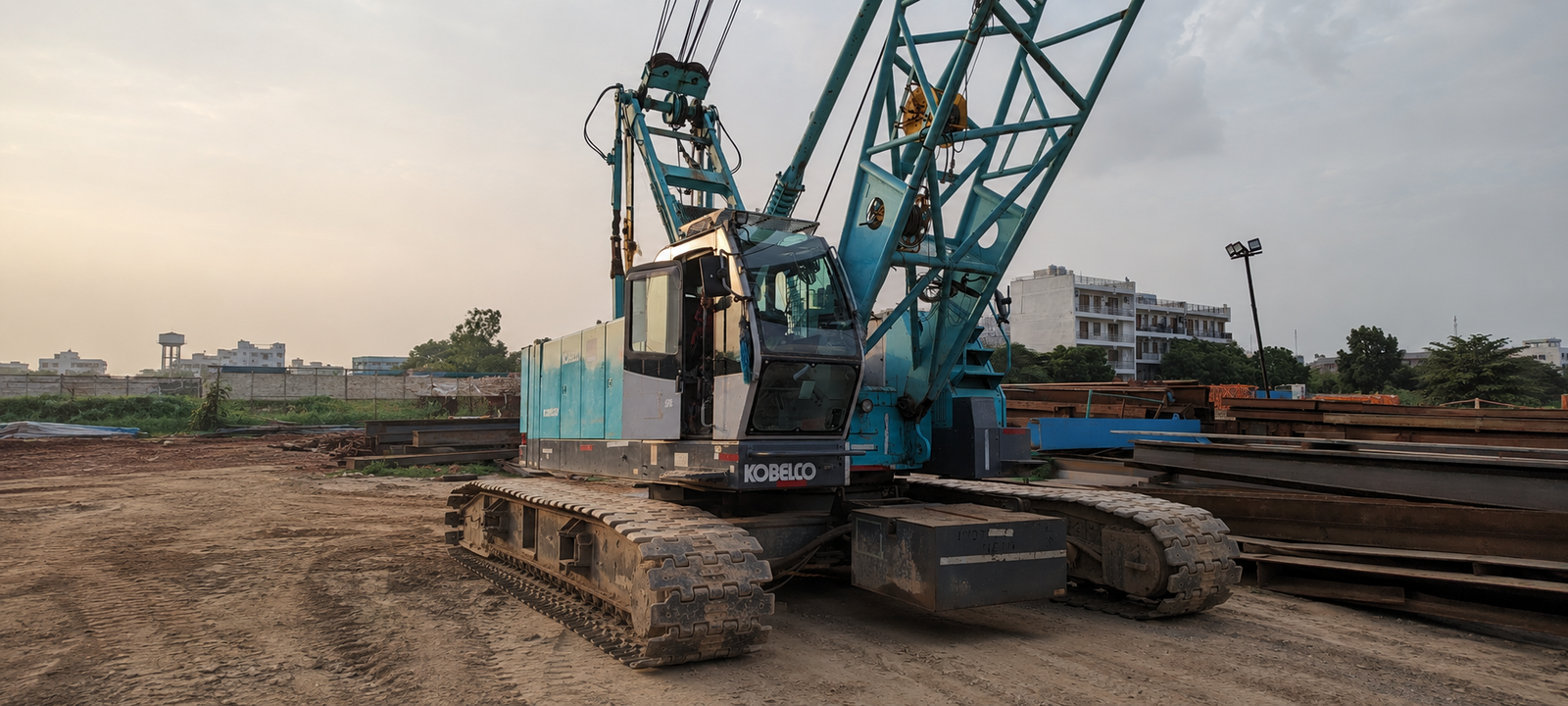
The Kobelco CKE800-1F is an 80-ton hydraulic crawler crane designed for heavy construction, high-rise lifting, industrial erection and material handling. It combines a 54.9 m maximum crane boom, fixed jib combinations up to 42.7 m + 18.3 m, high-speed 120 m/min winches, 3 variable-displacement main pumps, self-removal counterweight handling and a wide operator cab with LMI display.
Capacity80 t
Max Boom54.9 m
Fixed Jib18.3 m
Engine159 kW
Fuel Tank415 L
Operating Weight73.8 t
Key Highlights
Lift Capacity
80 t x 3.0 m
Max Boom Length
54.9 m
Fixed Jib Capacity
6.6 t x 20.0 m
Max Boom + Jib
42.7 m + 18.3 m
Alternate Combination
45.7 m + 12.2 m
Engine Output
159 kW @ 2,000 rpm
Fuel Tank
415 L
Hydraulic Tank
440 L
Main Pumps
3 variable displacement
Max Line Speed
120 m/min
Rated Line Pull
78 kN / 8.0 tf
Hydraulic Pressure
31.9 MPa
Wire Rope Dia.
22 mm
Swing Speed
4.0 rpm
Travel Speed
1.9 / 1.2 km/h
Operating Weight
Approx. 73.8 t
Counterweight
25.7 t + 6.7 t
Transport Weight
Approx. 41.2 t
Ground Pressure
88 kPa
Transport Width
3.39 m retracted
Specifications
Detailed technical specifications for Kobelco CKE800-1F Hydraulic Crawler Crane
Optional Safety SupportRear/winch cameras with color monitor and one-way call system
Noise & EmissionsDesigned to meet European exhaust-gas and noise regulations
Kobelco CKE800-1F Maintenance Checklist
Daily pre-operation checks · Planned inspections by operating hours · Warning alerts and immediate actions — covering the Hino J08E-TM engine, crawler undercarriage, 415 L fuel system, 440 L hydraulic tank, winches, 22 mm hoist ropes, lifting structure and safety controls.
Daily Pre-Operation Checklist
Complete before engine start, after any crane configuration change and before the first lift. Remove the crane from service when a defect affects load control, brakes, ropes, structure, hydraulics, safety devices or ground stability.
Every Shift
1
Configuration & Display
Record serial number and hourmeter; confirm boom, jib and counterweight configuration, load chart, open defects, display self-check and maintenance status.
Act if: configuration, display status or load data is incorrect — do not lift until corrected.
2
Ground & Crawler Position
Inspect bearing condition, mats or cribbing, crawler extension and locks, and verify the crane is level.
Act if: settlement, washout, voids, damaged mats or abnormal tilt is present — stop and stabilise the setup.
3
Engine & Cooling
On level ground, check engine oil, coolant only when cool, belts, intake, exhaust, leaks and radiator/oil-cooler blockage.
Act if: fluid is low or contaminated, a belt is damaged, leakage is active or airflow is blocked — correct before starting.
4
Fuel System
Check the 415 L tank level and leakage; drain accumulated water from the fuel-water separator using the correct procedure.
Act if: fuel is contaminated, leakage is active or the water warning recurs — stop and investigate.
5
Hydraulic System
Check oil at the specified machine condition and level. Inspect tank, pumps, hoses, tubes, fittings, cylinders, cooler and travel motors.
Act if: leakage, abrasion, swelling, heat damage or contaminated oil is found — isolate and repair before operation.
6
Winches & Wet Brakes
Test main and auxiliary winches for smooth raise/lower, neutral hold and brake response without shock.
Act if: load drift, delayed response, shock, heat or unusual odour occurs — lower safely and remove from service.
7
Hoist Ropes
Inspect accessible main and auxiliary 22 mm ropes and the boom-hoist rope for broken wires, diameter loss, corrosion, heat damage, kinks, crushing, bird-caging and poor spooling.
Act if: any discard condition or termination defect is found — stop lifting and quarantine the rope.
Act if: cracked, distorted, unmarked or insecure — quarantine the component.
10
Boom, Jib & Gantry
Inspect chords, lacings, welds, connectors, pins, retainers, pendant system and boom stops.
Act if: a crack, bend, missing retainer, elongated hole, corrosion loss or impact damage is found — remove from service.
11
Swing System
Test swing, brake/lock and warning; inspect the bearing area and mounting interface for loose hardware, grease leakage, noise or movement.
Act if: braking is abnormal, hardware is loose or movement/noise is excessive — stop and inspect.
12
Crawler Undercarriage
Inspect 800 mm shoes, bolts, pins, links, sprockets, idlers, final drives and guards; check track sag/tension correctly.
Act if: loose, cracked, leaking or abnormally worn — repair before travel or lifting. Sealed rollers are not routine grease points.
13
Safety Devices
Test rated-capacity indication, boom angle/radius display, over-hoist device, emergency stop, horn, warnings and fitted cameras or mirrors.
Act if: a device is bypassed, failed or uncalibrated — no lifting is permitted.
14
Cab, Controls & Final Walk-Around
Confirm controls return to neutral; inspect pedals, locks, access, extinguisher and communication equipment. After warm-up, check for leaks, noise, smell, overheating or debris.
Act if: a control, brake or access defect exists, or leakage/overheating is found — isolate and correct the cause.
Safety rule: never bypass a safety device, search for a pressurised hydraulic leak by hand, open a hot cooling-system cap, or continue lifting with a rope, brake, structural or stability defect.
Planned Service Schedule
Complete every lower-interval check at each higher interval. These hour bands are inspection checkpoints: change fluids, filters, ropes or components only when the applicable maintenance indication, condition result or approved service limit requires it.
Complete the full 14-point pre-operation checklist every shift and carry it into every higher interval.
Status & Setup
Hourmeter, configuration and defects
Record status and confirm the display self-check.
CHECK
Ground, crawlers and level
Confirm stable bearing and locked crawler position.
INSPECT
Machine & Lift Systems
Engine, fluids and leaks
Check engine, fuel, hydraulics and undercarriage.
CHECK
Ropes, structure, brakes and safety
Inspect and function-test before the first lift.
TEST
Every 50 hours or weekly — plus all daily checks. Increase frequency in dust, salt, heat, rain or continuous duty.
Cooling & General
Radiator and hydraulic cooler
Clean externally without bending fins.
CLEAN
Battery, clamps and guards
Inspect terminals, hose clamps and access hardware.
INSPECT
Ropes, Drums & Structure
Rope cleaning and lubrication
Clean/lubricate when surface condition requires; do not hide broken wires.
SERVICE
Drums, sheaves, pins and retainers
Inspect spooling, anchorage, grooves, bearings and visible fasteners.
INSPECT
Every 100 hours — plus 50-hour and daily work. Record all measurements at repeatable positions.
Ropes & Hooks
Rope diameter and wire condition
Measure diameter; map broken wires, wear and corrosion.
MEASURE
Hook geometry and blocks
Measure throat/twist; check pins, nuts, guards and sheave grooves.
MEASURE
Brake Holding
Hoist, swing and travel brakes
Test holding and controlled release under an approved no-load/light-test condition.
TEST
Acceptance
Stop for drift, delay, shock, local heat or unusual odour.
CHECK
Every 250 hours — service decisions follow machine status and measured condition; keep hydraulic work exceptionally clean.
Engine, Fuel & Electrical
Service status and records
Review engine maintenance indication and service history.
CHECK
Oil, fuel and air elements
Service only when due, using exact approved specifications and parts.
SERVICE
Cooling and electrical
Clean coolers; check charge, batteries, harnesses, grounds, lights and warnings.
INSPECT
Hydraulic & Gear Drives
Hydraulic oil and filter status
Sample from the clean point; review cleanliness, water, wear and restriction indication.
SAMPLE
Swing, winch and final-drive oils
Check levels and leakage at the correct machine condition; never mix oils.
CHECK
Every 600 hours — complete all lower checks and close every safety-critical defect before release.
Verify boom angle/radius input, over-hoist limit and cut-outs in the current configuration.
VERIFY
Measured release record
Record instruments, values, samples, parts, defects and competent-person release.
RECORD
Every 2,000 hours — complete all earlier work plus measured performance, oil analysis and structural engineering assessment.
Engine, Fluids & Hydraulics
Engine diagnostics
Test balance/compression when trends warrant; inspect turbo and cooling integrity.
TEST
Oil programme
Sample engine, hydraulic, winch, swing and final-drive oils before draining; review contamination and wear.
SAMPLE
Pumps, motors and lines
Measure pressure, flow, case drain and temperature; inspect every hose and tube.
MEASURE
Winch & Swing Drives
Winch gear trains
Sample oil; inspect plugs/screens; test play, backlash, brake hold and cooling.
TEST
Swing bearing and reduction
Measure axial/radial movement and gear backlash; inspect lubrication and bolt condition.
MEASURE
Ropes, Blocks & Structure
Ropes and end fittings
Detailed qualified examination; replace only at discard condition, after shock load, or with unacceptable history.
INSPECT
Hooks, blocks and sheaves
Measure geometry, pins, bores, grooves and bearing play; apply NDT where findings require.
MEASURE
Boom, jib and gantry
Engineering visual inspection and targeted MT/PT/UT based on history, damage and corrosion.
ASSESS
Undercarriage, Controls & Release
Crawler wear and alignment
Measure components and frame alignment; inspect tensioning and final-drive performance.
MEASURE
Electrical and safety controls
Inspect harnesses, grounds, sensors, limits and display; record faults and validate interlocks.
VERIFY
Functional test and release
After critical repair, test under an approved lift plan and close all defects before release.
RELEASE
Warning Alerts & Immediate Actions
RED: stop crane operation, secure the load and shut down when safe. AMBER: stop the lift cycle and correct the condition before continuing. Record the alert, hourmeter and corrective action.
Red — StopAmber — Correct first
RED
Overload / Rated-Capacity Stop
The current load and radius have reached the stop condition for the crane configuration.
Immediate action: stop hoist-up and radius-increasing motion. Stabilise and lower using the permitted direction; verify load, radius and configuration.
Risk if ignored: tip-over, structural failure, dropped load or fatal injury.
RED
Over-Hoist / Upper Limit
The hook block or overhaul ball is approaching the boom-head limit, or the device failed its test.
Immediate action: stop and lower the hook. Inspect the switch, weight, chain/cable and circuit; never bypass the device.
Risk if ignored: rope or boom-head damage and dropped load.
RED
Low Engine Oil Pressure
Hino J08E-TM lubrication pressure is below the safe range or remains on after start.
Immediate action: once the load is safe, shut down. Check oil level/leakage and test pressure before restart.
Risk if ignored: bearing or turbo damage and engine seizure.
RED
Engine Coolant Overtemperature
Coolant is low, heat exchangers are blocked, or a fan, belt or internal fault is reducing cooling.
Immediate action: stop lifting, idle only as permitted, then shut down and cool. Never open a hot cap.
Risk if ignored: cylinder-head/turbo damage, fire or sudden shutdown.
RED
Hydraulic Oil Loss / Hose Failure
Rapid oil or pressure loss, spray, a burst hose or uncontrolled movement is present.
Immediate action: secure/lower the load if controllable, isolate and shut down. Depressurise before repair and never check leaks by hand.
Risk if ignored: injection injury, fire or loss of load/motion control.
RED
Brake Slip / Load Drift
A hoist load will not hold, or swing/travel brake response is abnormal.
Immediate action: stop motion and lower the load safely without shock. Isolate and inspect the brake/control circuit.
Risk if ignored: uncontrolled load, boom or house movement.
RED
Structural Crack / Retainer Loss
A crack-like indication, bent member, loose/missing pin or retainer is present in the load path.
Immediate action: remove from service, barricade and obtain engineering assessment and required NDT. Do not field-weld or substitute hardware.
Risk if ignored: progressive collapse or component separation.
RED
Wire Rope Discard Condition
Broken wires, diameter loss, kink, crushing, bird-cage, displaced core, heat damage or termination defect is beyond safe condition.
Immediate action: stop lifting, unload safely and quarantine the rope for qualified assessment and traceable replacement.
Risk if ignored: rope failure and dropped load.
AMBER
Maintenance Due
The multi-display reports an engine or machine maintenance item due.
Immediate action: record the hourmeter/message and complete the correct task before the approved grace limit; reset only after documentation.
Risk if ignored: accelerated wear, contamination and lost maintenance traceability.
AMBER
Fuel-Water / Filter Restriction
Separator water or fuel, air or hydraulic filter restriction is indicated.
Immediate action: stop the cycle; drain the separator or service the exact element cleanly and investigate recurrence.
Risk if ignored: power loss, injector/pump wear or hydraulic cavitation.
AMBER
High Hydraulic Temperature
Low level, cooler blockage, wrong oil, internal leakage or sustained duty is overheating the system.
Immediate action: stop heavy cycling, place the load safe and diagnose level, cooler airflow and leakage.
Risk if ignored: seal hardening, degraded oil and pump/motor wear.
AMBER
Abnormal Swing / Winch Noise
Grinding, clunking, vibration, local heat or metallic debris suggests gear, bearing or brake deterioration.
Immediate action: stop the affected function, secure the crane and inspect lubricant and mechanical clearances before the next lift.
Risk if ignored: gear or bearing failure and loss of control.
Critical: never clear an alert without diagnosis. Any overload, oil-pressure, brake, rope, hydraulic or structural event requires the relevant competent inspection before the crane returns to lifting duty.
Frequently Asked Questions
Everything you need to know about the Kobelco CKE800-1F Hydraulic Crawler Crane
The Kobelco CKE800-1F has a maximum crane boom lifting capacity of 80 t at 3.0 m radius.
The crane boom length ranges from 9.1 m to 54.9 m.
The fixed jib has a maximum lifting capacity of 6.6 t at 20.0 m. The maximum combinations are 42.7 m + 18.3 m and 45.7 m + 12.2 m.
The CKE800-1F uses a Hino J08E-TM engine rated at 159 kW at 2,000 rpm.
The main and auxiliary winches have a maximum line speed of 120 m/min on the first layer, with rated single-line pull of 78 kN / 8.0 tf.
Operating weight is approximately 73.8 t with upper and lower machine, counterweight, carbody weight, basic boom, hook and accessories. Transport weight is approximately 41.2 t for the base machine arrangement.