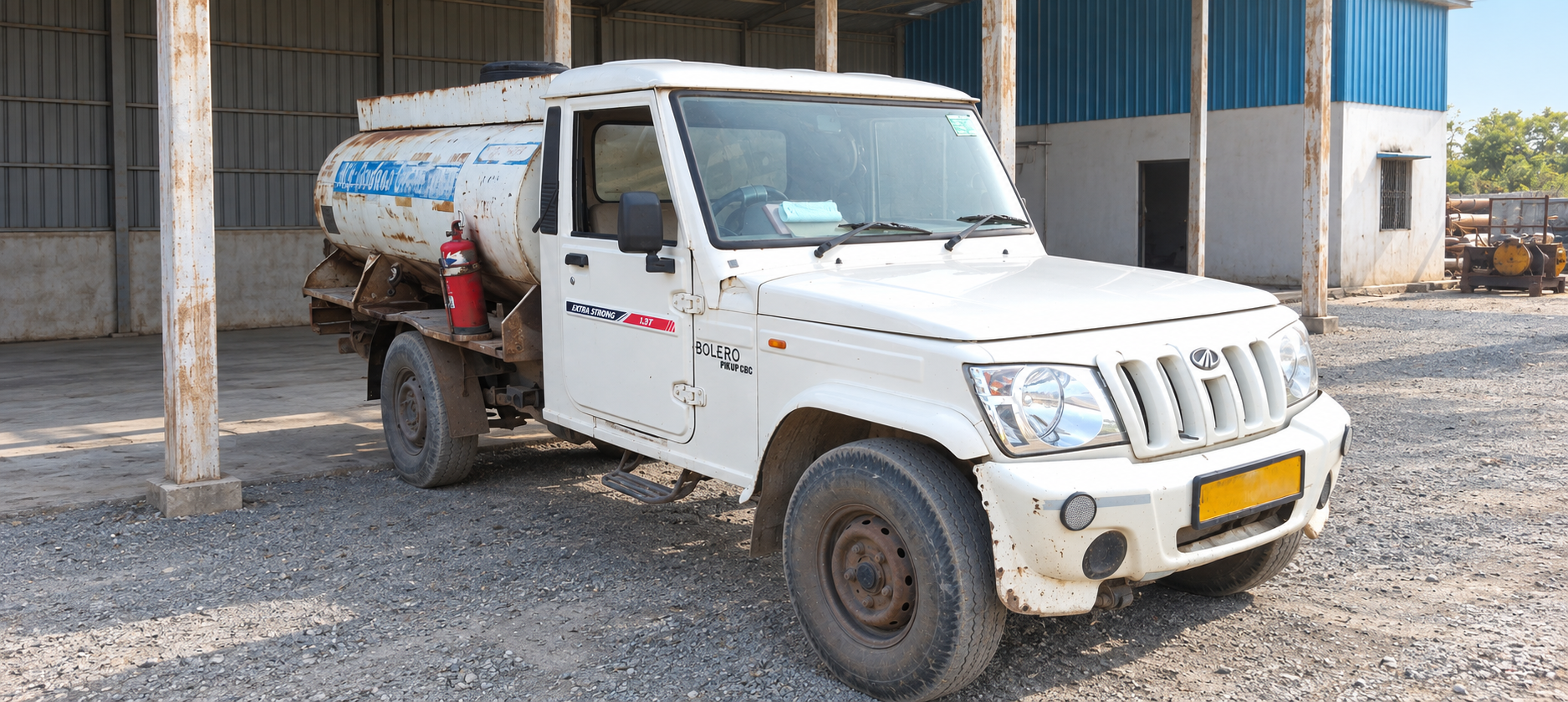
Mahindra Bolero MaXX Pik-Up City 1.3 Diesel Bowser
A compact diesel-bowser configuration based on the Mahindra Bolero MaXX Pik-Up City 1.3. The chassis provides a 2,825 kg GVW, 1,300 kg payload before body fitment, 52.2 kW engine output and 3,150 mm wheelbase. The bowser tank capacity depends on the approved fabrication and final vehicle configuration, and must remain within applicable payload and axle-load limits.
GVW2,825 kg
Engine Output52.2 kW
Maximum Torque200 Nm
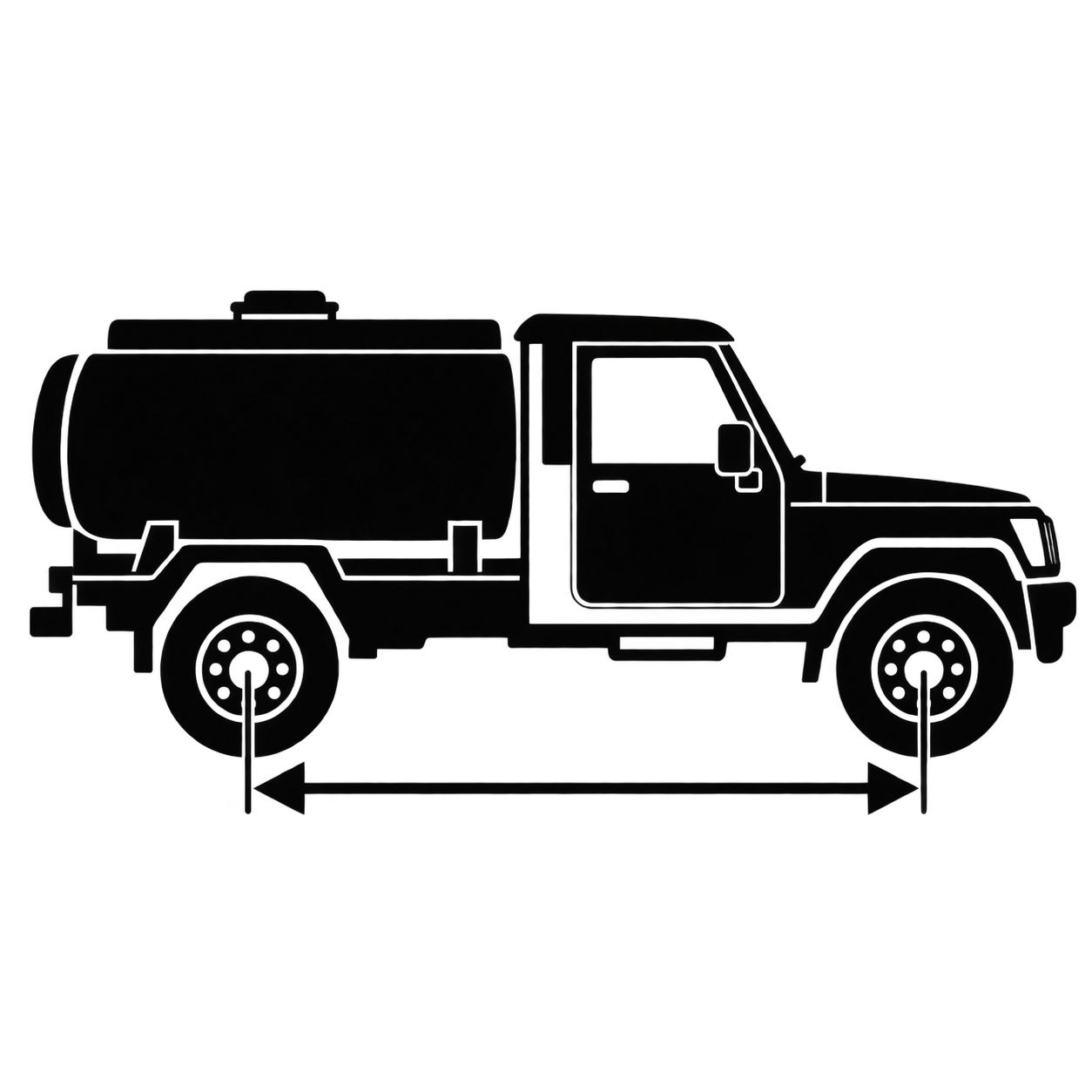
Wheelbase3,150 mm
Payload1,300 kg
Vehicle Fuel Tank45 L
Key Highlights
Gross Vehicle Weight
2,825 kg
Payload
1,300 kg
Engine Output
52.2 kW @ 3,200 rpm
Maximum Torque
200 Nm @ 1,400-2,200 rpm
Displacement
2,523 cc
Transmission
5-speed synchromesh
Wheelbase
3,150 mm
Turning Radius
5.5 m
Ground Clearance
185 mm
Tyres
195/80 R15 LT
Vehicle Fuel Tank
45 L
Bowser Tank Capacity
Fabrication dependent
Original Cargo Box
2,500 × 1,700 × 458 mm
Overall Dimensions
4,800 × 1,755 × 1,873 mm
Seating Capacity
D+2 (D+1 manual steering)
Specifications
Technical details for the Mahindra Bolero MaXX Pik-Up City 1.3 chassis and diesel-bowser fitment
Daily checks · kilometre-based service schedule · fluids and capacities · safe return to service · warning actions.
Daily / Pre-Start Checklist
Complete before first use, after refuelling or maintenance, and after any abnormal event.
Before every shift
1
Engine oil
Park level, switch off the engine, check the dipstick and inspect for leakage.
Do not operate if: oil is below minimum, contaminated, falling rapidly or visibly leaking.
2
Coolant and cooling path
When cool, check the reservoir, radiator pack, hoses, joints and belt condition.
Do not operate if: coolant is low, steam or leakage is present, a belt is damaged or airflow is blocked.
3
Brake, clutch and steering fluids
Check reservoir levels and inspect pipes, hoses, pump and steering gear for leakage.
Do not operate if: a level is low, a pedal is soft, steering is unusually heavy or fluid is leaking.
4
Battery and washer system
Check battery mounting, terminals, cables and case; verify washer level and spray.
Do not operate if: the battery is loose, swollen, cracked or leaking, or the windscreen cannot be cleared.
5
Leaks, hoses and pipes
Inspect the engine bay and ground for oil, fuel, coolant and brake-fluid traces.
Do not operate if: fuel smell, pooled fluid, a damaged hose or an active leak is found.
6
Instrument telltales and start-up
At key-on and start, check the telltales and observe for abnormal noise, smoke, smell or vibration.
Do not operate if: a stop warning remains on or an abnormal condition persists.
7
Service and parking brakes
Check pedal feel, travel and return; confirm the parking brake holds and releases fully.
Do not operate if: braking is weak or uneven, a pedal is spongy, or the vehicle is not held securely.
8
Steering
Check free movement, response and abnormal noise with the engine running where applicable.
Do not operate if: steering binds, has excessive free play, pulls strongly or loses assistance.
9
Lights, horn, wipers and wash
Operate headlamps, stop lamps, indicators, hazards, horn, wipers and washers.
Do not operate if: a required control is inoperative or visibility is impaired.
10
Seats, belts and body closures
Confirm the seat locks, belts latch and retract, and bonnet, doors and tailgate close securely.
Do not operate if: a seat or latch does not hold, or a belt is cut, frayed or inoperative.
11
Tyres and wheels
Check tyre pressure, tread, cuts, bulges, rims and wheel-nut condition.
Do not operate if: a tyre is underinflated or damaged, cord is exposed, or a wheel nut is loose or missing.
12
Underbody and exhaust
Inspect for hanging parts, damaged lines, loose exhaust components and unusual contact marks.
Do not operate if: a fuel or brake line is damaged, the exhaust is loose or an obstruction is unsafe.
13
Bowser tank and dispensing system
Inspect the fabricated bowser tank, mountings, pump, flow meter, hose, nozzle, valves and joints.
Do not operate if: a mounting is loose, the tank or piping leaks, or dispensing equipment is damaged.
14
Safe dispensing controls
Confirm secure parking, earthing, spill-control equipment and removal of ignition sources.
Do not dispense if: the area is unsafe, earthing is unavailable or a leak or ignition hazard is present.
Service cadence: initial service at 10,000 km, then normal scheduled service every 20,000 km. Use the earlier applicable distance or time limit. In severe duty, change engine oil and filter every 10,000 km or 12 months, whichever occurs first.
Initial scheduled service and full inspection.
Engine and intake
Engine oil and filter
Change engine oil and replace the oil filter.
CHANGE
Valve clearance
Check and adjust using the correct engine procedure.
CHECK
Air cleaner
Clean the element and replace early if restricted or damaged.
CLEAN
Fuel-water separator
Drain and inspect for contamination or leakage.
DRAIN
Driveline and chassis
Rear differential oil
Complete the initial oil change.
CHANGE
Propshaft and universal joints
Inspect and lubricate.
LUBRICATE
Suspension, steering and brakes
Inspect, tighten or adjust as required.
INSPECT
Tyre rotation
Rotate tyres and inspect pressure, wear and wheel nuts.
ROTATE
Electrical and final checks
Headlamp aiming
Adjust at this first service; repeat only after work that affects lamp aim.
ONE-TIME
Diagnostics and road test
Check telltales, scan active faults, road-test and complete a post-service leak check.
VERIFY
Normal scheduled service with filter replacement and the first brake/clutch-fluid change.
Engine and filters
Engine oil and oil filter
Change at the normal scheduled-service interval.
CHANGE
Air-cleaner element
Replace at this interval, or sooner if restricted or damaged.
REPLACE
Fuel-filter element
Replace the filter element and seals.
REPLACE
Brakes and full inspection
Brake and clutch fluid
Complete the first fluid change; thereafter change every 40,000 km or 2 years.
Component-specific interval for transmission oil and wheel alignment.
Transmission and alignment
Manual transmission oil
With Maximile Syntec F2, change at 40,000 km intervals and within the 3-year limit. Confirm the interval if a different oil is installed.
CHANGE
Wheel alignment
Check every 40,000 km, and earlier after impact, abnormal wear or steering pull.
CHECK
Cooling-system interval, or earlier when the 3-year limit is reached.
Cooling system
Engine coolant
Drain, flush as required, refill and bleed the system using compatible coolant.
CHANGE
Hoses, belt and cooling pack
Inspect for leakage, damage, restriction and correct operation.
INSPECT
Normal scheduled service plus rear-axle and brake/clutch-fluid changes. Clean the air filter at this visit; the next air and fuel filter replacement is due at 90,000 km.
Engine service
Engine oil and oil filter
Change at the normal scheduled-service interval.
CHANGE
Air cleaner
Clean only at this visit unless condition requires earlier replacement.
CLEAN
Axle and brakes
Rear differential oil
Change at the recurring 60,000 km interval after the initial service.
CHANGE
Brake and clutch fluid
Change at the recurring 40,000 km interval after the first change.
CHANGE
Full vehicle inspection
Inspect brakes, steering, suspension, driveline, tyres, electrical equipment and leakage.
INSPECT
Drive-belt replacement point, subject to condition and steering variant.
Drive belts
Accessory / alternator belt
Replace at 80,000 km, or earlier for cracks, fraying, oil contamination or slip.
REPLACE
Power-steering drive belt
If fitted, replace at 80,000 km or earlier when condition requires.
REPLACE
Continue the normal 20,000 km scheduled-service sequence after the initial 10,000 km visit, together with the component-specific intervals below.
Recurring intervals
Oil, filter and valve clearance
Every 20,000 km in normal duty; engine oil and filter every 10,000 km / 12 months in severe duty.
20k km
Air cleaner
Clean every 10,000 km and replace every 30,000 km.
10k / 30k
Fuel filter
Replace every 30,000 km; drain the water separator at each service and whenever indicated.
30k km
Rear brakes
Inspect drums and linings every 20,000 km, or earlier for noise, pull or reduced braking.
20k km
Chassis intervals
Rear differential oil
Initial change at 10,000 km, then every 60,000 km or 3 years.
60k km
Brake and clutch fluid
First change at 30,000 km, then every 40,000 km or 2 years.
40k km
Tyres and wheel alignment
Rotate tyres at every scheduled service; check alignment every 40,000 km.
CHECK
Propshaft and universal joints
Inspect and lubricate at every scheduled service; service earlier after water or mud ingress.
LUBRICATE
Engine and driveline fluids
Engine oil
Maximile Ultra; verify the grade for operating conditions and confirm the dipstick level after filling.
7.0 L
Engine coolant
Maximile Ultra Cool or a compatible specified coolant; fill and bleed correctly.
~8.0 L
Manual transmission
Maximile Syntec F2; establish the final level at the level plug.
2.0 L
Rear differential
Maximile Elite axle oil; establish the final level at the level plug.
1.75 L
Steering, brakes and grease
Manual steering gear
Maximile Synchro UV2; only for the manual-steering configuration.
0.6 L
Power steering
Maximile Power Steering Fluid; only for the power-steering configuration.
0.8 L
Brake and clutch system
Maximile DOT 3 or a compatible sealed DOT 3 fluid meeting the required specification.
1.0 L
Chassis and propshaft grease
Maximile LCG lithium-complex grease, NLGI 2.5; clean fittings before and after greasing.
AS NEEDED
Fuel and bowser systems
Vehicle fuel tank
Use BS6-compliant automotive diesel and avoid running the system dry.
45 L
Bowser tank
Tank capacity, material and compartments depend on the approved fabrication and final vehicle configuration.
FABRICATION DEPENDENT
Pump, meter, hose and nozzle
Use the lubricant, seals and maintenance interval specified for the installed dispensing equipment.
VERIFY
Fluid-control rules
Confirm the steering variant
Identify manual or power steering before selecting fluid, capacity or belt.
CONFIRM
Set the final level correctly
Drain quantities can differ from dry capacity; use the correct dipstick, plug, bleed or reservoir method.
VERIFY
Avoid fluid mixing
Do not mix unknown oil, coolant or hydraulic-fluid chemistry; keep containers and filling tools clean.
CONTROL
Secure the vehicle
Park and prevent movement
Park on firm level ground, apply the parking brake, select neutral, chock wheels and remove the key.
SECURE
Cool and depressurise
Hot or pressurised systems
Allow cooling and relieve pressure before opening cooling, fuel, oil, steering or dispensing-system connections.
WAIT
Prevent injection and fire injury
Pressurised leaks
Never use hands to locate a pressurised fuel or hydraulic leak; treat injection injury as an emergency.
CAUTION
Ignition control
Keep flames, sparks and smoking away from the vehicle and bowser system.
ISOLATE
Parts and fluids
Confirm before installation
Match filters, belts, seals and fluids to the VIN, engine number and fitted component markings.
CONFIRM
Bowser equipment
Inspect after maintenance
Secure tank mounts, guards, caps, valves and connections; test the pump, meter, hose and nozzle in a controlled area.
TEST
Return to service
Final functional check
Account for tools, restore guards, verify fluid levels, check for leaks, clear warnings only after correction and complete a controlled road test.
VERIFY
Service record
Record date, odometer, work completed, quantities, parts and technician details.
RECORD
STOP
Low engine-oil pressure
Stop safely and switch off. Check oil level and leakage. If the level is correct or the warning remains on, do not restart.
STOP
High coolant temperature
Stop safely, switch off the A/C, reduce load and allow cooling. Never open a hot pressure cap; inspect level, leakage, belt and airflow.
STOP
Brake warning while driving
Stop safely, confirm the parking brake is released and check fluid and leakage. Do not drive if the warning persists or braking is abnormal.
STOP
Fuel leak, smell or visible vapour
Stop the engine, keep ignition sources away, isolate the area and repair the fault before restart or dispensing.
ACTION
Battery or charging warning
Switch off non-essential electrical loads and check the charging circuit promptly. Stop if overheating, belt failure or loss of steering assistance occurs.
ACTION
Check-engine warning
Reduce load and arrange diagnostic service. Stop safely for a flashing warning, severe power loss, smoke or rough running.
ACTION
Water-in-fuel warning
Stop safely and drain the fuel-water separator using the correct procedure. Do not continue while the warning remains on.
ACTION
DPF or regeneration indication
If equipped, follow the displayed instruction. Perform parked regeneration only in a safe open area and act promptly if the warning persists or derate occurs.
ACTION
Glow-plug lamp remains on or flashes
After a normal start, arrange diagnostic service if the lamp stays on or flashes.
ACTION
Low-fuel warning
Refuel promptly with BS6-compliant diesel and avoid running the fuel system dry.
ACTION
Bowser leak or dispensing fault
Stop dispensing, switch off the pump, isolate ignition sources and secure the area. Do not resume until the leak or equipment fault is corrected.
SERVICE
Scheduled service due
Book the due service, record the odometer and date, and apply the earlier applicable distance or time limit.
Frequently Asked Questions
Mahindra Bolero MaXX Pik-Up City 1.3 diesel bowser
The Mahindra Bolero MaXX Pik-Up City 1.3 has a gross vehicle weight of 2,825 kg.
The listed vehicle payload is 1,300 kg. Final bowser fitment must remain within applicable payload, GVW and axle-load limits.
The 2,523 cc m2Di engine produces 52.2 kW @ 3,200 rpm and 200 Nm @ 1,400-2,200 rpm.
No. 45 L is the vehicle's own fuel-tank capacity, not the fabricated diesel-storage tank.
The diesel-bowser tank capacity is fabrication dependent and must remain within applicable payload, GVW and axle-load limits.