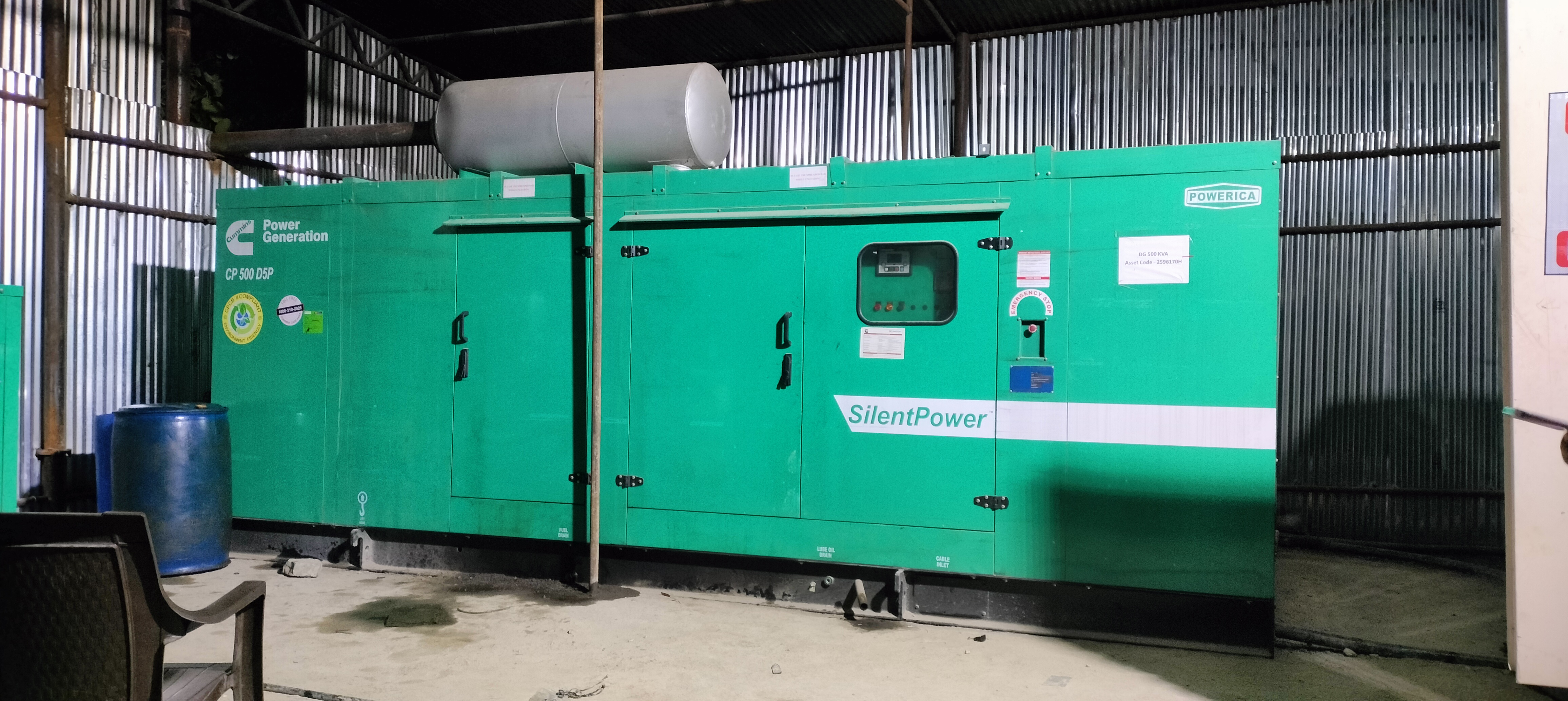
The Cummins C500D5P K19 Series diesel generator set is rated for 500 kVA / 400 kWe prime duty. It combines a Cummins KTAA19-G10 liquid-cooled engine, Stamford HCI544D alternator, PowerCommand 1.2 controller, acoustic enclosure and standard 690 L fuel tank.
Prime Rating500 kVA
Prime Power400 kWe
EngineKTAA19-G10
Wet Weight7,600 kg
Noise Level75 dBA
Fuel Tank690 L
Key Highlights
Prime Rating
500 kVA / 400 kWe
Engine Model
Cummins KTAA19-G10
Engine Power
587 hp
Fuel Tank
690 L
Wet Weight
7,600 kg approx.
Voltage / Frequency
415 V / 50 Hz
Current
695 A
Speed
1500 rpm
Alternator
Stamford HCI544D
Cooling
Liquid cooled
Fuel @ 75% Load
79.83 L/hr
Fuel @ 100% Load
103.64 L/hr
Lube Oil System
50 L total
Coolant Capacity
85 L
Acoustic Level
75 dBA @ 1 m
Specifications
Detailed technical specifications for Cummins C500D5P K19 Series Diesel Generator Set
Daily pre-start checks · hour-based service schedule · fluids and capacities · warning actions.
Daily Pre-Start Inspection
Complete before starting or reconnecting load. Do not operate with active shutdown faults, leakage, unsafe wiring, blocked ventilation or failed protection functions.
Stop for unsafe conditions
1
Engine lubricating oil
Check on level ground before starting and keep the level between the dipstick marks.
Do not operate if: oil is below the low mark, contaminated by fuel/coolant or showing abnormal consumption.
2
Coolant level
Check recovery/radiator level only when safe and cool; inspect cap area and hoses.
Do not operate if: coolant is low, leaking, cap/seal is damaged or frequent top-up is required.
3
Fuel-water separator
Drain collected water or sediment using the installed separator procedure.
Do not operate if: water-in-fuel indication persists or fuel is contaminated.
4
Fuel supply and tank
Check fuel level, tank cap, drain, vent, external transfer arrangement if fitted and visible fuel lines.
Do not operate if: leakage, contamination, blocked vent or insufficient fuel for the duty is found.
5
Leaks and loose parts
Inspect engine, radiator, filters, hoses, clamps, mounts and base frame.
Do not operate if: active oil, fuel or coolant leakage, loose mount or damaged hose is present.
6
Drive belts and fan area
With engine stopped, inspect belt condition and fan/guard security.
Do not operate if: belt cracking, fraying, looseness, contact damage or a missing guard is found.
7
Air cleaner and intake path
Check precleaner, restriction indicator and intake sealing.
Do not operate if: restriction indication, damaged housing/element or unfiltered-air path is present.
8
Batteries and DC starting
Inspect two 12 V batteries, terminals, cables and charger indication.
Do not operate if: terminal/cable is loose or corroded, battery case is damaged or weak-voltage warning is active.
9
Cooling airflow and enclosure
Clear louvers and radiator face; verify service doors, guards and acoustic panels are secure.
Do not operate if: airflow is blocked, panels are loose or combustible debris is present.
10
Exhaust and silencer
Inspect visible joints, supports, rain entry points and clearance to combustible material.
Do not operate if: exhaust leakage, loose support, hot-gas impingement or smoke/fire evidence is present.
11
Alternator and power cabling
Inspect alternator, customer cabling, covers, earth bonds and signs of contamination or moisture.
Do not operate if: damaged cable, moisture/oil ingress, loose cover or earth defect is found.
12
Controller and area safety
At key-on/start, confirm no shutdown remains; verify ventilation, access, extinguisher, spill control and clear work area.
Do not operate if: oil pressure, temperature, overspeed, sensor, AC protection or safety-area fault remains active.
Service Schedule by Hours
Select an interval and complete earlier recurring checks where due. Use the installed engine ESN/CPL and alternator nameplate for part selection.
Daily checks before start or load connection.
Engine levels
Lubricating oil and coolant
Check levels and stop for low level, contamination or active leakage.
Major overhaul service every 6,000 hours / 2 years.
Engine overhaul checks
Fuel pump and injectors
Inspect/calibrate by Cummins technician using ESN/CPL data.
INSPECT
Turbocharger, vibration damper, fan hub and water pump
Check/inspect using the specified service procedure.
CHECK
Cooling system
Drain, flush and refill with approved premix; remove air as per manual procedure.
CHANGE
Alternator long interval
Bearing / service level planning
Use alternator label and HC manual: bearing lubrication/inspection at 4,000-4,500 hours, Level 2 at 10,000 hours, Level 3 planning at 30,000 hours.
PLAN
Return-to-service: account for tools, restore guards and covers, clear personnel, remove lockout under site control, test protections, then verify no-load and controlled-load operation.
Fluids, Lubricants & Capacities
Use clean filling equipment and verify levels after circulation. Use ESN-specific information for ordering filters and service parts.
Engine lubrication
Engine lubricating oil
SAE 15W-40, API CH-4.
CH4 15W40
Oil sump
High-low level capacity; fill by dipstick after circulation.
38-32 L
Total lubrication system
Total system capacity.
50 L
Cooling system
Coolant
Cummins/Fleetguard EG Compleat premix 50:50.
85 L
Cooling practice
Do not mix incompatible coolant chemistry; check SCA and antifreeze concentration.
CHECK
Fuel system
Fuel
High Speed Diesel conforming to IS 1460.
HSD
Standard fuel tank
Enclosed genset standard tank capacity from the specification sheet.
690 L
Fuel filters
Dual system: pre-filter / water separator with WIF sensor plus main filter.
250 HR
Alternator and battery
Alternator
STAMFORD HCI544D, IP23, Class H; use alternator serial/nameplate for parts and service.
HCI544D
Starting system
24 V DC electrical starting with two 12 V batteries.
24 V
No aftertreatment: this K19 configuration is described as meeting its cited emission requirement without an after-treatment device, so DEF/SCR/DPF maintenance is not added to this page.
Warning Alerts & Immediate Actions
Read and record the exact displayed code. Never bypass a shutdown or energise output while a protection fault is unresolved.
Red — StopAmber — Act
RED
Low lubricating-oil pressure
Action: open generator breaker or remove load if possible, stop immediately, check oil level/leaks and do not restart until diagnosed.
RED
High coolant temperature
Action: remove load safely, stop as directed, allow cooling and inspect coolant level, leaks, belts and airflow.
RED
Overspeed
Action: trip/remove load, stop and isolate. Do not restart until governor/speed sensing is checked by qualified service.
RED
Fuel leak, fire or smoke
Action: stop, isolate electrical and fuel sources, evacuate and use the correct extinguisher only if trained.
AMBER
Fail to crank / fail to start
Action: stop repeated cranking; check displayed code, DC voltage, fuel supply and start permissives.
AMBER
Water-in-fuel indication
Action: drain separator, inspect fuel quality and service filters if the indication persists.
Frequently Asked Questions
Everything you need to know about the Cummins C500D5P Diesel Generator Set
The Cummins C500D5P K19 Series diesel generator set is rated at 500 kVA / 400 kWe for prime duty.
It uses the Cummins KTAA19-G10 engine with 6 cylinders in-line, 19 litre displacement, turbocharging and charge air cooling.
The standard fuel tank capacity listed for the typical enclosed genset is 690 litres.
The generator set uses a Stamford HCI544D alternator from Cummins Generator Technologies with IP23 enclosure and H Class insulation.
The typical enclosed genset dimensions are 6000 x 2000 x 2250 mm, and the approximate wet weight is 7600 kg.