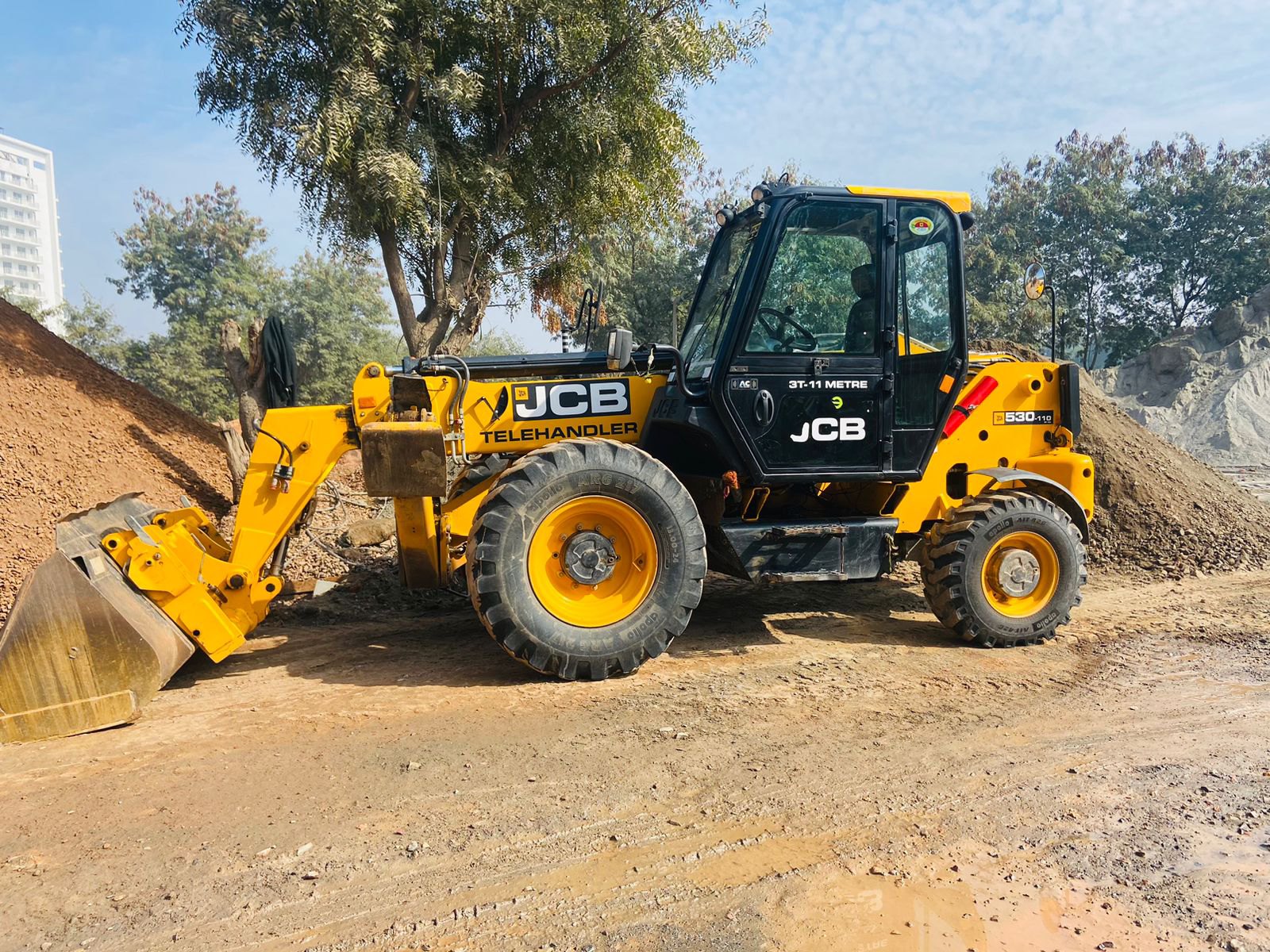
A Stage 5 telehandler built for material handling, pallet movement, loading, unloading and high-reach work, with 3 tonne maximum lift capacity, 11 m lift height, 4WD synchro-shuttle transmission and JCB LiveLink support.
Product specification of JCB 530-110 telehandler.
Engine
JCB 430, CRDi, 55 kW Stage 5
Type
4-cylinder, water-cooled, turbocharged diesel with EGR cooler
After-treatment
DOC and DPF
Displacement
3.0 L
Gross Power
55 kW (74 hp) @ 2200 rpm
Max Torque
440 Nm @ 1150 rpm
Operating Modes
Eco mode and Power mode operation with switch
Maximum lift capacity
3,000 kg
Lift capacity to full height
3,000 kg with stabilisers extended / 250 kg retracted
Lift capacity at full reach
1,400 kg with stabilisers extended / 250 kg retracted
Lift height
11.0 m extended / 10.7 m retracted
Reach at maximum lift height
0.9 m extended / 1.5 m retracted
Maximum forward reach
7.4 m extended / 7.5 m retracted
Reach with 1 tonne load
7.4 m extended / 4.9 m retracted
Placing height
10.5 m extended / 10.25 m retracted
Overall height / width over tyres
2.64 m / 2.4 m
Inside width of cab
0.79 m
Front track width / wheelbase
1.99 m / 2.54 m
Overall length to front tyres
4.13 m
Overall length to front carriage
5.43 m
Ground clearance from rear axle differential
0.305 m
Operating weight
9,060 kg specification / 9,272 kg with fork
Outside turn radius over tyres
4.85 m
Bucket rollback / dump angle
38° at ground / 12° at full height
Overall width with stabilisers deployed
2.65 m
Transmission
JCB 4WD synchro shuttle transmission
Gearbox
4-speed fully synchromesh gearbox with integral torque converter
Forward/reverse shuttle
Electrically operated forward-reverse shuttle
Torque converter stall ratio
3.01:1
4WD selection
Selectable at any time on the move with electric switch
Maximum road speed
30 km/hr
Pump
Variable displacement piston pump
Pump capacity
108 lpm
Main relief valve
263 bar
Boom up / down
9.2 sec / 9.2 sec
Crowd / dump
2.3 sec / 2.3 sec
Extend / retract
12.6 sec / 13 sec
Service brakes
Hydraulically actuated, dual-line, self-adjusting, compensated oil-immersed multi-disc type on front axle
Brake pedals
Independent pedals, linked together for normal use
Parking brake
Hand-operated cable-actuated disc brake on front axle input disc with transmission dump
Steering
Rear-wheel hydrostatic power steering with manual capability
4WS
Selectable at any time on the move with a manual lever
Sway / crab mode
Chassis levelling ±9° with stabilisers retracted; crab mode option available
Fuel tank
135 L
Hydraulic tank / system
120 L
Engine coolant
21 L
Engine oil
14.2 L
Transmission
18.25 L
Front axle
21 L
Rear axle
11 L
Front tyres
33 cm (13 in) × 61 cm (24 in), 16PR
Rear tyres
31.8 cm (12.5 in) × 45.7 cm (18 in), 12PR industrial traction pattern
Tyre options
HD tyres, Extra HD tyres, Solid tyres and Agri tyres
Battery system
130 Ah, 12 V battery system with alternator and full road lighting
Connectors
Dust and waterproof IP69 electrical connectors
Cab structure
ROPS ISO 3471 and FOPS ISO 3449 compliant cabin
Operator comfort
Adjustable seat with seat belt, soft-touch steering wheel and ergonomically positioned controls
Instrumentation
Engine speed, engine hours, fuel level, coolant temperature, engine oil pressure, blocked air filter, transmission oil pressure, 12V socket and DPF regeneration status
Stability monitoring
Longitudinal Load Moment Indicator (LLMI), inclinometer and LLMC feature available
Safety features
Hose burst check valves, stabiliser cut-off on 530-110, hydraulic cut-off optional, reverse alarm and three-point access
Telematics
JCB LiveLink 4.0 for uptime, productivity, cost, profitability and fuel consumption monitoring
Options & accessories
Windscreen & roof guard, hydraulic cut-off, fire extinguisher, reversible fan and rear-view camera
Attachment system
JCB Q-Fit quick attachment changeover with single boom auxiliary feature
Standard material handling
Industrial fork, narrow industrial fork, truck unloading bucket and power grab
Bulk material buckets
Grain bucket, coal bucket, cotton bucket, bucket with grab and concrete skip
Lifting attachments
Short jib crane, fork-mounted crane hook and man platform
Applications
Pallet handling, material shifting, tyre unloading, waste paper unloading, hopper feeding, bale handling, maintenance work and coal sampling
Daily pre-start checks · hour-based service schedule · warning actions · fluids and lubricants.
Complete before every shift to protect safety, uptime and machine condition.
On level ground, check engine oil after a 10-minute shutdown and coolant only when cold.
Act if: either level is below MIN, contaminated or leaking. Do not start until corrected.
Check the gauge and separator bowl; refuel before the tank falls below one-quarter.
Act if: water is visible or the wrong fuel was added—drain before starting.
Close all rams, check hydraulic sight glass, transmission level and brake-fluid reservoir.
Act if: levels are low, hydraulic oil is milky, or any leak is found. Use only the specified brake fluid.
Clean the pre-cleaner, check restriction indicator, DPF status, exhaust joints and heat shields.
Act if: restriction shows red, soot leaks are visible or a DPF warning remains active.
Inspect battery terminals and disconnect; run the ignition-on warning-light self-test.
Act if: the casing is damaged, corrosion is heavy or any warning stays illuminated.
Confirm LMI/LLMI/LLMC self-test and inclinometer reading; inspect cab, glass, latches and belt.
Act if: stability systems fail, glass is cracked or cab/seat-belt damage is present. Do not lift.
Inspect ram hose-burst valves, test stabiliser deployment/retraction and stabiliser cut-off.
Act if: a leak, cylinder drift or incomplete stabiliser movement is found.
Test reverse alarm, front/rear horns, lights and mirrors; keep all sight lines clear.
Act if: the alarm, horn or lights fail, or mirrors are damaged.
Inspect tyre inflation/damage and wheel nuts; function-test service and parking brakes.
Act if: tyres are damaged, nuts are loose, braking is spongy or the parking brake will not hold.
Test steering modes, play/noise, forward/reverse shuttle and transmission dump.
Act if: steering is difficult or shuttle engagement is delayed or harsh.
Inspect boom sections, welds, rams, carriage lock, pins, forks and attachment seating.
Act if: structural damage, an unlocked attachment or excessive fork wear is found.
Check quick couplings and walk around for leaks, debris, ground hazards and overhead clearance.
Act if: couplings leak, fluids pool beneath the machine or the work area is unsafe.
Grease accessible pivots; at scheduled intervals include all pivot pins, drive shafts, U-joints and steer-axle pivots.
Act if: old grease does not exit the nipple—continue until the joint is properly purged.
Select an interval to view the main work due; include earlier recurring checks.
Air pre-cleaner
Clean; check engine oil and coolant.
Fuel filter & sedimenter
Drain water; drain and clean sedimenter.
Transmission, tyres & wheel nuts
Check oil level, tyre pressure/condition and nut tightness.
Shafts, U-joints, steer pivots & all pivot pins
Grease every listed point.
Brake fluid, seat belt, seat & mirrors
Check level, condition and operation.
Washer fluid
Fill the reservoir.
Transmission oil filter
Replace at the 100-hour service.
Wheel nuts
Check and tighten correctly.
Parking-brake cable
Lubricate cable and linkage.
Alternator belt, battery terminals & carriage/fork pins
Check belt/terminals and grease pins.
Pre-cleaner, dust valve & fuel sedimenter
Clean; check fuel leaks, hoses and fan-belt tension.
Transmission, axle, brake & hydraulic levels
Check levels; inspect tyres and grease shafts, U-joints, steer and pivot pins.
Battery electrolyte, seat belt, mirrors & washer
Check safety items and fill washer fluid.
Engine oil & filter
Drain oil and install a new filter.
Fuel lift pump, radiator & hoses
Clean pump/radiator, drain fuel-filter water and inspect hoses.
Hydraulic oil filter
Replace the filter.
Wear pads, runways & inner boom hoses
Check pads, treat runways and grease inner hoses.
Axle/hub levels, wheel nuts, ROPS/FOPS & electrical
Check all items; lubricate parking cable and pivot pins.
Fuel-filter element
Replace; service sedimenter and lift pump.
Engine oil/filter, radiator & intake
Change oil/filter; clean cooling and intake items and inspect belts/hoses.
Transmission filter, bearings, king pins & bushes
Change filter; check and adjust components.
Hydraulics, boom, ROPS/FOPS & safety equipment
Change hydraulic filter; inspect and service all listed items.
Inner/outer air elements, engine oil/filter & fuel filter
Replace all listed elements and fluids.
Transmission, axle and hub oils; brake-system fluid
Drain and renew; replace transmission filter.
Hydraulic oil & strainers
Renew oil, clean strainers and complete boom/pivot/structure service.
Park on level ground, lower the attachment, retract and lower the boom where possible, apply parking brake, isolate the machine, relieve hydraulic pressure and keep all people clear of the boom, stabilisers and attachment carriage.
A red alert requires an immediate stop; resolve an amber alert before continuing work.
Action: stop the engine immediately. Do not restart until the oil level and cause have been checked by a qualified technician.
Action: stop work, idle for two minutes, shut down, then inspect coolant and the cooling pack when safe.
Action: stop all lifting, do not override the cut-off, and lower the load using controlled descent.
Action: stop safely and inspect the drive belt, alternator connections and electrical connectors.
Action: stop lifting, idle without hydraulic movement for 10–15 minutes, clean the cooling pack and check oil level.
Action: stop work and inspect the outer element; clean or replace it before restarting.
Action: do not shut down during regeneration; follow the display procedure and seek service if the warning remains.
Action: drain the separator bowl fully before starting to protect the injection system.
Action: stop travel, check transmission oil level and cooler condition, and verify transmission-dump operation.
Action: refuel promptly and do not run the tank dry.
Action: replace the hydraulic filter at the next safe opportunity and avoid heavy operation meanwhile.
Action: reduce the load or retract the boom, check the inclinometer, and reposition on stable ground if needed.
Use the specified grade and keep filling equipment clean.
Fuel tank
Diesel meeting ASTM D975 / IS 1460:2017 BS-VI.
Engine oil
SAE 15W/40, API CF4/SG.
Coolant
Universal antifreeze/water 55% mix.
Synchro gearbox
Special transmission fluid, ESP-M2C 33G.
Front axle
Special gear oil, ESEN-M2C 86A/B.
Rear axle
Special gear oil, ESEN-M2C 86A/B.
Hydraulic system
ISO VG46 above 38°C; ISO VG32 below 38°C.
Brake system
Use light hydraulic fluid ISO VG15 only; do not use ordinary automotive brake fluid.
Pivot grease
Lithium-complex NLGI No. 2 with EP properties.
Wear pads & boom hoses
Use Waxoyl on wear-pad runways and the specified slide lubricant on boom hoses.
Everything you need to know about the JCB 530-110 Telehandler