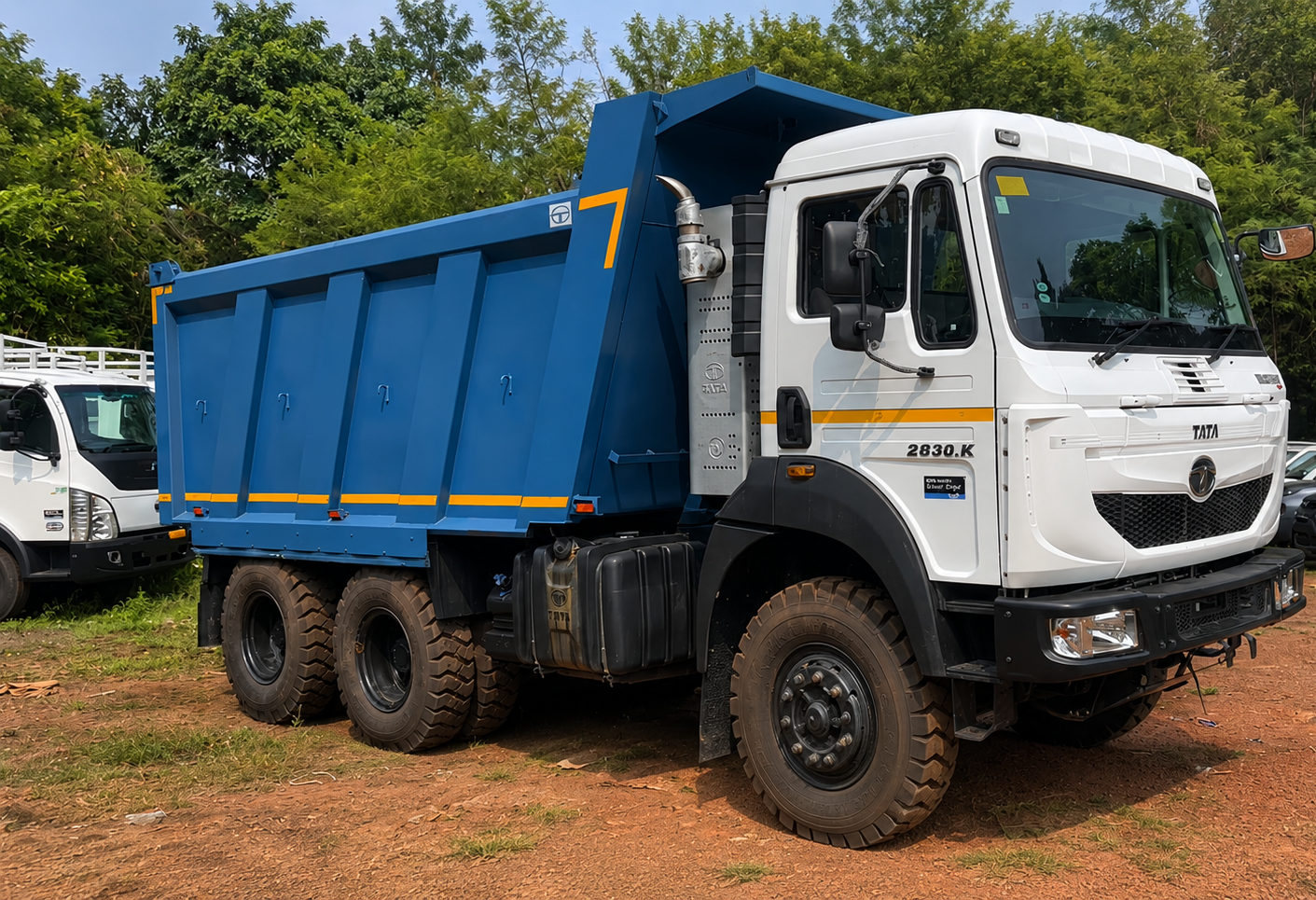
A 28-tonne GVW 6×4 tipper truck powered by a Cummins 6.7 l OBD-II engine. It delivers 224 kW / 300 HP and 1,100 Nm torque through a TATA G1150 gearbox, with 16 and 22 Cu.m box or 14 Cu.m scoop body options, a 335 L HDPE fuel tank and BS6 Phase 2 readiness.
GVW28T
EngineCummins 6.7 l
Power224 kW
Torque1,100 Nm
Body16 / 22 Cu.m
Fuel Tank335 L
Key Highlights
GVW
28,000 kg
Engine
Cummins 6.7 l OBD-II
Engine Capacity
6,702 cc
Maximum Power
224 kW / 300 HP
Maximum Torque
1,100 Nm
Body Capacity
16 / 22 Cu.m Box
Scoop Body
14 Cu.m
Transmission
TATA G1150
Clutch
430 mm
Configuration
6 × 4
Fuel Tank
335 l HDPE
Wheelbase
38 WB / 48 WB
Tyres
11×20 NT / 11R20
No. of Tyres
10 Tyres
Emission
BS6 Phase 2
Specifications
Detailed technical specifications for the Tata Signa 2830.K SRT 28T 6×4 tipper truck
Front AxleHeavy duty forged I beam Reverse Elliot type
Rear AxleSingle reduction heavy duty rear axle with differential lock
CHASSIS & SUSPENSION
FrameHeavy duty straight frame with riveted / bolted cross members
Rear SuspensionBogie
Tyres11 × 20 NT, 11R20 Radial
No. of Tyres10 Tyres
CABIN & FUEL
Cab / CowlSIGNA Day Cab
VentilationBlower / AC
Fuel Tank Capacity335 l HDPE
FEATURES & APPLICATIONS
Driver AidsGear Shift Advisor, Mode Shift Advisor, Hill Start Assist
Fuel EfficiencyMultimode FE Switch, Fuel Monitoring System
BrakingEngine Brake
ConnectivityFleetedge Telematics, Firmware Over The Air (FOTA)
ApplicationsCoal yard, crusher to site – blue metal, road construction site
Tata Signa 2830.K SRT Maintenance Checklist
Daily pre-start checks · Service schedule by operating hours and kilometres · Warning indicator actions — Tata Signa 2830.K SRT 28T 6×4 tipper with Cummins ISBe 6.7L BS6 engine, SCR + DEF aftertreatment, TATA G1150 (9F + 1R) gearbox, bogie rear suspension and PTO-driven tipper hydraulics.
Daily Pre-Start Inspection
To be performed by the driver before every shift.
Every Shift
1
Engine Oil & Coolant Level
Engine off, vehicle on level ground. Oil on dipstick between marks. Coolant in recovery tank with engine cold — never open a hot radiator cap.
Act if: Oil below MIN — do NOT start; low oil destroys bearings. Coolant below LOW — check for leaks before running.
2
Leak Inspection (Air / Oil / Fluid)
Walk around and under the vehicle — look for puddles or wet patches on the ground below engine, gearbox, axle and hydraulic tank.
Act if: Any active leak — do not operate until the source is traced and rectified.
3
Air Filter Clogging Indicator
Check the dash indicator or the red band on the air filter housing.
Act if: Red band showing — replace the primary element (never wash or clean it). Replace the secondary element every 3rd primary change.
4
‘Water in Fuel’ Warning Light
Switch ignition ON and observe whether the lamp stays lit after the normal warm-up sequence.
Act if: Stays ON — drain water sediment from the fuel-water separator manually before driving.
5
Air Tank Condensate Drain
Open the drain valve on each air tank and drain until only air comes out, with no water.
Act if: Excess water draining out — check more frequently; moisture causes brake valve corrosion and failure.
6
Lights, Switches, Gauges & Buzzers
Power on and cycle all lights (head, tail, indicator, brake), test the horn, and confirm all gauges register and warning lamps self-test on ignition.
Act if: Any non-functional item — attend to it before the trip. Do not operate with faulty lighting or brake-related warnings.
7
Service Brake & Parking Brake
Test service brake pedal feel and stopping response at low speed. Engage and release the parking brake and confirm it holds.
Act if: Spongy pedal, uneven braking, or parking brake not holding — do NOT drive. Get to the workshop.
8
DEF (AdBlue) Level / SCR Warning Lamp
Check the DEF gauge on the dash, usually adjacent to the fuel gauge, or the SCR warning lamp status.
Act if: Low DEF warning — top up with Tata Genuine DEF immediately. The BS6 ECU will derate power and can prevent restart if DEF runs empty.
Never work under a raised tipper body without the mechanical safety prop or stay rod engaged, regardless of hydraulic hold or engine-off state. A hydraulic seal or valve failure with no mechanical prop in place will let the body fall without warning.
Periodic Service Schedule
Workshop schedule by hourmeter, with approximate kilometre equivalents. CHANGE / REPLACE / INSPECT / GREASE / CHECK / CLEAN / ADJUST.
Weekly or every 50 Hrs — tipper greasing and breather care, plus the daily hydraulic level check.
Gear Box — TATA G1150 (9F + 1R)
Remote gear-shift linkage — grease
Monthly.
GREASE
Tipper Hydraulic System
Hydraulic fluid level — check, top up, trace leaks
Daily.
DAILY
Grease cylinder, load body, body lock, safety stay rod, tailgate hinge & lock points
Every 50 Hrs or weekly.
GREASE
Breather element — clean with compressed air
Every 50 Hrs or weekly.
CLEAN
250 Hrs (≈6,250 km) — tipper performance check.
Tipper Hydraulic System
Dumping time vs. rated payload
If slow, inspect control valve, cylinder and pump.
CHECK
500 Hrs (≈12,500 km) — 1st and 2nd service. All daily and weekly items apply as well.
Engine — Cummins ISBe 6.7L BS6
Engine oil & filter — change
Drain hot. Both 1st and 2nd service fall at 500 Hrs.
CHANGE
Drive belts — tension & condition
Check water pump, tensioner, idler, fan, alternator and steering pump pulleys. Replace on wear or glazing.
Free service schedule. PDI at delivery, then 1st service at 500 Hrs (≈12,500 km), 2nd at 1,000 Hrs (≈25,000 km), 3rd at 2,000 Hrs (≈50,000 km), 4th at 3,000 Hrs (≈75,000 km) and 5th at 4,000 Hrs (≈100,000 km). Also expressed in days as 1 to 5 years respectively — whichever of hours or days arrives first.
Warning Indicators & Immediate Actions
RED = stop immediately. AMBER = act before continuing.
Engine Oil Pressure Warning / Oil Below MIN
RED
What is happening: Insufficient lubrication pressure or level.
Immediate action: Stop the engine immediately. Do NOT continue running. Check the level, top up and investigate leaks before restarting.
Risk if ignored: Running on low oil pressure destroys bearings and can seize the engine.
Coolant Temperature High / Coolant Low
RED
What is happening: Overheating risk — low coolant, a blocked radiator, or belt failure.
Immediate action: Stop safely, let the engine idle briefly, then switch off. Do not open a hot radiator cap. Check for leaks and belt condition before restarting.
Air Pressure Low Warning (Brake System)
RED
What is happening: Insufficient air pressure for the braking system to function safely.
Immediate action: Do not move the vehicle. Wait for air pressure to build to the safe operating range shown on the gauge before departing.
Raised Tipper Body — Working Underneath
RED
What is happening: The load body is raised and only hydraulic pressure is holding it.
Immediate action: Never work under a raised body without the mechanical safety prop or stay rod engaged, regardless of hydraulic hold or engine-off state.
Risk if ignored: A hydraulic seal or valve failure with no mechanical prop in place will let the body fall without warning.
Air Filter Clogging Indicator — Red Band
AMBER
What is happening: Restricted intake airflow, usually from dust or soot buildup.
Immediate action: Replace the primary air filter element. Never wash or clean it — replace only. Replace the secondary element every 3rd primary change.
‘Water in Fuel’ Lamp Stays ON
AMBER
What is happening: Water has collected in the fuel-water separator.
Immediate action: Drain water sediment manually before continuing.
Risk if ignored: Running with contaminated fuel damages the common-rail injection system.
DEF (AdBlue) Low-Level Warning
AMBER
What is happening: SCR system diesel exhaust fluid is running low.
Immediate action: Top up with Tata Genuine DEF immediately.
Risk if ignored: On BS6 vehicles the ECU progressively derates power and can prevent restart if DEF empties completely. Do not ignore this warning.
Slow Tipping / Body Not Rising to Rated Speed
AMBER
What is happening: Hydraulic system fault — low oil, a clogged filter, a worn pump, or a control valve issue.
Immediate action: Do not force repeated attempts. Check hydraulic oil level and filter condition, and have the pump and valve inspected before further tipping.
ABS Warning Lamp Stays ON
AMBER
What is happening: Wheel speed sensor or ABS system fault.
Immediate action: The vehicle is still driveable with reduced ABS function, but have the sensor and air-gap checked at the next workshop visit. Do not delay.
ECU / Engine Warning (MIL) Lamp ON
AMBER
What is happening: An emissions or engine control system fault has been logged.
Immediate action: Get a diagnostic scan at an authorised workshop.
Risk if ignored: Continuing to run with an active fault can worsen DPF and SCR aftertreatment damage.
Frequently Asked Questions
Everything you need to know about the Tata Signa 2830.K SRT 6×4 tipper truck.
The Tata Signa 2830.K SRT has a gross vehicle weight of 28,000 kg in a 6×4 configuration.
It uses a Cummins 6.7 l OBD-II engine of 6,702 cc producing 224 kW (about 300 HP) at 2,300 r/min and 1,100 Nm of torque between 1,100 and 1,700 r/min.
Body sizes are 16 and 22 Cu.m box options and a 14 Cu.m scoop body.
The fuel tank is 335 litres in HDPE. Wheelbase options are 38 WB and 48 WB.
It uses a TATA G1150 gearbox with a 430 mm clutch, a heavy duty forged I beam Reverse Elliot front axle, and a single reduction heavy duty rear axle with differential lock on bogie suspension.