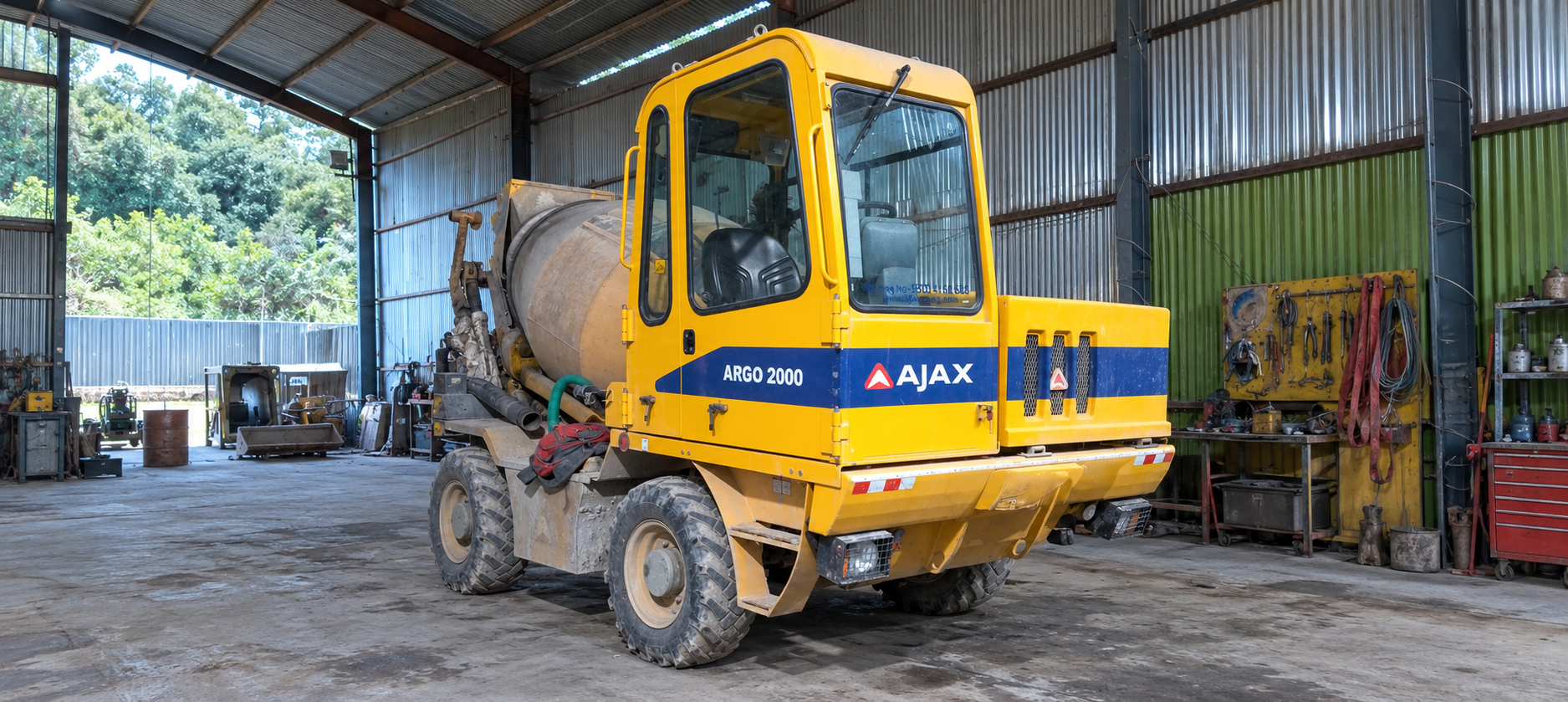
The Ajax ARGO 2000 is part of the ARGO Series SLCM range for 360° concreting solutions. It combines a 2 cu.m drum, 320 L bucket, naturally aspirated Kirloskar CEV Stage V engine, 4 wheel drive and pressure transducer weighing technology for concrete production in compact project sites.
Engine Type4-cylinder inline, water cooled, naturally aspirated
Emission ComplianceCEV Stage V engine
Adblue Tank CapacityNA
Vehicle Speed22 kmph
Gradeability22°
DriveFull time 4 wheel drive
CAPACITIES
Water Tank Capacity360 L
Fuel Tank Capacity64 L
Hydraulic Tank Capacity82 L
Water Pump Capacity230 lpm
Drum Capacity2 cu.m
Bucket Capacity320 L
Unladen Weight5661 kg
Tyre Spec12.0/75-18, 14 PR
DIMENSIONS
Dimension A2887 mm
Dimension B (Overall Length)6132 mm
Dimension C (Overall Height)3320 mm
Dimension D (Ground Clearance)280 mm
Dimension E2177 mm
FEATURES
3 Way SteeringTight turning radius and maneuverability
Auto Mixing ModeAuto mixing ensures complete mixing cycle due to preset duration
Smart CBCConcrete batch controller for mix design and recipe control
TelematicsIoT enabled fleet tracking and monitoring
Centralized GreasingSupports lubrication of internal components
Rear View CameraWide display vision from sitting inside cabin
Emergency Parking BrakeSafety and hazard support in working and static condition
APPLICATIONS
ApplicationsRailways, precast, buildings, bridges, canal lining and CC roads
Project UseIndustrial foundation and smart city project applications
Concrete SolutionSelf-loading, batching, mixing and placing support
Safety FeaturesQuality and safety standards, emergency parking brake and wet disc brakes
Ajax ARGO 2000 Maintenance & Inspection Checklist
Daily pre-start checks · Kirloskar service schedule · lubrication and batching system care · warning actions · fluids and capacities.
Daily Pre-Start Inspection
Complete before the first start of every shift and correct unsafe conditions before loading, travelling or mixing.
Every 10 hours
1
Machine & work area
Park on firm, level ground and check access, ground condition and operating clearance.
Act if: the machine is unstable, obstructed or anyone is inside the operating area.
2
Arm, bucket & pins
Inspect articulations, pins, stops, locking pin and safety retainers.
Act if: a pin, retainer or stop is missing, loose, bent or damaged.
3
Hydraulic system & hoses
Inspect cylinders, pipes, joints and tank for leakage, damage and loose connections.
Act if: a pressurised leak, damaged hose or falling oil level is found.
4
Engine & radiator
Check for fuel, oil and coolant leaks; clear the radiator grille and cooling surfaces.
Act if: leakage, loose parts or blocked cooling airflow is found.
5
Engine oil level
With the engine off and machine level, wait 45–60 minutes, then check the dipstick.
Act if: oil is below minimum or abnormal loss is found.
6
Coolant level
When cold, verify coolant is between the minimum and maximum marks.
Act if: the level is low, leakage is present or the system is hot.
7
Hydraulic oil level
Stop the engine, lower implements and let oil cool; the level should be near the middle of the upper sight glass.
Act if: it is below the lower control point or the low-level buzzer sounds.
8
Brake fluid
Check the reservoir beneath the rotating driving post and keep the level between minimum and maximum.
Act if: the level is low, leakage is visible or braking is abnormal.
9
Fuel system
Check fuel level and drain water from the fuel tank and water separator; inspect drains and lines.
Act if: water continues, leakage is found or fuel is insufficient.
10
Air intake
Check the pre-cleaner, air-cleaner element, seals and restriction indicator.
Act if: the indicator remains red or an element is wet, torn or unsealed.
11
Water-pump filter
Clean the filter and confirm the suction filter is intact and properly immersed when used.
Act if: the filter is missing, blocked or damaged.
12
Drum & machine cleanliness
Remove concrete residue after work and keep the drum, rollers, chute and radiator grille clean.
Act if: hardened concrete interferes with moving parts or controls.
13
Tyres, wheels & drive
Inspect tyre condition and inflation, wheel security, axles, transmission and visible oil leakage.
Act if: a tyre is damaged or low, a fastener is loose or leakage is present.
14
Jacks, chassis & mountings
Check jacks, pins, chassis and accessible engine and pump mountings for damage or looseness.
Act if: structural damage, missing pins or loose mountings are found.
15
Safety equipment
Check the seat belt, guards, lamps and safety labels for condition and legibility.
Act if: any required belt, guard, label or warning device is damaged or missing.
16
Controls before start
Apply the parking brake, select neutral and return the hand accelerator to rest.
Act if: the neutral or parking-brake interlock is ineffective.
17
Indicators after start
At about 1,000 rpm, confirm oil-pressure and battery warnings clear and gauges operate normally.
Act if: a warning remains on, a gauge is abnormal or the warning check fails.
18
Service & parking brakes
Test service-brake response at low speed in a clear area and confirm the parking brake holds.
Act if: braking is weak or uneven, or the machine moves with the parking brake applied.
Service Schedule by Hours
Service schedule for the Kirloskar 4R810NA2 engine configuration listed for ARGO 2000.
Timing rule: use the earlier of operating hours or calendar time where both are shown. Replace damaged, wet, unsealed or restricted air-cleaner elements immediately.
Includes all daily 10-hour inspections and lubrication.
Weekly machine checks
Air cleaner & battery
Clean the air cleaner, battery and lead connections; check electrolyte.
At the first 50 hours, change engine oil and replace the oil and fuel filters.
FIRST CHANGE
Complete lower-interval tasks that are due.
Machine checks
Mounting bolts & gear oils
At 150 hours, tighten chassis, engine and pump mountings; check axle, wheel-hub and drum-gearbox oil levels.
150 HR
Radiator fins
Clean at 250 hours.
250 HR
Kirloskar 500-hour service. Complete all lower-interval tasks that are due.
Fuel & engine
Fuel tank
Clean at 500 hours.
CLEAN
Engine oil & oil filter
Change at 500 hours or 6 months, whichever occurs first.
CHANGE
Fuel filters
Replace the fuel filter at 500 hours or 6 months, whichever occurs first.
REPLACE
Hydraulic & driveline
Hydraulic filter
Complete the first change at 500 hours.
FIRST CHANGE
Axles, hubs & drum gearbox
Complete the first oil change at 500 hours.
FIRST CHANGE
Replace both air-cleaner elements by 1,000 hours or one year, or sooner when damaged or repeatedly restricted.
Air intake
Primary & secondary elements
Replace at 1,000 hours or one year. Replace both if the restriction indicator reaches red for the third time.
REPLACE
1,500-hour hydraulic service
Hydraulic oil & filter
Change hydraulic oil and replace the filter at 1,500 hours or 12 months, whichever occurs first.
CHANGE
Brake & driveline oils
Change brake fluid and axle, wheel-hub and drum-gearbox oils at 1,500 hours or 12 months.
CHANGE
Hydraulic-tank breather
Replace at 1,500 hours or 12 months.
REPLACE
Kirloskar fluid-renewal service at 1,500 hours or 12 months, whichever occurs first.
Both engine configurations
Hydraulic oil & filter
Change the oil and filter. Replace the filter immediately if the clog warning activates.
CHANGE
Brake & driveline oils
Change brake fluid and axle, wheel-hub and drum-gearbox oils.
CHANGE
Hydraulic-tank breather
Replace at 1,500 hours or 12 months.
REPLACE
These extended intervals apply to the Kirloskar engine configuration.
2,500-hour checks
Injectors & valve clearance
Check and adjust.
ADJUST
Starter motor & alternator
Check and adjust.
CHECK
5,000-hour renewal
Radiator coolant
Drain and replace at 5,000 hours.
CHANGE
Before maintenance: park level, lower the loading arm and drum, apply the parking brake, stop the engine, remove the key, release stored pressure and secure the machine.
Lubrication & Concrete Batch Controller
Clean every nipple before and after greasing and stop when fresh grease appears. Do not use graphite grease on drum-roller bearings.
Every 8 hours
Loading-arm rods & tie rods
Grease all 4 points.
4 POINTS
Bucket-tilting cylinders
Grease all 6 points.
6 POINTS
Drum rollers
Grease daily to purge concrete residue.
4 POINTS
Unloading chute
Grease both points.
2 POINTS
Loading arm
Grease both points.
2 POINTS
Every 40 hours
Pivoting driving post
Grease the single point.
1 POINT
King pins
Grease all points.
4 POINTS
Transmission shaft
Grease all points.
3 POINTS
Oscillating bracket
Grease both points.
2 POINTS
Drum locking pin
Grease the single point.
1 POINT
Drum lifting cylinders
Grease all points.
4 POINTS
Pressure-sensor CBC
Tare & calibration
At installation and daily, warm the hydraulic oil, keep the machine level and bucket empty, then perform tare and calibration.
CALIBRATE
Repeatability
Verify with a known test weight and recalibrate if readings are outside the permitted limit.
VERIFY
Load-cell CBC & display
Load-cell calibration
At installation or after disturbed readings, complete tare and the 4-point calibration sequence.
CALIBRATE
Display & wiring
Daily, check the display, low-battery indication, sensor cables, connectors and visible damage. Do not use liquid cleaners.
CHECK
CBC setup: identify the fitted controller type before calibration. Keep the machine level, warm the hydraulic oil and maintain steady engine speed.
Warning Alerts & Immediate Actions
Treat any warning that remains on after starting as a fault.
Red — StopAmber — Act
STOP
Low engine-oil pressure
Action: stop safely and shut down. Check oil level and leakage; do not restart while the warning or abnormal pressure remains.
Risk: severe engine damage.
STOP
Brake-fail indication
Action: stop on firm, level ground, secure the wheels and arrange service. Do not travel or work.
Risk: loss of machine control.
STOP
Low hydraulic-oil buzzer
Action: lower the arm and drum, stop the engine and inspect for leakage before qualified repair.
Risk: pump damage or uncontrolled movement.
ACTION
Hydraulic-filter restriction
Action: stop loaded operation, replace the suction-filter cartridge and restore the correct hydraulic oil level.
Risk: cavitation, heat and hydraulic damage.
STOP
High coolant temperature
Action: stop work and allow the engine to cool. Check coolant, leaks, radiator fins and fan belt; never open a hot cap.
Risk: overheating and burns.
ACTION
Battery-charge warning
Action: stop at a safe point, check belt condition and battery connections, and service the charging circuit.
Risk: electrical shutdown or no restart.
ACTION
Fuel reserve on a slope
Action: stop in a safe position and refuel immediately to prevent the pickup drawing air.
Risk: unexpected engine stall.
STOP
Fluid or hydraulic leak
Action: lower equipment, shut down and release pressure. Keep hands away from hydraulic spray and repair before use.
Risk: fire, burns or injection injury.
STOP
Failed warning-light check
Action: tag the machine out and repair the indicator, gauge or circuit before operation.
Risk: a critical fault may go undetected.
Hot fluids: allow hydraulic oil, engine oil and coolant to cool before loosening plugs or caps. Release pressure gradually and wear eye and hand protection.
Fluids, Lubricants & Capacities
Fill using the specified level-check procedure and confirm the installed engine and axle configuration.
Engine & fuel
Kirloskar engine oil
Use the approved lubricant for the installed Kirloskar engine.
12.5 L
Fuel tank
Good-quality diesel suitable for the installed engine.
64 L
Cooling & hydraulic
Kirloskar cooling system
Use approved coolant for the installed Kirloskar engine.
18 L
Hydraulic tank
Hydraulic oil tank capacity for ARGO 2000.
82 L
Axles, hubs & gearboxes
Front axle differential
Use the axle gear oil specified for the fitted DANA or COMER axle.
6 L
Rear axle differential
Use the axle gear oil specified for the fitted DANA or COMER axle.
6 L
Four wheel hubs
Fill and level-check every hub.
1.5 L EACH
Two-speed gearbox
Fill with the specified axle gear oil to the level opening.
2 L
Drum reduction gearbox
AJAX Gear Oil XTR; use the sight-glass level procedure.
2 L
Brake, grease & process fluids
Brake system
AJAX Brake Oil HP; do not substitute unsuitable fluid.
1 L
Grease points
AJAX Grease HD; do not use graphite grease on drum rollers.
AS REQUIRED
Process-water tanks
Use clean process water in the two connected tanks.
360 L TOTAL
Optional additive tank
Use a compatible admixture.
15 L
Frequently Asked Questions
Everything you need to know about the Ajax ARGO 2000 Self Loading Concrete Mixer
The Ajax ARGO 2000 has a 2 cu.m drum capacity.
The ARGO 2000 is listed with a Kirloskar engine rated at 36.09 kW @ 2200 rpm. It is a 4-cylinder inline, water-cooled, naturally aspirated engine compliant with CEV Stage V.
The bucket capacity is 320 L.
The ARGO 2000 has a 360 L water tank, 64 L fuel tank and 82 L hydraulic tank.
The ARGO 2000 has 22° gradeability and full time 4 wheel drive.