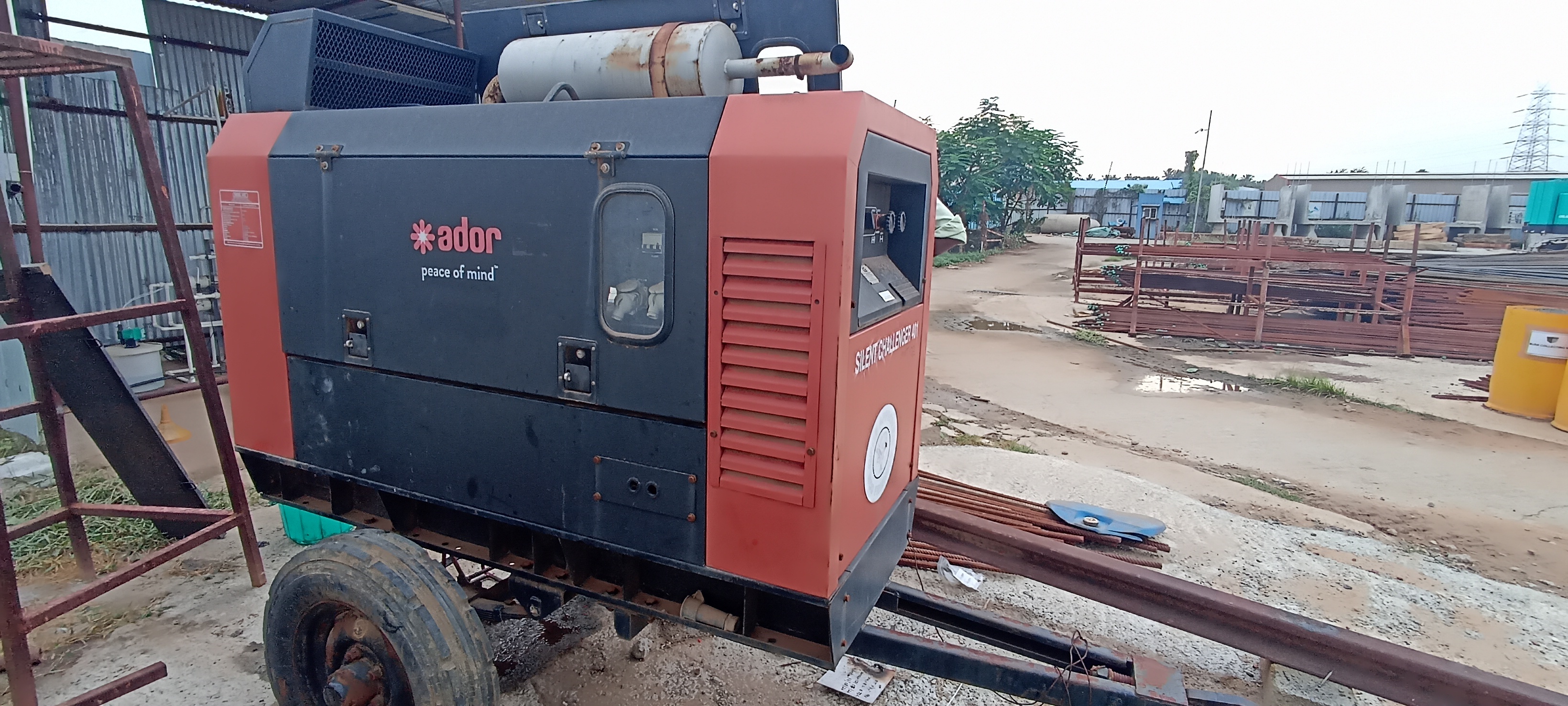
The Ador Silent Challenger 401 is a diesel engine driven welding set built for site work beyond the reach of mains supply. It delivers 50-400 A of constant-current SMAW output from a brushless generator, runs on a 3-cylinder Simpson SJ327T CPCB-II engine, and provides 10 kVA of auxiliary power for tools and lighting while welding.
Welding Current50 – 400 A
At 60% Duty Cycle400 A
Engine38.5 BHP
Auxiliary Power10 / 3 kVA
Weight (skid)1,100 kg
Fuel Tank70 L
Key Highlights
Welding Process
SMAW
Welding Current
50 – 400 A
At 60% Duty Cycle
400 A
At 100% Duty Cycle
310 A
Open Circuit Voltage
100 / 45 V
Electrode Diameter
2.5 – 6.3 mm
Engine
Simpson SJ327T
Engine Rating
38.5 BHP @ 1800 rpm
Auxiliary Power
10 / 3 kVA
Fuel Tank
70 L
Fuel Consumption
4.0 L/hr @ 100%
Weight (skid)
1,100 kg
Emission
CPCB-II
Noise Level
Within 75 dBA @ 1 m
Arc Cutting
Up to 4 mm electrode
Specifications
Detailed technical specifications for the Ador Silent Challenger 401 diesel welding generator
Generator TypeBrushless, high frequency, constant current (CC); winding-less, commutator-less, magnet-less, slip-ring-less and rotating-diode-less rotor
OperatorsSingle
Welding Current Range50 – 400 A
Max. Hand Welding Current400 A
Max. Welding Current @ 60% Duty Cycle400 A
Max. Welding Current @ 100% Duty Cycle310 A
Open Circuit Voltage (Max / Min)100 / 45 V
Diameter of Coated Electrode2.5 – 6.3 mm
Insulation ClassH
Arc CuttingUp to 4 mm arc cutting electrode
ENGINE
Make / TypeSimpson SJ327T, CPCB-II compliant
No. of Cylinders3
CoolingWater cooled
Engine Rating38.5 BHP @ 1800 rpm
Rated Engine Speed1800 rpm
StartingElectric (battery 12 V, 75 AH)
Conforms ToIS 10002 (BI)
Fuel Tank Capacity70 L
Fuel Consumption4.0 L/hr @ 100% duty cycle
Engine Safety Protection (optional)Auto shut-off on low lube oil pressure
Daily pre-start checks · service schedule by hours · warning alerts · spare parts and capacities.
Before Start — engine stopped
About 5–10 minutes. Set level on firm ground, engine cold, all loads off. Never open the radiator cap on a hot engine.
Every day / 8 hours
1
Placement and covers
Level, firm ground, away from humidity and dust. Exhaust and radiator air free to escape (indoors: 3 feet clear on all sides). Canopy and generator cover closed; no rags or cotton waste inside. No grinding near the generator end shield.
Act if: the set is tilted, air is blocked or a cover is open. Fix before starting.
2
Engine oil level
Dipstick at the full mark. Use the specified oil grade for the SJ327T engine.
Act if: the level is below the mark: top up. Milky oil or a diesel smell: do not start — report it.
3
Coolant and radiator
Coolant (antifreeze mixture) up to the overflow pipe. Cap locked, drain cock closed, hoses tight. Radiator fins clear of dust and leaves.
Act if: the level is low again or a hose is wet: find the leak — the engine will overheat.
4
Fuel and water drain
Drain water from the fuel pre-filter / water separator. Fill clean, filtered diesel. No leaks on the fuel lines.
Act if: there is any fuel leak: do not start — fire risk. Water every day: check the fuel supply.
5
Air cleaner
Dry-type air cleaner properly mounted, hoses and clips tight. On an extremely dusty site, clean it daily.
Act if: the element is missing or a hose is cracked: do not run — dust wears the engine.
6
Battery and wiring
Terminals tight; electrolyte about 10 mm above the plates (distilled water only); battery negative earthed. All electrical connections tight.
Act if: polarity is wrong: do not start — it burns the charging alternator.
7
Welding cables and terminals
Correct-size supplied cables with plugs, insulation sound. Electrode and earth clamp tight on the right range terminal (I 50–150 A, II 70–240 A, III 130–400 A). Auxiliary sockets and MCB undamaged.
Act if: insulation is cut or a socket is burnt: do not use. A hot terminal: tighten it and clean the plug.
After Start — engine running, no load
Check these before putting any welding or auxiliary load on the set.
8
Oil pressure
Read oil pressure on the gauge or the DECU screen right after start.
Act if: there is no pressure, or a low oil pressure alarm shows: stop at once (see Warning Alerts).
9
Charging and alarms
The charging warning lamp goes off and the charging ammeter shows charge. On DECU sets, no alarm LED is on.
Act if: the lamp stays on or any alarm shows: find the cause before welding.
10
Log book
Record hours run, fuel and oil added, and any work done.
Act if: it has been 250 hours since the last oil change: plan the service.
Starting and stopping: switch the MCB on and turn the key clockwise. Never start or stop the engine on load. A new or long-idle set needs the fuel line bled first. Do not change engine speed — the no-load speed is factory set at 1,890 rpm, and the engine and generator foundation bolts are factory set. After work, remove the load, stop with the key, then wipe dust off the generator, coil the cables, clean the air filter and refill fuel. Never remove a battery terminal while the engine is running.
Service Schedule by Hours
Five service points are defined for this set. At each interval, also complete every item from the shorter intervals.
Engine procedures: follow the procedures specified for the Simpson SJ327T engine. Engine oil grade and quantity, coolant specification, valve clearances, injector pressure and belt tension are engine settings — use the specified values, do not estimate them.
These are the checks listed in the Daily Pre-Start tab.
Engine, cooling & fuel
Engine oil level in sump
Check and top up to the full mark with the specified grade.
CHECK
Lube oil pressure (gauge / DECU)
Check after start. The DECU alarms below 2.1 kg/cm².
CHECK
Coolant level
Fill to the overflow pipe with the engine cold.
CHECK
Radiator fins, hoses, drain cock, cap
Fins clear, hoses tight, cap locked.
CHECK
Fuel pre-filter / water separator
Check for water and drain it off.
DRAIN
Fuel lines, connections, fuel filter
Check for leaks after operation.
CHECK
Air, electrical & generator
Air cleaner / dust bowl
Check condition and mounting. In extremely dusty conditions, clean it and empty the bowl daily.
CHECK
Battery electrolyte and terminals
Top up distilled water to about 10 mm above the plates; terminals tight.
CHECK
Charging ammeter and warning lamp
Check while the engine is running.
CHECK
Wires, terminals, start button, switches, starter
Inspect for damage, wear and looseness; test after operation.
A one-time service after the first 25 to 50 hours of operation.
Engine
Lubricating oil
Change the full fill.
CHANGE
Oil filter canister (S12.10.003.0178)
Fit a new canister.
REPLACE
Lube oil pressure
Check on the gauge or DECU.
CHECK
Idle speed (where applicable)
Check and adjust if needed. The no-load speed is factory set at 1,890 rpm — do not change it.
ADJUST
Valve tip clearance
Check and adjust to the specified clearance if needed.
ADJUST
Cooling, fuel & air
Coolant level
Check and fill to the overflow pipe.
CHECK
Drive belt(s) / fan belt
Check and keep properly adjusted to the specified tension.
CHECK
Fuel pre-filter / water separator
Check for water.
CHECK
Air cleaner / dust bowl
Clean and empty the dust bowl (extremely dusty conditions).
CLEAN
Includes every daily / 8-hour check.
Engine oil & filter
Lubricating oil
Change the full fill.
CHANGE
Oil filter canister (S12.10.003.0178)
Fit a new canister.
REPLACE
Cooling & air intake
Drive belt(s) / fan belt
Check and adjust.
CHECK
Air cleaner / dust bowl — normal conditions
Clean the element and empty the dust bowl.
CLEAN
Includes every daily and 250-hour task.
Fuel system
Fuel lift pump sediment chamber and strainer
Clean both.
CLEAN
Primary fuel filter element (S12.10.007.0219)
Fit a new element.
REPLACE
Secondary fuel filter element (S12.10.007.0220)
Fit a new element.
REPLACE
Air intake
Air filter element (S12.07.000.0317)
Clean or replace, if not already done earlier. Replace once cleaning no longer restores it.
SERVICE
Major service. Includes every applicable lower-interval task.
Engine
Valve tip clearance
Check and adjust to the specified clearance if needed.
ADJUST
Atomizers (injectors)
Check the opening pressure.
CHECK
Engine breather vent valve
Clean.
CLEAN
Electrical
Alternator, starter motor and related items
Check condition and operation.
CHECK
Condition-based items: the generator bearings are sealed and need no lubrication. In dusty environments, blow out the generator interior with compressed air once a week. On two-wheel and four-wheel mounted versions, grease the axle bearings, leaf springs and shackles at the specified interval and grease grade.
Before maintenance: remove the welding and auxiliary load, stop the engine with the key, switch the MCBs off and isolate the battery. Never start or stop the engine on load, never remove a battery terminal while the engine is running, and never open the radiator cap until the engine is cool.
Spare Parts & Capacities
Service part numbers, published capacities and control panel alarm limits.
Service parts (Ador part numbers)
Oil filter canister
Replaced at the first service and every 250 hours.
S12.10.003.0178
Fuel pre-filter / water separator
Drained daily; checked at the first service.
S12.10.007.0255
Primary fuel filter element
Replaced every 500 hours.
S12.10.007.0219
Secondary fuel filter element
Replaced every 500 hours.
S12.10.007.0220
Air filter element
Cleaned or replaced every 500 hours if not done earlier.
S12.07.000.0317
Engine maintenance kit
Supplied as a kit for scheduled engine servicing.
S12.10.007.0197
Capacities & alarm limits
Fuel tank
Clean, filtered diesel.
70 L
Battery
12 V, negative earth, electric start.
75 AH
Low lube oil pressure alarm
DECU trip point.
2.1 kg/cm²
High coolant temperature alarm
DECU trip point.
105 °C
Fuel low alarm
DECU warning at this tank level.
10%
Battery low alarm
DECU warning at this voltage.
10.8 V
No-load engine speed
Factory set — do not adjust.
1,890 rpm
Engine fluids and settings: use the oil grade and quantity, coolant specification, valve clearances, injector pressure and belt tension specified for the Simpson SJ327T engine. Do not estimate engine settings.
Warning Alerts & Immediate Actions
Stop immediately for red alerts; resolve amber alerts before continuing. Rows naming the DECU apply to sets with the digital engine control panel — on analog-panel sets, watch the oil pressure and temperature gauges for the same conditions.
Red — StopAmber — Act
RED
Low lube oil pressure
DECU LED, or pressure below 2.1 kg/cm² on the gauge. Oil level low, an oil line leak, or a fault in the oil pressure switch.
Action: Stop the engine. Check the dipstick and look for a leak in the oil line. Fill the recommended oil to the dipstick mark. If pressure is still low, call a service engineer.
If ignored: bearings and crankshaft run without an oil film — seizure, engine overhaul or replacement.
RED
Engine overheat
DECU LED above 105 °C, or a high reading on the temperature gauge. Low coolant, blocked radiator fins, a slack or broken fan belt, or poor ventilation.
Action: Remove the load and stop. Wait about an hour for the temperature to settle. Do not open the radiator cap until cool. Then check coolant, fins and belt.
If ignored: cylinder head and gasket damage, piston seizure.
RED
Coolant level low (DECU)
The radiator water level sensor reads low — a leak or loss of coolant.
Action: Stop and let the engine cool. Fill coolant up to the overflow pipe and tighten the cap. Find the leak.
If ignored: overheating and engine damage.
RED
Engine stops on its own
On sets with auto shut-off: low oil level tripped the pressure switch, an oil line leak, or low coolant tripped the temperature switch.
Action: Do not keep restarting. Check oil and coolant levels and the oil line. Restart only after the cause is fixed.
If ignored: repeated restarts with no oil or coolant destroy the engine.
RED
Fuel leak, burning smell or smoke
Fuel near the hot exhaust, or an overheated cable joint or terminal.
Action: Stop the engine and switch off the MCBs. Keep a fire extinguisher ready. Do not restart until repaired.
If ignored: fire on site.
RED
Shock felt from frame, holder or cable
Damaged welding cable insulation or an electrical fault.
Action: Stop welding, stop the engine and isolate the set. Replace the damaged cable.
If ignored: electric shock to the welder.
AMBER
Fuel low (DECU)
Tank below 10%. Little fuel left.
Action: Plan refuelling with clean, filtered diesel.
If ignored: the engine runs dry; air enters the fuel line and it needs bleeding before restart.
AMBER
Battery low (DECU)
Below 10.8 V. The MCB may be off, or the battery may be faulty.
Action: Check the MCB. Check the battery and replace it if faulty.
If ignored: the set cannot restart.
AMBER
Battery charging fail
Charging fail LED, or the charging warning lamp stays on while running. The MCB may be off, or there is a fault in the charging circuit or alternator.
Action: Check the MCB and the charging circuit. Replace the battery or MCB if faulty.
If ignored: the battery runs down and the set will not restart.
AMBER
RPM low message (DECU)
A control transformer fault is the likely cause.
Action: Do not adjust engine speed. Have the control transformer checked and replaced by a service engineer.
If ignored: wrong welding and auxiliary output; equipment on the auxiliary socket may be damaged.
AMBER
Engine fails to start
Loose or discharged battery, no fuel, an air lock in the fuel line, wrong starting procedure, loose wiring or earthing, low oil level on auto shut-off sets, a stiff stop solenoid joint, or a relay RL1 fault.
Action: Check in this order: battery connections and charge, fuel, air lock, start procedure, wiring. Lubricate the ball joint of the start/stop solenoid.
If ignored: repeated cranking drains the battery and overheats the starter.
AMBER
No welding current
A blown fuse, loose output terminals, or a faulty current regulator.
Action: Check and replace the fuse. Tighten the terminals and clean the cable plug. Replace the regulator if faulty.
If ignored: lost welding time.
AMBER
Generator does not reach rated voltage
A loose connection at the regulator PCB, a faulty remote/local switch or regulator pot, no 17-0-17 V control supply, or a field winding fault.
Action: An electrician should check these against the regulator settings. Call a service engineer if the fault is not found.
If ignored: poor arc and unstable welding.
AMBER
250 hour service due
The hour meter or DECU run-hours have reached the next 250-hour point.
Action: Plan the oil and oil filter change, belt check and air cleaner cleaning.
If ignored: the oil breaks down and engine wear accelerates.
Frequently Asked Questions
Everything you need to know about the Ador Silent Challenger 401 diesel welding generator
It is a single-operator SMAW (shielded metal arc welding) set with a 50 – 400 A current range. Maximum hand welding current is 400 A, held at 400 A on a 60% duty cycle and 310 A on a 100% duty cycle. Open circuit voltage is 100 / 45 V (max / min).
A Simpson SJ327T — 3-cylinder, water cooled and CPCB-II compliant — rated at 38.5 BHP at 1800 rpm and conforming to IS 10002 (BI). Starting is electric from a 12 V, 75 AH battery, and auto shut-off on low lube oil pressure is available as an option.
Yes. The set provides auxiliary power with a simultaneous welding load: 10 kVA at 415 V 3-phase and 3 kVA at 240 V single-phase, through 2 output sockets protected by a 16 A MCCB.
Coated electrodes from 2.5 mm to 6.3 mm diameter. The set also handles arc cutting with electrodes up to 4 mm. The generator is brushless and constant-current, with a rotor that has no windings, commutator, magnets, slip rings or rotating diodes, and class H insulation.
Skid mounted: 2,000 × 820 × 1,460 mm, 1,100 kg. Two wheel mounted: 2,900 × 1,455 × 1,990 mm, 1,240 kg. Four wheel mounted: 2,900 × 1,555 × 1,990 mm, 1,340 kg. The set meets CPCB-II for exhaust emission and noise, staying within 75 dBA at 1 m. Fuel tank capacity is 70 L with consumption of 4.0 L/hr at 100% duty cycle, and the warranty runs one year from the date of commissioning.