Fuel monitoring dashboard for refuelling reconciliation
BI-verified refuelling reconciliation

Manually Verified Refuelling Reconciliation

Aether's BI team compares fuel transaction records — Fuel Dispenser System records, store records, manual log sheets, and IoT sensor data — to find quantity mismatches, missing refuelling entries, and high-risk fuel leakage across your fleet.

17,000+ L Fuel discrepancy found at a Hydro Electric project site
₹15+ Lakh Financial impact identified and reported to management
1,500+ L Discrepancy identified at a large infrastructure project site
95%+ Validated accuracy vs 60–75% industry average

Why it matters

Fuel records rarely tell the full story on their own

Refuelling data exists across multiple disconnected systems. The Aether BI review checks whether fuel issued in operational records is also captured in IoT sensor data and the LLS fuel graph — correcting entry errors, detecting missed refuelling, and acting only on verified discrepancies.

10%+
Quantity variance threshold used to trigger manual review of any refuelling event.
100%
Discrepancy flag raised when one system records a refuelling event and the other does not.
3-way
Comparison of transaction records, manual confirmation slips, and IoT sensor graph evidence.
95%+
Target accuracy for Aether-validated reconciliation output versus 60–75% for manual-only logs.

Data sources

Three independent inputs — one reconciled view

The BI team never relies on a single log. Digital transaction records, IoT sensor data, and manual confirmation are cross-checked before any event is classified.

Operational records

Fuel transaction & store records (Fuel Dispenser System)

Approved refuelling entries are consolidated from Fuel Dispenser Systems using date, time, asset reference, quantity issued, and transaction ID. API or dashboard exports are processed through Python-based data engineering to generate a clean consolidated summary.

IoT sensor evidence

Aether portal refuelling logs

Aether refuelling events, raw LLS graph behaviour, sensor health reports, and refuelling event quantities are verified against the fuel transaction records to confirm delivery.

  • Fuel graph rise and Aether-dispensed quantity per event
  • LLS health status, blind area, and threshold checks
Manual confirmation

Manual refuelling log-sheets

Handwritten log-sheets from P&M and store teams provide a third data point: asset code, quantity, issue date, and swiping status — authenticated before inclusion.

  • Asset code, quantity, and issue date from physical slips
  • Swiping / signature status validated by AE-BI team

End-to-end process

AE-BI team workflow

From raw fuel logs to a verified discrepancy report — five structured phases the BI team follows on every reconciliation cycle.

Data Collection

Fuel transaction logs are pulled from Fuel Dispenser Systems via API and dashboard exports. Manual log-sheets are collected from the store or P&M team for the same period.

Fuel Dispenser System / Aether portal data exported
Manual refuelling records collected from site store or P&M team

Data Validation & Cleaning

Records are cross-checked for date, time, asset reference, and quantity. Gaps where refuelling is recorded in one system but absent in the other are flagged for immediate review.

Verify transaction date, time, and dispensed quantity across all three sources
Flag mismatched or missing entries; document and escalate unresolved cases

Processing & Analysis

Python-based data engineering generates a consolidated summary (merging split transactions) and a consolidated Aether summary. Both are then compared to produce a difference report with absolute and percentage variance per event.

Events with >10% variance are moved to the manual verification queue
Manual verification covers: fuel fluctuation, LLS failure, blind area, and under-threshold refuelling scenarios

Internal Review & Verification

Before submission, the AE-BI team conducts an internal review — cross-verifying event calculations, portal screenshots, and evidence quality. The Senior BI Lead validates the final discrepancy summaries.

Report Submission

The final manually verified refuelling discrepancy report is delivered to the client. Event-wise tables, discrepancy observations, and supporting screenshots from both the Fuel Dispenser System and Aether portal are included for full traceability.

Manual verification scenarios

What the BI team checks — four key scenarios

Each scenario below explains a distinct discrepancy type and the verification steps used to resolve it.

High-risk discrepancy

Refuelling in Fuel Dispenser System but no matching event in Aether

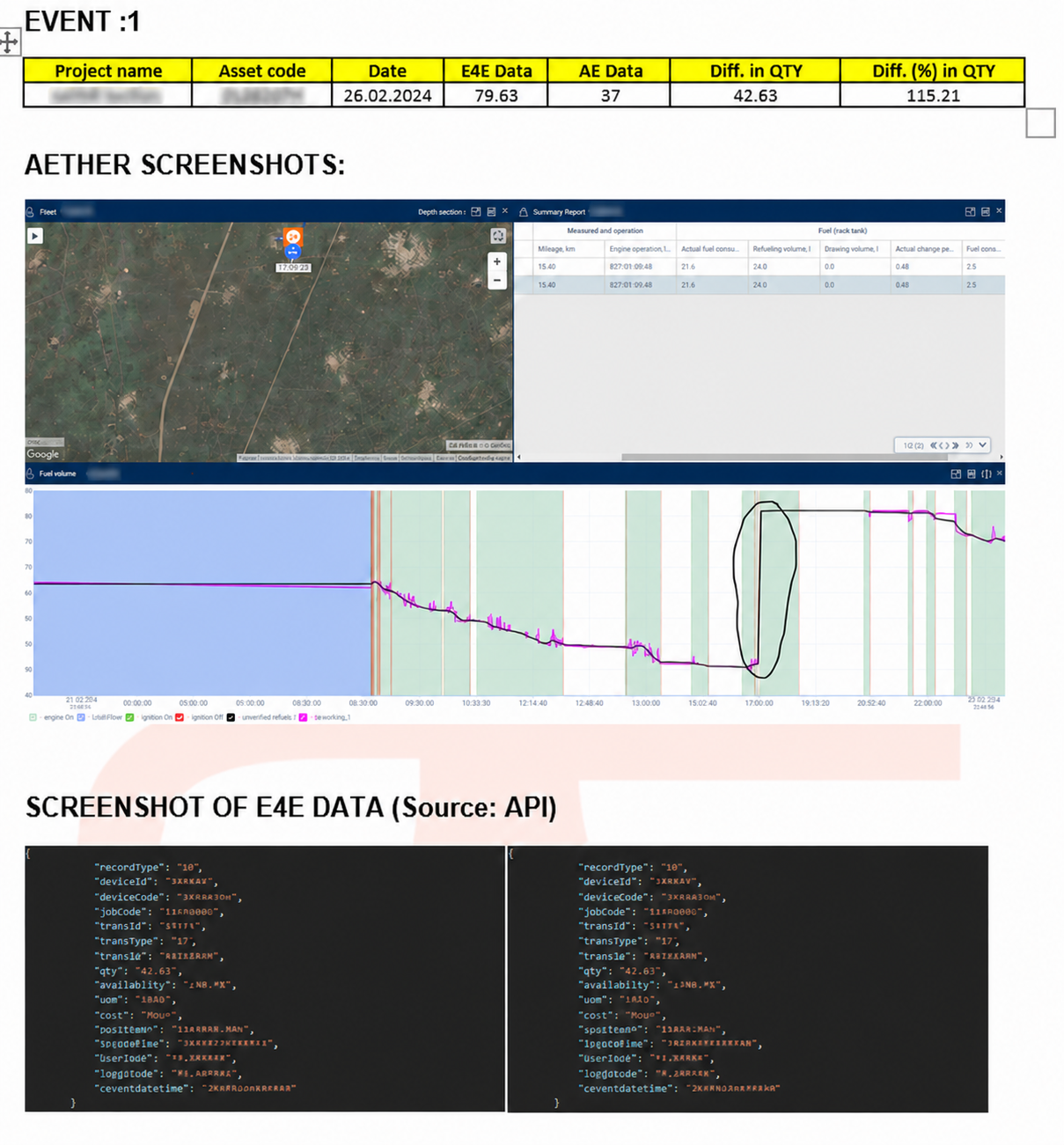
When the Fuel Dispenser System shows a confirmed transaction but the Aether portal does not show a corresponding fuel rise, the event is classified as a 100% discrepancy. This is the highest-risk scenario and requires site-level verification — the entire dispensed quantity may have been diverted before reaching the tank (e.g. decanted into jerry cans).

Confirm the Fuel Dispenser System transaction ID, dispensed quantity, asset, and date.
Open the Aether portal graph for the same asset and date — check for any rise.
Check LLS sensor health and connectivity status for that time window.
Confirm at site level whether fuel reached the tank or was diverted.
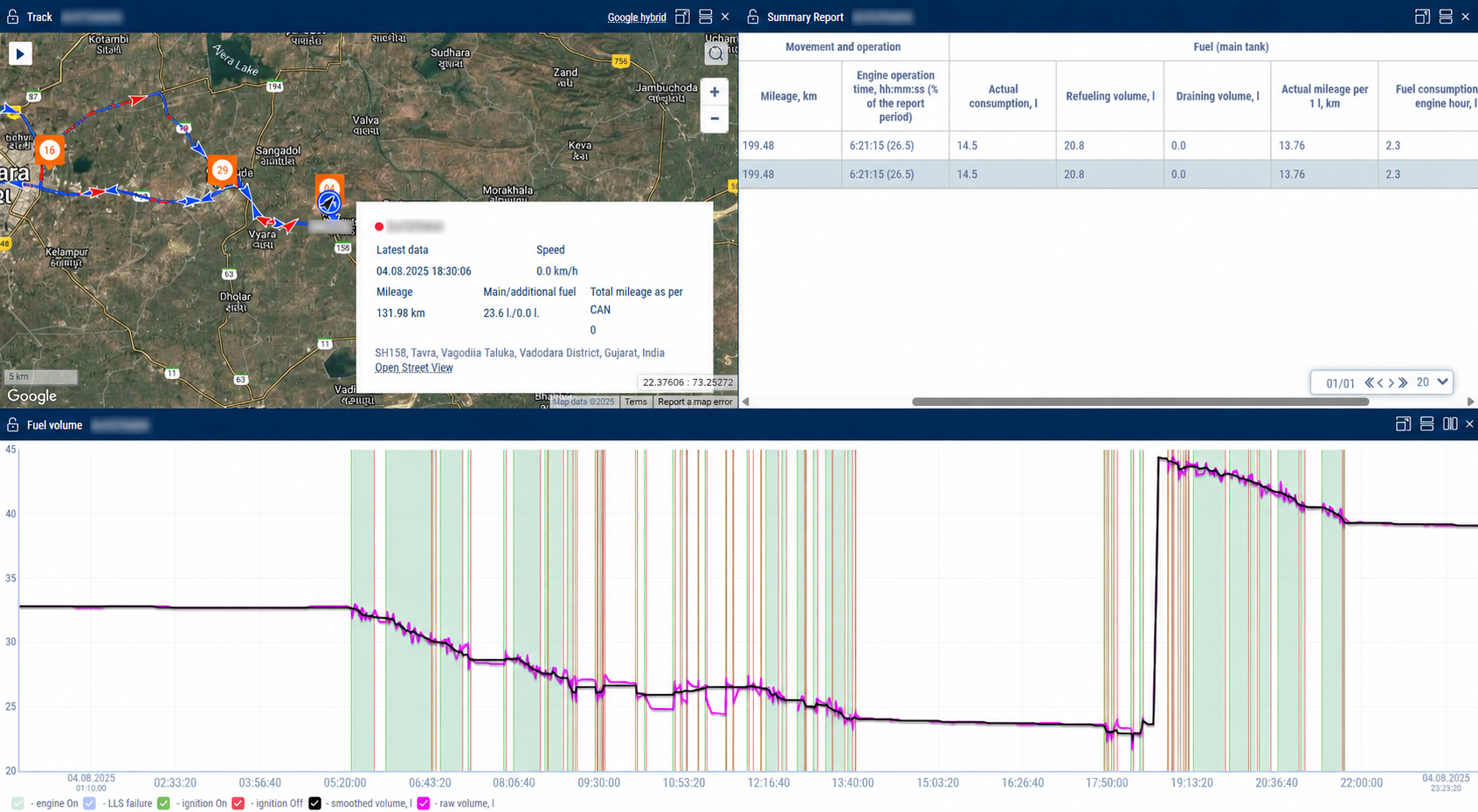
Fuel Dispenser System transaction recorded but no matching refuelling rise in Aether portal
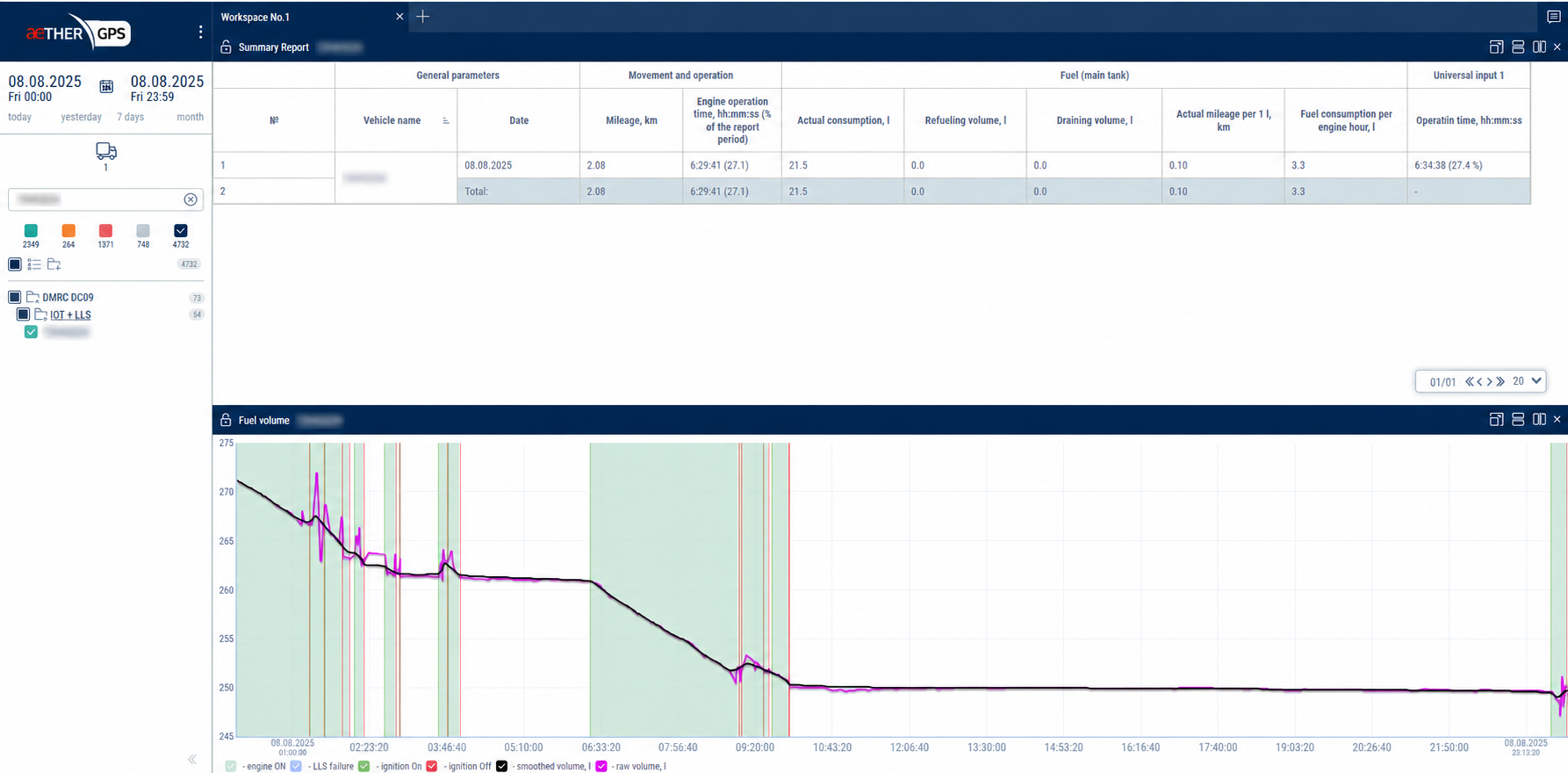
The Fuel Dispenser System has a confirmed refuelling entry, but the Aether graph shows no corresponding fuel level rise for the same asset and date.
Manual record gap

Aether shows refuelling but no store Logsheet record exists

If the Aether portal captures a refuelling event but store Logsheet records have no matching entry for the same date and asset, it typically indicates a missed log-sheet entry, delayed manual recording, or operational negligence by the store team. A call is scheduled with the P&M team to resolve the discrepancy.

Confirm the Aether refuelling rise, event time, and dispensed quantity.
Check store Logsheet records for the same asset and date range.
Schedule a clarification call with the P&M or store team.
Aether refuelling event not recorded in store data
Aether records a refuelling event, but the store data has no matching volume entry for the same day.
Difference analysis

Fuel Dispenser System quantity and Aether quantity do not match

After consolidated summaries are generated, the BI team calculates absolute and percentage differences per event. All events above the 10% threshold are rechecked against both Fuel Dispenser System transaction data and the Aether portal graph before being included in the final report.

Merge split Fuel Dispenser System transactions with separate transaction IDs before comparison.
Isolate all rows with >10% variance into the manual verification queue.
Attach Aether portal screenshots and Fuel Dispenser System transaction details as evidence.
Event-wise refuelling discrepancy report with Fuel Dispenser System and Aether evidence columns
Report format: project, asset, date, Fuel Dispenser System quantity, Aether quantity, difference (litres), and difference (%) — with screenshot evidence attached.
Hardware context

LLS failure, blind area, fluctuation, and under-threshold events

Not every discrepancy is pilferage. The BI review ensures hardware context is checked before reporting — preventing incorrect theft classification and protecting site teams from unfair escalation.

Fuel fluctuation: Review sudden fuel level changes against activity logs to confirm whether variance is operationally justified.
LLS failure: Detect sensor disconnection or hardware malfunction; cross-check with manual records.
Blind area: Occurs when the sensor cannot capture the tank's full capacity due to installation position or tank shape — a 20 L blind area on a 450 L tank leaves that volume unmeasured.
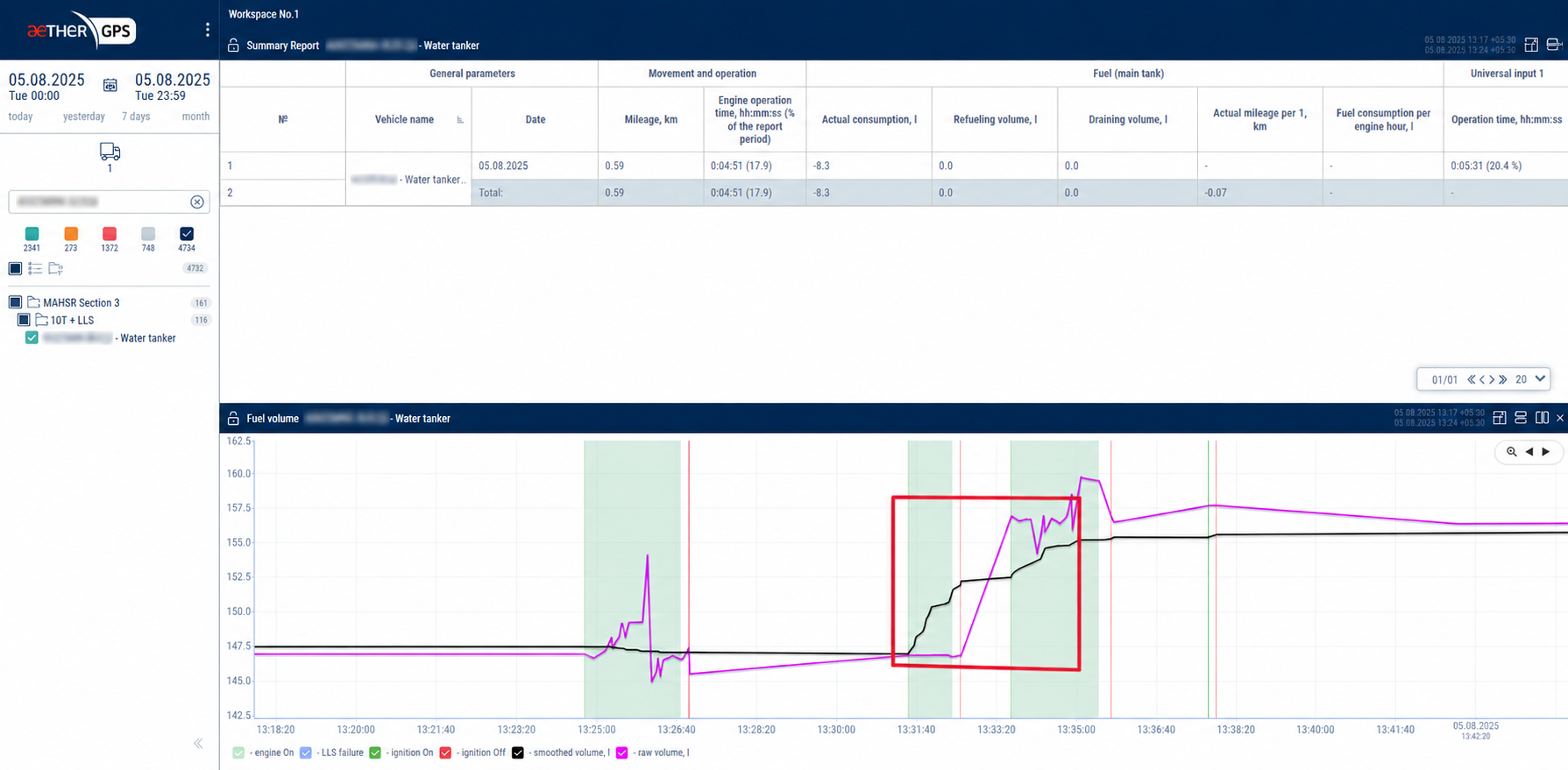
Under-threshold refuelling: Small refuelling volumes below the configured asset threshold register as 0 in Aether even though the Fuel Dispenser System records show the dispensed quantity (e.g. 10 L).
Under-threshold refuelling event visible in graph but recorded as zero in Aether
A small fuel rise is visible in the LLS graph but the event is recorded as 0 because the volume fell below the asset's configured refuelling threshold.

Deliverables

What the AE-BI team delivers

Every reconciliation cycle produces four structured outputs designed for action by P&M, store, operations, and finance teams.

Reconciliation Summary Report

Structured Excel report with event-wise fuel differences, percentage variance, asset-wise discrepancy totals, and high-level mismatch summary.

  • Difference in litres per refuelling event
  • Difference (%) in quantity per event
  • Asset-wise and site-wide discrepancy totals
  • Supporting evidence screenshots from Aether and Fuel Dispenser System

Exception & Flagged Alerts

Highlighted list of high-risk events that require immediate site investigation or corrective action.

  • Missing 100% refuelling entries (Fuel Dispenser System has entry, Aether absent)
  • Cases where Fuel Dispenser System quantity exceeds tank capacity (potential theft vector)
  • Tampered or disconnected LLS sensor signals

Trend Analysis

Recurring discrepancy patterns surfaced across daily, weekly, or monthly windows depending on L&T reporting requirements.

  • Daily / weekly / monthly fuel consumption trends
  • Changes in discrepancy patterns across reporting periods
  • Identification of assets with recurring variance behaviour

Operational Recommendations

Actionable guidance for site and management teams to prevent recurrence and improve documentation quality.

  • Reduce manual entry errors and missed log-sheet submissions
  • Improve accountability at individual site level
  • Corrective actions for recurring or high-value events
  • Guidance for third-party-managed sites where Fuel Dispenser System data may be unavailable

Sample output

What a reconciliation report looks like

Each verified event is presented with project type, asset, period, Fuel Dispenser System quantity, Aether quantity, absolute difference, and percentage difference — with evidence screenshots attached.

Project Type Asset Period Dispenser Qty (L) Aether Qty (L) Diff. (L) Diff. (%) Status
Hydro Electric ProjectDG Unit AJun 2025~3000~300100% 100% Missing
Hydro Electric ProjectDG Unit BJun 2025~500~255~245~96% High Variance
Hydro Electric ProjectDG Unit CJun 2025~600~360~240~65% High Variance
Hydro Electric ProjectDG Unit AJun 2025~600~540~60~10% Review
Infrastructure ProjectEquipment AOct 2025~100~19~81~430% High Variance
Infrastructure ProjectEquipment BOct 2025~30~23~7~29% Review

Sample rows drawn from verified reconciliation reports. Actual reports include all events, full transaction IDs, and screenshot evidence.

Case studies

Verified results from real project sites

These reconciliations were completed by the Aether BI team on live projects. Financial impact figures are based on actual discrepancies identified and acknowledged by the project management teams.

Case Study 1 — DG Fleet
2000 kVA DG Fleet Fuel Reconciliation at a Hydro Electric Project
Mid 2025 • Multiple DG assets monitored (some non-reporting due to LLS failure)
17,000+ L
Total fuel discrepancy confirmed
₹15+ Lakh
Financial impact identified
Multiple DGs
Assets assessed across site

Key findings

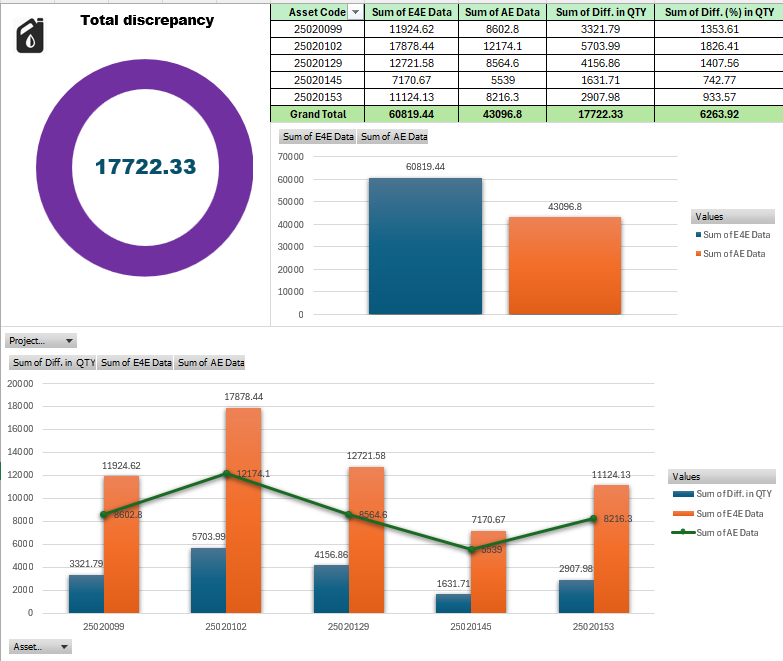
Over 17,000 litres of discrepancy identified across monitored DG assets — representing the gap between Fuel Dispenser System-logged fuel issued and Aether IoT-measured fuel received.
A 100% missing refuelling event was detected: a full refuelling was recorded in Fuel Dispenser System with no corresponding event in the Aether IoT portal — confirmed non-delivered or non-reported activity.
Multiple Fuel Dispenser System transactions with separate transaction IDs were consolidated into single Aether IoT events — exposing inconsistencies in refuelling entry reporting.
Several DG assets produced no IoT fuel data during the period due to confirmed LLS sensor failure — highlighting the need for regular sensor health checks.
The project management team acknowledged the findings and initiated corrective actions at site level following Aether's formal report submission.
₹15+ Lakh
Total fuel-related financial impact identified and formally reported to the project management team.
Case Study 2 — Infrastructure Site
Fuel Discrepancy Detection at a Large Infrastructure Project Site
Oct – Nov 2025 • Multiple assets across the site
1,500+ L
Total discrepancy identified
₹1.3+ Lakh
Financial loss surfaced
~5 weeks
Analysis coverage period

Key findings

Over 1,500 litres of discrepancy identified across multiple assets by comparing manual refuelling logs against Aether IoT automated refuelling records.
Automated IoT logs clearly indicated mismatch instances where manually recorded fuel issued exceeded fuel actually measured by the equipment sensors.
Over ₹1.3 lakh in fuel-related financial loss was identified — previously invisible to site management before the IoT reconciliation was performed.
Following the evidence-based report: the management team acknowledged discrepancies, initiated site-level measures, and strengthened refuelling SOPs and monitoring protocols.
₹1.3+ Lakh
Previously undetected fuel-related financial loss surfaced and formally reported to the project management team.
Refuelling discrepancy dashboard showing total discrepancy chart and asset-wise breakdown
Dashboard view summarising total discrepancy, asset-wise differences, and evidence tables — format used in final reports submitted to project management.
Report output

What the final report includes

The final reconciliation output is structured for immediate action by P&M, store, operations, and finance teams — with evidence attached to every flagged event.

  • Event-wise fuel difference in litres and percentage variance
  • Asset-wise and site-wide discrepancy totals
  • Missing refuelling entries and 100% discrepancy flags
  • Supporting Aether portal screenshots and Fuel Dispenser System transaction evidence
  • Exception alerts for LLS failure, tampered sensors, and over-capacity entries
  • Operational recommendations to reduce manual errors and site-level leakage

Estimated ROI

What reconciliation saves — in real numbers

Illustrative estimates based on verified case studies across DGs, dumpers, transit mixers, and heavy equipment.

01 — PILFERAGE PREVENTION
3%–12% of monthly fuel recovered

Typical site fuel consumption: 20,000–60,000 L/month.
Savings from pilferage detection: ₹54,000 – ₹6,48,000 per month at ₹90/litre.

02 — MANUAL ERROR CORRECTION
18%–25% manual mismatch rate eliminated

Incorrect manual entries contribute ₹20,000–₹1,00,000 in monthly leakage.
Aether reconciliation replaces guesswork with Aether-validated evidence.

03 — ACCURACY IMPROVEMENT
95%+ validated accuracy achieved

Industry average for manual logs: 60%–75%.
Aether-validated output: 95%+ — fewer billing disputes, audit flags, and reconciliation cycles.

04 — MISSED REFUELLING RECOVERY
1–5 missed events per site per month

Each missed event = 100–500 L loss avoided.
Total monthly recovery: ₹9,000–₹45,000 per site.

05 — BUSINESS ROI RATIO
₹10–₹25 saved for every ₹1 spent

Through pilferage prevention, reduction of entry errors, and improved asset-level accountability — verified across active reconciliation engagements.

₹16+ Lakh
Total verified financial impact across two case studies — over ₹15 lakh at a Hydro Electric project and over ₹1.3 lakh at a large infrastructure site — identified through Aether's manually verified reconciliation and formally acknowledged by project management teams.

Challenges addressed

Why manual verification is needed even when digital systems exist

These are the structural problems the BI reconciliation process is built to handle — issues that automated matching alone cannot resolve.

Manual vs digital inconsistency

Store records often differ from Fuel Dispenser System data due to human error, delayed entry, incorrect volume estimation, or inconsistent timestamp formats.

Incomplete refuelling logs

Refuelling entries may be missing from the store log, Fuel Dispenser System records, or Aether portal — requiring constant follow-up with the L&T P&M team to obtain accurate information.

Communication gaps

Miscommunication between drivers, operators, and the operations team leads to missed log-sheet entries that cannot be reconciled without a follow-up investigation.

Manual slip authenticity

Handwritten refuelling slips may be unclear, lack signatures, or show volume figures that do not match dispenser or tanker readings — requiring additional checks with L&T P&M to confirm credibility.

Turn disconnected fuel records into verified discrepancy reports.

Aether reconciles Fuel Dispenser System records, store records, manual log sheets, and IoT sensor data so your team acts on confirmed mismatches — not uncertain entries. Verified across multiple live project sites with over ₹16 lakh in financial impact identified and acknowledged.