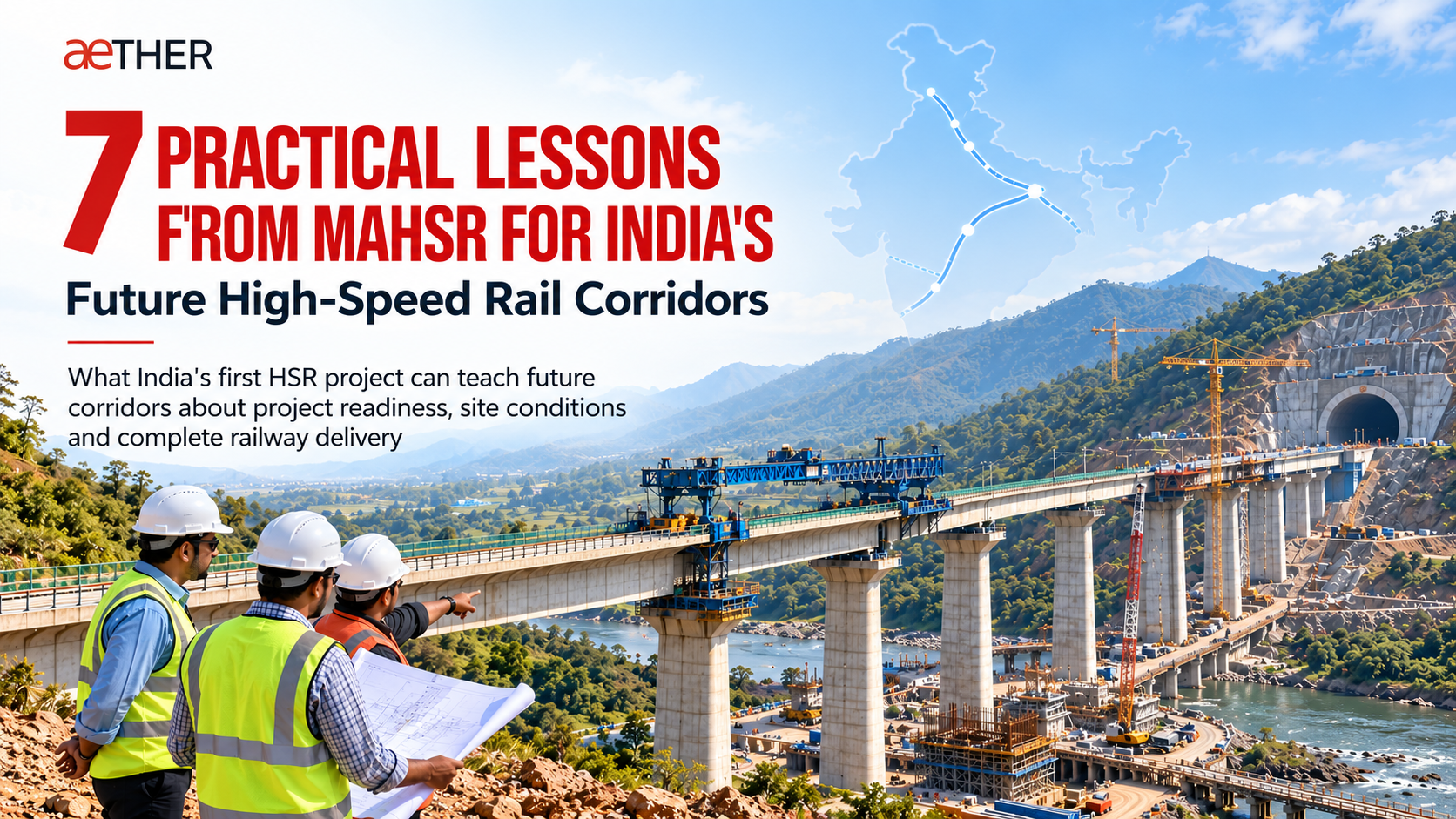
7 Practical Lessons from MAHSR for India’s Future High-Speed Rail Corridors
What India’s first high-speed rail project shows about land, utilities, difficult sites, urban interfaces, environmental constraints, specialist capability and complete railway delivery.
Last updated:
India’s Mumbai–Ahmedabad High-Speed Rail (MAHSR) project is the country’s first dedicated high-speed rail project. As construction has moved forward, it has also created practical experience that future high-speed rail projects can learn from — including land acquisition, existing pipelines and cables, difficult construction locations, environmental conditions, specialist skills and the railway systems needed before trains can operate.
The value of this experience is not that another corridor can simply copy the Mumbai–Ahmedabad project. Every future route will have its own land conditions, cities, rivers, ground conditions, environmental concerns and existing infrastructure around the construction area.
The central question is simple: What challenges appeared on MAHSR, how were they handled, and what should future high-speed rail corridors prepare for earlier?
For EPC and construction teams, these lessons also raise a practical question: will the next construction location be ready when workers and equipment arrive? A workfront is the specific area where a team is expected to carry out its planned activity. Depending on the work, the required land, access, drawings, existing services, equipment and trained workforce need to be ready together. Otherwise, resources may be available, but the planned construction activity may still be unable to begin.
The seven lessons broadly fall into three parts.
| 1.Project readiness — Land and existing services | 2.Design meets the real site — Difficult locations, operating infrastructure and environment | 3. Deliver the complete railway — Trained people and railway systems |
|---|---|---|
| Before construction reaches a location, the required land should be available and existing pipelines, cables and other services should be identified and cleared where necessary. | Ground conditions, rivers, tunnels, operating railways, dense cities and environmentally sensitive areas can change how a project should be designed and built. | Completing bridges, viaducts, tunnels and stations is not enough. A high-speed railway also needs trained people, track, power, signalling, communications, trainsets and testing before it can operate. |
1. Land Acquisition: Make Critical Land Available Before Construction Needs It
What was the challenge?
The Mumbai–Ahmedabad High-Speed Rail (MAHSR) project required about 1,389.5 hectares of land across Gujarat, Maharashtra and Dadra & Nagar Haveli. The Ministry of Railways has stated that slower land acquisition in Maharashtra affected the project through 2021, while the pace of acquisition increased during 2022. Press Information Bureau
There was no single reason why acquisition took longer in some areas. In parts of Maharashtra, particularly Palghar, some landowners and local communities resisted the acquisition or raised concerns about the process. Contemporary reporting documented concerns about insufficient compensation, errors in land measurement and poor communication about the project. Other affected farmers were concerned about losing agricultural land and the impact on their livelihoods. The Indian Express
Some landowners also wanted clearer information about what they would receive and how the project would affect them before agreeing to give up their land. In several Palghar villages, resistance continued even after broader community meetings were held. The Indian Express
This became important for construction because a high-speed railway needs land for much more than the final railway alignment. Land and access are also required for stations, viaducts, bridges, tunnel works, construction access and other workfronts.
So even if a large percentage of the total land has already been acquired, construction can still be affected if the remaining land is exactly where the next major activity needs to begin.
How was it handled?
The project responded on several fronts rather than through one single action.
Land acquisition continued with the involvement of NHSRCL and the relevant state authorities. Where landowners and local communities had concerns, communication and facilitation became an important part of moving the process forward.
In Palghar, for example, NHSRCL initially used broader village-level outreach. When this made limited progress in areas facing strong resistance, project representatives began approaching affected landowners more directly to understand their individual concerns and demands. The Indian Express
NHSRCL also appointed a dedicated agency for communication management and facilitation in land acquisition in Palghar district. This shows that community communication was treated as part of the acquisition process rather than relying only on formal land-acquisition procedures. Tender award record
Compensation and rehabilitation were also part of the response. The Ministry of Railways states that affected people were compensated under the applicable land-acquisition law and relevant state policies, while rehabilitation and resettlement measures were carried out in coordination with the state governments. Press Information Bureau
The progress happened gradually. In July 2021, consent agreements had been signed or regular awards completed for about 1,046 hectares of the then-reported land requirement. Press Information Bureau By February 2022, about 1,193 hectares had been acquired. Press Information Bureau Acquisition continued after that, particularly in Maharashtra, until the full 1,389.5 hectares required for MAHSR was acquired. Press Information Bureau
So, in simple terms, the problem was handled through:
continued land acquisition → direct communication with affected communities → compensation and rehabilitation → coordination with authorities → full land availability
What should future corridors learn?
Future high-speed rail projects should begin land acquisition and local coordination early, rather than waiting until the construction schedule is already fixed.
Project teams should know:
Which land is still pending? → Why is it pending? → Which construction activity needs it? → When is access required?
They should also begin communication with affected communities, compensation and rehabilitation work early. If concerns about compensation, land measurement, livelihood or the acquisition process remain unresolved, they can delay the availability of land that construction later depends on.
The lesson is therefore not simply to report a high overall percentage of land acquired.
A project may have acquired most of its total land and still face a problem if the missing land is located at a station, bridge, tunnel area or another workfront that construction needs next.
The more useful question is:
Is the land required for the next construction activity actually available when the project needs it?
For EPC and Plant & Machinery (P&M) teams, this also affects equipment and workforce planning. If the required land or site access is still unavailable, machines and workers scheduled for that location may have to wait or be moved to another available construction area. Confirming land and access before mobilising resources can help avoid unnecessary waiting and disruption to planned work.
Do differently on the next project: Start land acquisition, compensation and community coordination early, and prioritise the land needed to unlock upcoming construction work.
2. Utility Shifting: Move Existing Services Before Construction Reaches Them
What was the challenge?
Before MAHSR could build foundations, stations and other structures at some locations, it first had to deal with services that were already present there.
In construction, these existing services are often called utilities. They include things such as water pipelines, drainage lines, electrical cables, telecom cables and railway signalling cables.
The problem was simple: some of these existing pipelines and cables were located in the same areas where new HSR construction had to take place.
For example, at Ahmedabad station, existing signalling and telecom cables, electrical facilities, water and drainage pipelines and other railway services occupied areas required for the new HSR station.
If an existing water pipeline or electrical cable passes through the location where a new foundation has to be built, construction cannot simply proceed through it. The existing service first has to be safely moved, diverted or reorganised so that the construction area becomes available.
The scale of this work across MAHSR was significant. In July 2021, 1,342 of the 1,651 identified existing services had been shifted. By July 2026, all 1,651 had been shifted, according to the Ministry of Railways.
So the real challenge was:
existing services were occupying some of the same locations that MAHSR needed for construction.
How was it handled?
The project moved or diverted these existing services away from the areas required for HSR construction.
This was done location by location, depending on what service was in the way.
For example, in Vadodara, NHSRCL issued a tender for shifting or diverting underground sewerage lines, water-supply pipelines and storm-water drainage lines in connection with the MAHSR corridor.
At Ahmedabad station, existing signalling and telecom cables, electrical facilities, water and drainage pipelines and other railway services also had to be shifted or reorganised to make space for the new HSR station.
The work continued progressively across the corridor. In July 2021, 1,342 of the 1,651 identified services had been shifted. By December 2022, 1,596 had been shifted, and current Ministry updates report that all 1,651 have now been shifted.
So, in simple terms, the process was:
find the existing pipeline, cable or service → check whether it conflicts with the planned construction → move or divert it away from the construction area → make the location ready for HSR work
What should future corridors learn?
Future high-speed rail projects should identify these existing services early, before construction reaches the affected location.
For every important conflict, the project team should know:
What existing service is in the way? → Who is responsible for it? → Does it need to be moved or protected? → When must this be completed? → Which construction activity is waiting for that location?
This is especially important around stations, existing railway areas and cities, where many pipelines, cables and other services may already be present.
The aim should not simply be to report how many services have been shifted across the entire project.
The more important question is:
Have the existing services been cleared from the location where construction needs to start next?
Do differently on the next project: Identify existing pipelines, cables and other services early, and complete critical shifting or diversion work before construction starts at the affected location.
3. Difficult Locations: Choose the Construction Method to Match the Site
What was the challenge?
A high-speed railway may run for hundreds of kilometres, but the conditions are not the same everywhere. Ground conditions, water, available working space and access can change from one location to another.
MAHSR faced this clearly in Mumbai. The project includes an approximately 21 km underground tunnel between Bandra Kurla Complex (BKC) and Shilphata, including about 7 km beneath Thane Creek. One construction method could not be used for the entire tunnel.
About 5 km has already been completed using NATM, where the tunnel is excavated in stages, while the remaining 16 km is being constructed using Tunnel Boring Machines (TBMs)—large machines designed to bore through the ground.
For a general reader, the important point is simple:
Different parts of the same tunnel required different ways of digging because the surrounding conditions were different.
The Narmada River bridge created another type of challenge. Its deep bridge foundations had to be lowered into the riverbed. During this work, some foundations could tilt or move away from their intended position because of high river flow, tidal effects and soil conditions.
The site also faced a major flood in September 2023. NHSRCL reported that the flood damaged a temporary construction bridge, affected heavy cranes, made work areas inaccessible and disrupted electrical connectivity.
So the challenge was not simply that these locations were “difficult.”
The real issue was:
different locations created different physical problems, so the same construction approach could not be used everywhere.
How was it handled?
The project changed the construction approach according to the conditions at each location.
For the Mumbai tunnel, the work was divided between two tunnelling methods instead of forcing one method across the entire 21 km section. About 5 km was completed using staged excavation, while TBMs are being used for the remaining 16 km, including the undersea section.
At the Narmada bridge, engineers continuously monitored the deep foundations as they were lowered into the riverbed.
When a foundation tilted or moved away from its required position, the team used controlled jacking and pulling measures to correct it. One of these corrective techniques is known as the Jack-Down method. NHSRCL reports that additional teams were also mobilised to monitor the foundation work.
After the September 2023 flood damaged temporary construction facilities and disrupted access, site teams worked to restore operations and continue the bridge work.
So, in simple terms, the approach was:
understand the site condition → identify the specific problem → choose or adjust the construction method → monitor the work → correct problems when conditions change
What should future corridors learn?
Future high-speed rail projects should investigate difficult locations carefully before finalising how they will be built.
Project teams should ask:
What is the ground like? → Is water involved? → Is flooding possible? → Is there enough working space? → Can construction equipment reach the location? → Which construction method actually suits these conditions?
A method that works well at one location may not be suitable at another.
Once the construction method is chosen, teams should plan the required equipment and its deployment according to site access, available working space and actual ground conditions.
The main lesson is:
Understand the location first. Then choose the construction method.
Do differently on the next project: Study difficult locations early, and finalise the construction method, site access and temporary construction arrangements only after the actual site conditions are understood.
4. Construction Around Operating Railways: Simplify the Design Before Construction Begins
What was the challenge?
Building a new high-speed railway becomes more difficult when it has to pass through an area where trains, passengers, roads and other infrastructure are already operating.
Vadodara was one such location.
The original plan for the HSR station required the new railway to cross almost 13 existing railway tracks near Vadodara station. To make this crossing possible, the design included a very large bridge arrangement with a 220 m main span.
The problem was not simply the size of the bridge.
The bridge would have had to be constructed above railway lines that were still carrying regular trains. NHSRCL identified several difficulties: launching such a large bridge over running tracks would be complicated, construction had to protect operating trains and passengers, and the equipment needed for the work also faced height restrictions associated with Vadodara Airport. The proposed arrangement did not receive the required airport clearance.
So the real problem was that the original arrangement created major construction and clearance challenges. Building such a large crossing above running railway lines, while also working within airport height restrictions, would have made the work much more difficult.
How was it handled?
Instead of trying to solve the problem with an even more complicated construction method, NHSRCL changed the alignment and station arrangement.
The HSR alignment around Vadodara was redesigned so that it could cross the existing railway tracks at a more suitable location. The station arrangement was also changed as part of the redesign.
With the revised design, the railway tracks could be crossed using simpler 40 m spans instead of the earlier 220 m main span. This reduced the need for unusually complex bridge construction above the operating railway.
NHSRCL estimated that the revised arrangement could reduce the execution period for this work from about 66.6 months to about 48 months. The redesign also reduced the need for special structures and improved access and connections to other transport around the station.
So, in simple terms, the approach was:
identify that the original design was too difficult to build → reconsider the alignment → move the crossing to a better location → use a simpler bridge arrangement
What should future corridors learn?
Future high-speed rail projects should not check only whether an alignment works on a drawing.
They should also ask:
Can it actually be built safely? → What existing infrastructure is operating around it? → Will trains, passengers or roads need to remain in use during construction? → Are there height, access or other site restrictions? → Is there a simpler alignment or layout?
If these questions are asked while the design can still be changed, major construction problems may be avoided before they reach the site.
The main lesson is:
Sometimes the better solution is not a more complicated construction method. It is a simpler alignment or layout.
Do differently on the next project: Test major station and crossing designs against real construction conditions early, and change the alignment or layout while there is still time to simplify the work.
5. Environmental Impact: Address It in Design and Construction
What was the challenge?
Environmental issues can affect a major infrastructure project in two different ways.
Some issues can influence the design itself. Others have to be controlled during construction.
MAHSR faced both.
Around Thane Creek, the corridor passes through or near environmentally sensitive areas that include mangroves and migratory flamingo habitat. This meant the project had to consider not only where the railway would go, but also how the chosen design could reduce disturbance to the surrounding environment.
NHSRCL says environmental considerations around Thane Creek were one reason for taking the HSR alignment underground.
The nearby Thane station also affected mangrove areas. In an earlier design, about 12 hectares of mangrove area would have been affected.
So the design-level problem was:
How could the railway and station be built while reducing their impact on a sensitive natural area?
There was also a second type of environmental challenge during construction. Large construction sites can create dust, noise and changes in local air quality, especially in dense urban areas.
How was it handled?
The project addressed the issue at both the design stage and the construction stage.
At the design stage, the railway around Thane Creek was planned through an underground tunnel to reduce disturbance to the sensitive area above.
The design of Thane station was also modified. NHSRCL states that this reduced the affected mangrove area from about 12 hectares to around 3 hectares.
So in this case, the response was not only to manage the environmental impact later.
The design itself was changed to reduce the impact before construction.
Environmental management also continued once construction began.
At the underground BKC station, NHSRCL documented measures such as mist guns and water sprinkling to control dust, barriers to reduce construction noise, and real-time air-quality monitoring.
So, in simple terms, there were two parts to the response:
before construction → change the design where possible to reduce environmental impact
during construction → control dust, noise and other effects created by the work
What should future corridors learn?
Future high-speed rail projects should identify environmentally sensitive areas while the route, stations and major structures can still be changed.
Project teams should ask:
Is the route passing through a sensitive habitat? → Can the alignment or station design reduce the impact? → Would an underground or different construction solution help? → What environmental controls will still be needed during construction?
Environmental issues should therefore not be treated only as something to manage after the design has already been fixed.
Sometimes the design itself needs to change.
At the same time, even a better design will still need proper controls during construction.
Do differently on the next project: Identify sensitive environmental areas early, allow the alignment and station design to respond to them, and plan construction-stage controls before work begins.
6. Specialist Skills: Prepare the Workforce Before Specialist Work Begins
What was the challenge?
MAHSR is India’s first high-speed rail project, and some of the technology being introduced required skills that the local workforce first had to learn.
Track construction is a clear example.
MAHSR uses the Japanese J-Slab track system, a type of ballastless track in which the rails are installed on precisely positioned concrete slabs instead of conventional loose-stone ballast. NHSRCL says this system is being used for the first time in India and requires a high level of skill and accuracy during installation.
The challenge was therefore not simply finding enough workers.
The project could not rely only on existing railway experience. Engineers, supervisors and technicians needed additional training to learn how this particular high-speed rail track system should be installed and checked accurately.
NHSRCL also planned that trained and certified personnel would carry out the specialised track-construction work.
So the real challenge was:
new technology was being introduced, but the people needed to build it also had to develop the required skills before the work could begin.
How was it handled?
NHSRCL created a dedicated training and certification programme for the high-speed rail track work.
The training was organised with the Japan Railway Technical Service (JARTS), with Japanese specialists training Indian engineers, work leaders, supervisors and technicians.
A dedicated training facility was created at Surat Depot with three practice track lines, allowing teams to learn and practise the work before carrying it out on the actual railway.
The programme covered 15 specialised training modules for different parts of track construction. These included areas such as track-slab manufacturing, track-bed construction, slab installation, surveying and rail-related work. Around 1,000 engineers, work leaders and technicians were originally planned to receive this training, with Japanese experts supporting the programme.
The training was practical as well as classroom-based. For example, NHSRCL documented hands-on training in slab-track and cement-asphalt-mortar installation, followed by certification after successful completion.
This was not only a training plan. By September 2025, around 436 engineers had already been trained under the Gujarat T-2 and T-3 track packages. NHSRCL also planned similar training for personnel working on the Maharashtra track package before that work began.
The capability-building process continued as the project expanded into Maharashtra; NHSRCL reported completion of the first track-construction training module for the Maharashtra section in May 2026.
So, in simple terms, the approach was:
identify the specialist skill needed → train the people → let them practise the work → check and certify their skills → deploy them on the actual project
What should future corridors learn?
Future high-speed rail projects should identify specialist skills before the related construction or railway-system work is ready to begin.
Project teams should ask:
What specialist work will be required? → Do we already have trained people? → What additional training is needed? → Who will check their skills? → When must they be ready for site work?
This lesson applies beyond track construction. Future projects may also need specialist capability for tunnelling, signalling, railway systems, specialised construction equipment, testing and other HSR-specific work.
The important point is that training should not begin only when the construction team is already waiting for skilled personnel.
Before scheduling specialist work, future project teams should make sure that the required equipment and trained, certified personnel are ready together.
Do differently on the next project: Identify specialist skills early, train and certify the required workforce in advance, and make sure skilled personnel are ready before specialist construction begins.
7. Civil Construction: A Completed Viaduct Is Not the Complete Railway
What was the challenge?
The most visible parts of a high-speed rail project are its foundations, piers, viaducts, bridges, tunnels and stations.
But completing these structures does not mean the railway is ready to carry passengers.
A high-speed train still needs track to run on, electrical systems to supply power, signalling and train-control systems to manage safe movement, communication systems, an operation control centre and the trainsets themselves.
The Ministry of Railways has therefore stated that MAHSR’s completion can be reasonably assessed only after associated works such as civil structures, track, electrical systems, signalling, telecommunications and trainset supply are completed. Press Information Bureau
So the real challenge is:
many different parts of the railway have to become ready and work together before passenger operations can begin.
A completed bridge or viaduct is an important milestone, but it is still only one part of the railway.
How is it being handled?
MAHSR is being delivered through separate but connected packages for civil construction, track, electrification, signalling, telecommunications and other railway systems.
This can already be seen in the project’s progress.
As civil structures have become available, work has also moved into the next stages. By July 2026, the Ministry reported that the base for laying railway tracks had been prepared along about 209 km, while poles supporting overhead electrical wires had been installed along about 190 km. Civil construction was also continuing. Press Information Bureau
The signalling and telecommunications work is also being delivered as a separate railway-system package. The MAHSR-S-1 contract covers signalling and train-control systems, telecommunications and the operation control centre, which is used to monitor and manage train operations. The contract also covers installing these systems, connecting them so they work together, and testing them before they are brought into use.
This shows that railway delivery does not stop when the concrete structure is finished.
As different sections become ready, track, electrification, signalling, telecommunications and other railway-system work can follow or overlap, before the complete railway is brought together and tested as one system.
In simple terms:
sections become ready → track, electrical and other railway-system work follows or overlaps → the different systems are connected and tested together → the railway becomes ready for operation
What should future corridors learn?
Future high-speed rail projects should plan the complete railway, not only the large civil structures that are easiest to see.
Project teams should ask:
When will the structure be ready for track? → When can electrical and signalling work begin? → When will trainsets be available? → When can all the systems be tested together?
These activities should be planned together from the beginning so that one part of the project does not become ready while the next part is still waiting for access, equipment or design information.
Project reporting should also clearly distinguish between civil construction progress and railway readiness.
The main lesson is:
A completed viaduct is a construction milestone, not an operating railway.
Do differently on the next project: Plan civil construction, track, power, signalling, communications, trainsets and testing as one connected programme, so each part is ready when the next team needs it.
What Should Future High-Speed Rail Corridors Do Differently?
The seven lessons lead to one practical question:
What should the next project prepare earlier so that known risks are addressed before they disrupt construction?
| What MAHSR shows | What future projects should do earlier |
|---|---|
| Land acquisition delays can affect construction. | Start land acquisition, compensation and community coordination early, and make sure critical land is available before the next construction activity needs it. |
| Existing pipelines, cables and other services may be in the way of construction. | Identify them early and complete critical shifting or diversion before construction starts at that location. |
| Ground, rivers, water and access conditions can vary from one location to another. | Study difficult locations first, then choose the construction method that suits the actual site conditions. |
| Building around operating railways and dense cities can make the original design difficult to construct. | Check major station and crossing designs against real site conditions while the alignment or layout can still be changed. |
| Environmentally sensitive areas can affect both design and construction. | Identify sensitive locations early, allow the design to respond to them, and plan construction-stage environmental controls in advance. |
| New high-speed rail technology requires people with specialised skills. | Identify required skills early, and train and certify the workforce before specialist work begins. |
| Civil structures are only one part of an operating railway. | Plan civil works, track, power, signalling, communications, trainsets and testing as one connected programme from the start. |
Conclusion
The main lesson from MAHSR is not that future high-speed rail corridors should copy the Mumbai–Ahmedabad project. They should learn from the situations the first project has already had to deal with.
Land acquisition affected progress. Existing pipelines, cables and other services had to be identified and shifted. Difficult ground, rivers and urban locations required different construction approaches. Some designs had to be reconsidered when they proved too difficult to build around existing railways and city infrastructure. Environmental conditions influenced design decisions. New HSR technologies required specially trained people, and visible civil construction still has to be followed by track, power, signalling, communication systems, trainsets, integration and testing.
Not all of these were mistakes. Some were project challenges, some came from the actual site conditions, and some were requirements that come with building India’s first dedicated high-speed railway.
The advantage for future projects is that many of these issues are now known.
Before construction reaches a location, project teams should be able to ask:
- Is the required land actually ready?
- Have existing pipelines, cables and other services been moved or cleared where they conflict with construction?
- Have difficult ground, river and water conditions been investigated?
- Can the design actually be built around the existing city, railway and other infrastructure?
- Have environmental conditions influenced the design early enough?
- Are the required specialist people trained and ready?
- Are civil works and railway systems being planned as one connected programme?
MAHSR cannot remove the risks from future high-speed rail projects. Every corridor will have its own conditions.
But future projects do not have to face every known challenge for the first time.
For EPC teams, this also means checking that the next construction location is ready for the planned work before mobilising the required equipment and workforce.
The practical lesson is simple: identify known project risks early enough to act on them before they become construction problems.
Explore More on MAHSR
Explore our India’s First Bullet Train Project: MAHSR Case Study for a deeper look at the project’s planning, financing, land acquisition, EPC packages, construction and railway systems.