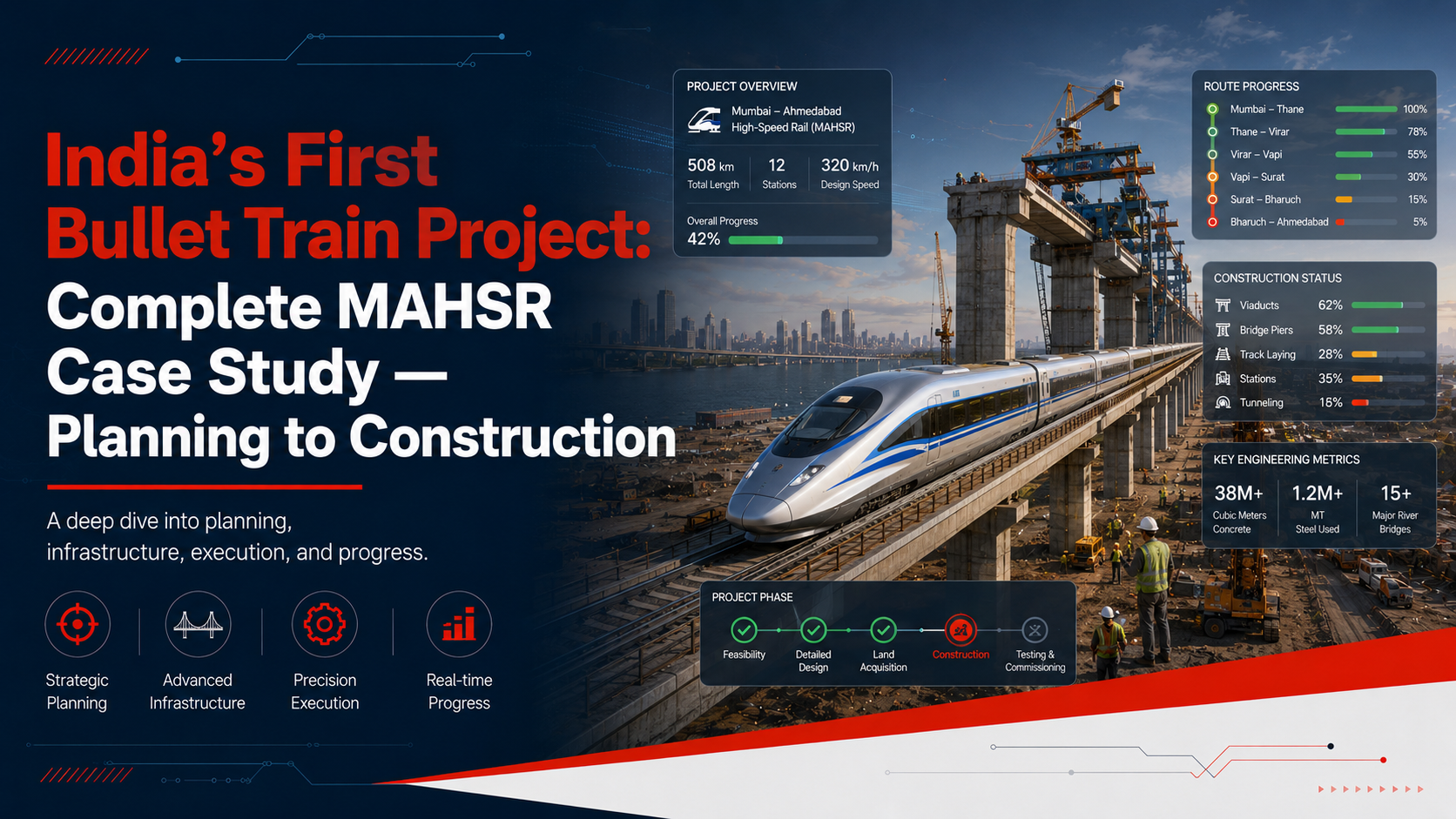
India’s First Bullet Train Project: Complete MAHSR Case Study — Planning to Construction
A structured case study on how MAHSR moved from policy intent to on-ground execution and what infrastructure leaders can apply next.
Reviewed by: Aether Infrastructure Intelligence Team | Last updated: May 14, 2026
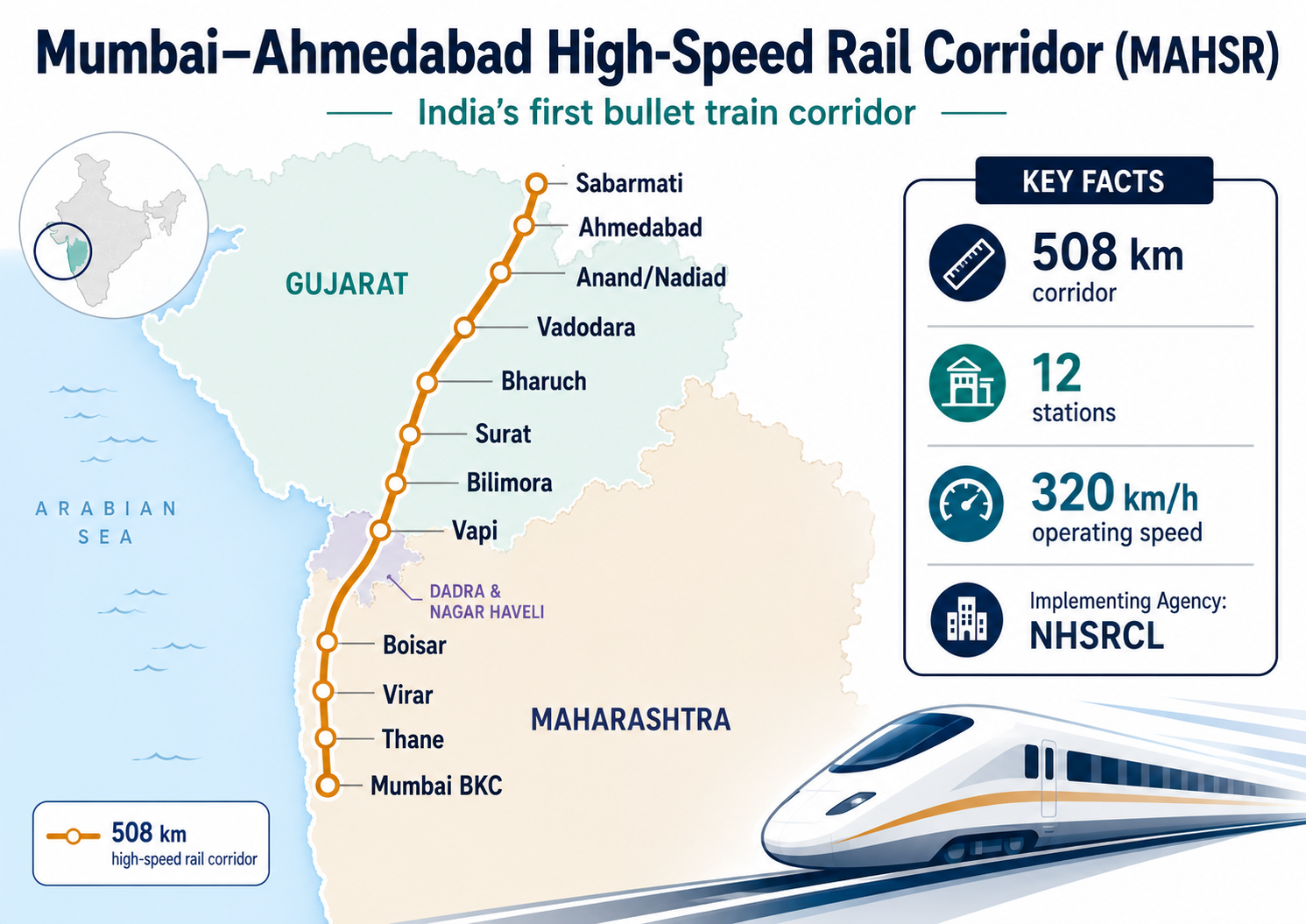
Mumbai–Ahmedabad High-Speed Rail Corridor (MAHSR)
How India planned, financed, and built its first bullet train — from the 2009 Rail Budget to a machine drilling under the Arabian Sea
| Parameter | Details |
|---|---|
| Corridor | Mumbai BKC to Sabarmati / Ahmedabad — 508 km |
| Stations | 12 stations across Maharashtra, Gujarat and Dadra & Nagar Haveli |
| Operating Speed | 320 km/h |
| Implementing Agency | NHSRCL (National High Speed Rail Corporation Limited) |
| Sanctioned Cost | ₹1.08 lakh crore (2017); revised ₹1.25 lakh crore (2024) |
| JICA Loan | ₹1,00,800 crore at 0.1% interest, 50-year tenure, 15-year grace period |
| Full Opening Target | 2028–2029 (first trial run: 15 August 2027) |
Planning · Decision Making · Land Acquisition · EPC Packages · Construction · Systems · Lessons
1. Introduction
Objective and Scope
This case study explains how large infrastructure projects are planned and built — with a focus on big, costly, and technically demanding projects. Using the Mumbai–Ahmedabad Bullet Train (MAHSR) as the main example, it breaks down the steps involved — from feasibility studies and land buying to bidding, site setup, construction, and systems installation.
It is written as a practical guide for anyone who wants to understand how large infrastructure projects actually work — from the first decision to the last bolt. By looking at real decisions made in a high-profile project, it connects classroom knowledge with on-ground reality, giving useful insights into timelines, costs, resources, and managing everyone involved.
Why Understanding Infrastructure Projects Matters
Infrastructure is the base of economic growth, social progress, and a cleaner environment. Big projects like highways, railways, airports, and ports need huge amounts of money, take many years to complete, involve many different parties, use advanced technology, and must follow strict government rules.
India's infrastructure gap is well known. The World Economic Forum has consistently said that poor infrastructure is holding India back. To close this gap, the government launched big plans — including the National Infrastructure Pipeline targeting ₹111 lakh crore investment from 2020–2025, and the plan to build seven high-speed rail corridors across the country.
| WHAT MAKES A PROJECT LARGE-SCALE |
|---|
| Large Investment: Costs usually cross ₹10,000 crore. MAHSR’s ₹1.25 lakh crore makes it one of India’s biggest ever projects. |
| Long Timeline: 7–15 years — planning (1–2 yrs) → approvals and design (2–3 yrs) → land buying (2–5 yrs) → construction (4–8 yrs) → testing and launch (1–2 yrs). |
| Many Parties Involved: Government ministries, state governments, foreign partners, banks, contractors, regulators, and local communities — all with different goals. |
| High Risk: Technical, financial, political, social, and environmental risks build up over a 10+ year project life. |
2. Planning Phase
2.1 Identifying the Need
TRAVEL DEMAND VS. AVAILABLE CAPACITY
In 2013, the Mumbai–Ahmedabad corridor carried about 25 million rail passengers, 40 million road travellers, and 1.7 million air passengers per year. Travel demand studies predicted this would grow from 75 million trips in 2023 to 140 million by 2053, pushed by 6–7% yearly economic growth, more people, and growing cities. Existing trains were already 90%+ full. Roads were getting more overloaded. Airport capacity was limited. A large number of travellers could not afford flights but badly needed something faster than the 7–8 hour train or road journey.
WHY THIS CORRIDOR WAS CHOSEN OVER OTHERS
Six corridors were studied across India. Mumbai–Ahmedabad came out on top because it had the highest number of passengers per km (1,60,000+ per year projected), generated about 15% of India's GDP, had mostly flat land making construction easier, and Japan was ready to give low-interest loans specifically for this route.
Social reason: Planned MAHSR fares of ₹2,500–3,500 for the full trip would bring time-saving travel within reach of middle-income people. Construction would create 50,000+ jobs at peak, plus 4,000+ permanent jobs once running.
Environmental reason: A high-speed train produces only 30–50 g of CO₂ per passenger per km — compared to 150–180 g for a flight and 120–140 g for a car.
2.2 Feasibility Study
India and Japan ran a joint feasibility study from September 2013 to July 2015 — 22 months, with both countries sharing the cost equally (¥500 million total). JICA led the work with Japanese firms. India's Railway Board and RDSO were the Indian partners. The study covered 10 components: passenger demand study, route options comparison, technical design, operations planning, cost estimation, economic analysis, environmental study, social impact study, how the company was set up to run the project, and how contracts would be managed.
PASSENGER DEMAND FORECASTS
| Scenario | GDP Growth | Passengers in 2023 | Passengers in 2053 |
|---|---|---|---|
| Normal Case | 6.0% per year | 40,000 per day | 79,000 per day |
| High Growth | 7.5% per year | 48,000 per day | 1,18,000 per day |
| Low Growth | 4.5% per year | 34,000 per day | 58,000 per day |
ROUTE SCORING — HOW THE HYBRID ROUTE WON
Five route options were scored on six factors: passenger volume (25%), journey time (20%), construction cost (20%), engineering ease (15%), environmental impact (10%), and land needed (10%). The Hybrid Route — coastal from Mumbai to Vapi, then inland via Surat–Vadodara–Ahmedabad — scored 81.0/100, beating Coastal (69.5), Inland (57.0), Three-city network (64.5), and Mumbai–Pune–Ahmedabad route (59.5).
| ECONOMIC VALUE — KEY NUMBERS FROM THE FEASIBILITY STUDY |
|---|
| Return on investment (social): 9.2% (normal case) · 11.8% (high growth) · 7.4% (low growth) — all above the 5–6% social minimum |
| For every ₹1 invested, society gets back: ₹1.85 (normal) · ₹2.42 (high growth) · ₹1.38 (low growth) |
| Net social value at 5% minimum return rate: ₹89,000 crore (normal case) |
| Annual time savings value (2023): ₹18,615 crore — based on 40,000 passengers/day saving 4.5 hours each |
2.3 Risk Assessment
The project team ran a computer-based probability model — testing 10,000+ different scenarios — to estimate how much the project could cost under different conditions:
| Probability Level | Estimated Cost | What It Means |
|---|---|---|
| P50 — Most Likely (50% chance) | ₹1,08,000 crore | There is a 50% chance the final cost stays at or below this |
| P80 — Cautious Estimate (80% chance) | ₹1,28,000 crore | There is an 80% chance of being accurate |
| P95 — Worst Case (95% chance) | ₹1,52,000 crore | Only a 5% chance cost goes above this |
| HOW THE RISKS ACTUALLY PLAYED OUT |
|---|
| Land buying: Gujarat — 2.3% court cases, finished in 36 months. Maharashtra — political change 2019–2022 caused significant delays and cost overruns. |
| Cost increases: Approved ₹1.08 lakh crore (2017), revised to ₹1.25 lakh crore (2024); latest projected final ~₹1,98,000 crore (2026 estimate, pending cabinet approval). |
| Tunnel boring: First undersea breakthrough on time and budget — risk managed through 850+ boreholes of advance ground study. |
| Pandemic: COVID-19 (March–June 2020) caused a 4-month shutdown and significant additional costs. This had been rated 'low risk' — a major lesson. |
2.4 Project Approval and Financing
MAHSR went through four government approval levels. The Cabinet Committee on Economic Affairs (CCEA) — the government body that approves large projects — gave initial approval in December 2015 for the ₹97,636 crore estimate. Full financial approval came in December 2017 along with the first JICA loan payout. NHSRCL (National High Speed Rail Corporation Ltd) was set up on 12 February 2016 as a dedicated government company created only for this project. Ownership: Ministry of Railways 50%, Government of Gujarat 25%, Government of Maharashtra 25%.
JICA LOAN STRUCTURE — WHY IT IS SIGNIFICANT
| Loan Term | Detail |
|---|---|
| Interest Rate | 0.1% per year |
| Repayment Period | 50 years from first payout |
| Grace Period | 15 years — first repayment ~2033 |
| Yearly cost during grace period | ~₹100 crore (interest only) |
| Yearly cost after 2033 | ~₹2,100 crore (principal + interest) |
| Payout 1 — December 2017 | ₹7,605 crore |
| Payout 2 — July 2022 | ₹10,000 crore |
| Payout 3 — August 2022 | ₹41,818 crore |
| Payout 4 — March 2023 | ₹18,750 crore |
| Payout 5 — December 2023 | ₹22,627 crore |
| Total JICA Loan | ₹1,00,800 crore (81% of project cost) |
At a normal 4% interest rate, total interest over 50 years would have been ₹2+ lakh crore more. Through the cheap interest rate alone, India effectively saved more than ₹2 lakh crore.
2.5 Land Acquisition
TOTAL LAND NEEDED
| State | Land (ha) | Villages | Families |
|---|---|---|---|
| Maharashtra | 700.5 | 68 | 1,125 |
| Gujarat | 684.2 | 140 | 1,456 |
| Dadra & Nagar Haveli | 4.8 | 3 | 18 |
| Total | 1,389.5 | 211 | 2,599 |
GUJARAT VS. MAHARASHTRA — THE NUMBERS
| What Was Measured | Gujarat | Maharashtra |
|---|---|---|
| Total time to finish land buying | 36 months | 69 months |
| Average time per plot | 14 months | 39 months |
| How many plots went to court | 2.3% | 11.8% |
| Cases settled without court | 89% | 68% |
| Cost per hectare | ₹2.8 crore | ₹4.7 crore |
| Village meetings before notice | 340 meetings | 180 meetings |
| Extra state payment | +20% on top of central rate | Nothing until 2023 |
| KEY TAKEAWAYS FROM THIS SECTION |
|---|
| 1. Land readiness = construction readiness. Never start bringing equipment to site before land possession is substantially complete. Maharashtra's delay caused idle resources and 24–36 month schedule slippage on multiple packages. Treat land as a top priority task. |
| 2. Engage communities before formal notice, not after. Gujarat held 340 village meetings 6 months before any legal notice. This single decision resulted in 89% cases settled without going to court vs. 68% in Maharashtra. Early engagement is not a formality — it is a way to avoid this problem. |
2.6 Breaking 508 km Into 28 Packages
One of NHSRCL's most important planning decisions was how to divide this massive project into smaller, manageable contracts. Key reasons: if one contractor fails the rest keeps going; multiple contractors can work at the same time saving 3–5 years; expert contractors are matched to their area; more companies can bid bringing prices down; payments can be spread to match JICA loan disbursements.
| Category | Packages | Scope | Key Contractors |
|---|---|---|---|
| Civil Works (C) | 8 | C1: BKC Underground Station, Mumbai. C2: 21 km tunnel including 7 km undersea. C3: Shilphata to Zaroli — 135.45 km, stations: Thane, Virar, Boisar. C4: Zaroli to Vadodara — 237.1 km (longest package), stations: Vapi, Bilimora, Surat, Bharuch. C5: Vadodara Station + 8 km viaduct. C6: Vadodara to Ahmedabad — 87.5 km, station: Anand/Nadiad. C7: Ahmedabad Station + Sabarmati area — 18 km. C8: Sabarmati Hub + Maintenance Depot. | MEIL-HCC JV (C1), Afcons (C2), L&T (C3, C4, C5, C6), IRCON-Dineshchandra JV (C7), SCC-VRS JV (C8) |
| Viaduct Works (V) | 10 | Elevated track sections, 40–60 km portions. Full Span Launching Method. | Multiple contractors |
| Track Works (T) | 3 | J-Slab ballastless track. T1: 156 km, T2: 237 km, T3: 114 km. | L&T (T1, T3), IRCON (T2) |
| Electrification (E) | 1 | 2×25 kV overhead power system, 14 substations. ₹12,000 crore. | To be awarded |
| Signaling & Telecom (S) | 1 | ETCS Level 2 + GSM-R (train control and communication systems). ₹4,100 crore. Awarded May 2024. | Siemens + DRA Infracon |
| Rolling Stock (R) | 1 | Trainset procurement is a critical dependency. Final official details on model, delivery schedule and contract value are not yet publicly confirmed by NHSRCL. | Procurement ongoing |
| Depot Works (D) | 3 | Sabarmati (83 ha), Thane (55 ha), Surat (38 ha). | Multiple |
| Consultancy (M) | 3 | Design, supervision, testing support. | Indian & Japanese firms |
2.7 Environmental and Social Impact Assessment
MAHSR was classified as a top-level environmental project. The full Environmental Impact Assessment (EIA) process took 15 months (March 2016–August 2017): classification → scoping → field surveys (48 air quality stations, 72 water sampling points, 120 soil sampling points, 284 plant species and 187 animal species surveyed) → impact analysis → 24 public hearings attended by 12,847 people → expert committee review → clearance August 2017.
45 clearance conditions were set. As of 2024: 42 of 45 fully met. Forest Clearance for 85.2 hectares granted in 2017. ₹6.8 crore paid to national afforestation fund. Coastal Zone clearance (special permission needed for construction near the sea) for the 7 km undersea tunnel granted November 2017. Height clearances from Airport Authority, No-Objection Certificates (NOCs) from the Defence Ministry at 5 locations, and wildlife clearance for Sanjay Gandhi National Park — all obtained by 2017.
KEY TAKEAWAY
Feasibility study investment is non-negotiable. 850+ boreholes and a 22-month study prevented tunnel alignment surprises worth hundreds of crores in rework. Projects that cut feasibility short always pay more later.
3. Execution Phase
3.1 Bidding Process
QUALITY + COST BASED SELECTION (QCBS)
NHSRCL used fixed-price contracts where the contractor both designs and builds. For choosing contractors, it used Quality and Cost-Based Selection (QCBS) instead of the L1 method (simply picking the cheapest bidder). Technical proposals (80 points) and price proposals (40 points) were submitted in separate sealed envelopes. Financial envelopes opened only for bidders scoring 60+ technical points.
| What Was Judged | Points | What Evaluators Looked For |
|---|---|---|
| Understanding of the project | 20 | Does the bidder understand the specific problems and goals of MAHSR? |
| Construction method and schedule | 20 | Is the plan realistic? Is the schedule achievable? Is the work breakdown logical? |
| Staff and equipment plan | 10 | Are the right people committed? Is enough equipment available? |
| Past work quality | 10 | Verified by calling 100% of listed reference clients |
| Safety and quality plan | 10 | Is there a real safety system? Are quality checks planned at every stage? |
| Innovation and sustainability | 5 | New ideas, less waste, lower carbon footprint |
| Railway safety rule compliance | 5 | Plans for working safely near running trains (GSR 36) |
| Total — Pass mark: 60 points | 80 |
WHO IS BUILDING THIS PROJECT
| Package | Scope | Contractor | Value | Contract Date |
|---|---|---|---|---|
| C1 | BKC Underground Station, Mumbai | MEIL-HCC JV | ₹3,681 crore | March 2020 |
| C2 | 21 km Tunnel incl. 7 km undersea — BKC to Shilphata | Afcons Infrastructure | ~₹10,081 crore | May 2020 |
| C3 | Shilphata to Zaroli — 135.45 km — Stations: Thane, Virar, Boisar | Larsen & Toubro | ₹15,697 crore | September 2020 |
| C4 | Zaroli to Vadodara — 237.1 km (longest) — Stations: Vapi, Bilimora, Surat, Bharuch + Surat Depot | Larsen & Toubro | INR 21,239.96 Cr + JPY 878,236,238 + USD 495,520,952 | 28 Oct 2020 (LOA) 26 Nov 2020 (Agreement) |
| C5 | Vadodara Station + 8 km Viaduct | Larsen & Toubro | Not publicly available from official NHSRCL pages checked | Not publicly available from official NHSRCL pages checked |
| C6 | Vadodara to Ahmedabad — 87.5 km — Station: Anand/Nadiad + Anand Depot | Larsen & Toubro | INR 6,149.20 Cr + JPY 495,219,655 + USD 150,852,271 | 18 November 2020 |
| C7 | Ahmedabad Station + Sabarmati area — 18 km — Stations: Ahmedabad & Sabarmati | IRCON-Dineshchandra JV | Not publicly available from official NHSRCL pages checked | 1 Dec 2021 |
| C8 | Sabarmati Hub + Maintenance Depot — 2.127 km | SCC Infrastructure-VRS JV | — | — |
| T1 & T3 | Track Work | Larsen & Toubro | ₹4,571 + ₹3,328 crore | — |
| T2 | Track Work — 237 km | IRCON International | ~₹6,842 crore | November 2022 |
| S1 | Signaling & Telecom — ETCS Level 2 + GSM-R | Siemens Mobility + DRA Infracon | ₹4,100 crore | May 2024 |
| Status | All 11 civil packages awarded · Land acquisition 100% complete | — | — | 2025-26 |
3.2 Mobilization and Site Setup
Mobilization is the period between signing the contract and starting construction. For MAHSR with 28 contracts running at the same time, a typical mobilization takes 90–120 days: planning before NTP (Notice to Proceed — official signal to start work) → site handover and surveys → building offices, plants, workshops → bringing in equipment → deploying people → trial runs (test piles, test concrete mixes) → full readiness.
A major viaduct package needed a full site complex: prefabricated two-storey 800 sq m office with 12-computer design office, 500 kVA power supply (enough to power the entire site) with 5-second diesel backup, 50,000-litre water storage, and a worker camp for 1,000 people (1 toilet per 15 workers, nurse 24/7).
Three dedicated track slab casting yards at Anand (Gujarat), Vapi (Gujarat), and Thane (Maharashtra). The Anand yard — 100,000 sq m — had 10 prestressing beds (where track slabs are made under tension to make them stronger), steam-curing chambers, and capacity of 120 slabs per day. By October 2025: 76,450 slabs produced at Anand alone.
TBMs took 18–24 months to manufacture. Two custom-built TBMs (Hitachi Zosen-Kawasaki, 7.2m cutting diameter) were made in Japan, shipped to Mumbai Port, brought to BKC on 100+ axle trailers with police escort, and assembled in 15m × 15m × 20m deep launch pits. Total time from order to first tunnel ring: 8–10 months.
3.3 Construction Phase
FOUNDATION: BORED PILES
Every viaduct pier sits on 4–8 bored piles drilled 20–35 metres into the ground. Across the 508 km corridor, 35,000+ piles were needed. Process: drill hole using bentonite clay slurry (a thick fluid that stops the hole from collapsing) → camera inspection → lower steel cage → pump concrete from bottom upward (tremie method) → 100% of piles tested within 48 hours using vibration sensors. Rate: 1–2 piles per drilling rig per day.
VIADUCT CONSTRUCTION: FULL SPAN LAUNCHING METHOD (FSLM)
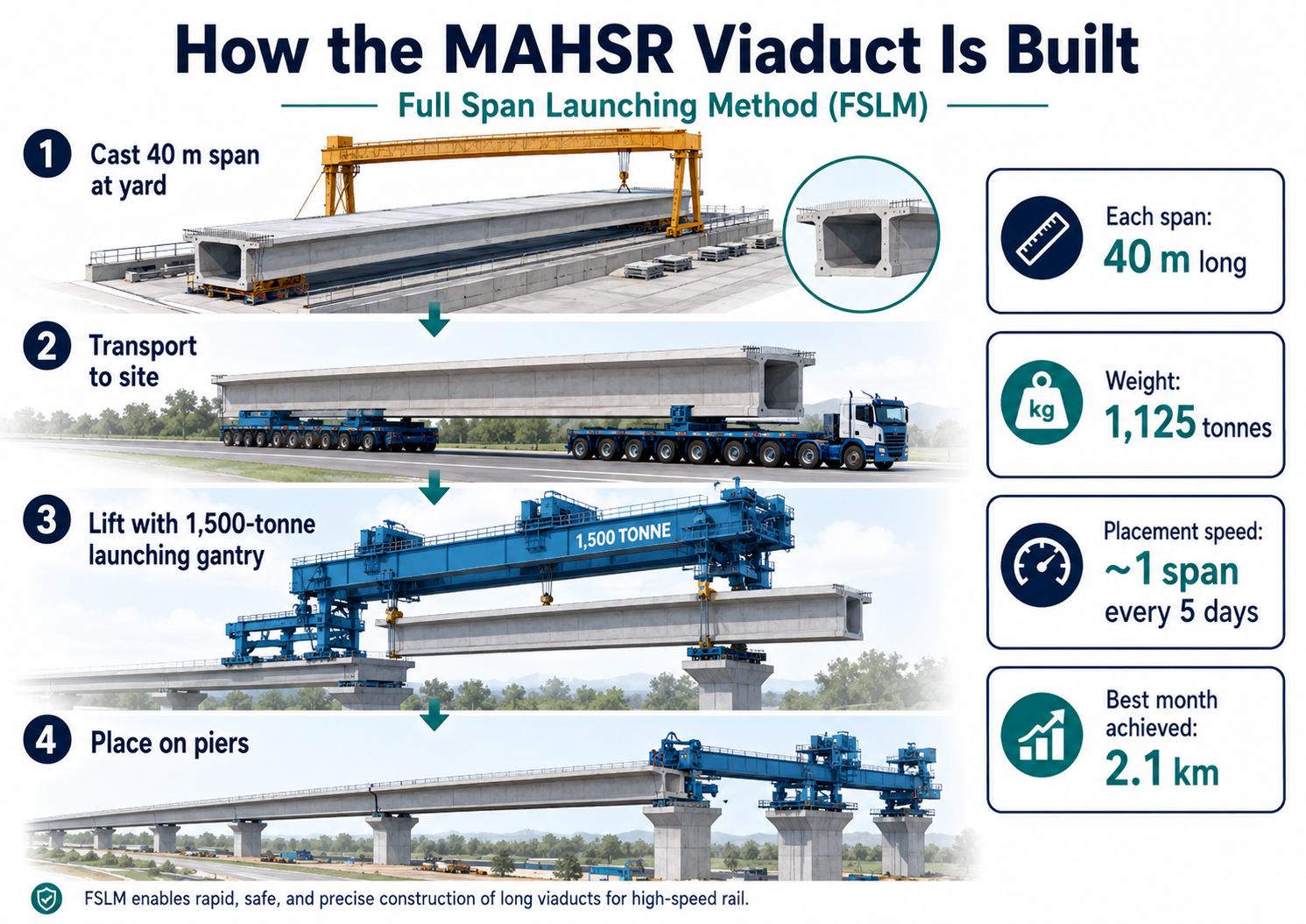
Pre-made concrete box beams (40 metres long, 12.6 metres wide, 3.2 metres deep, weighing 1,125 tonnes each) are made at casting yards, driven to site on special multi-axle vehicles, lifted by a 1,500-tonne overhead gantry crane, and placed on the next pair of pillars. One span placed every 5 days. With two gantry cranes working at once, L&T's team achieved 2.1 km of viaduct in their best month — 75% better than the contract target.
TUNNEL BORING
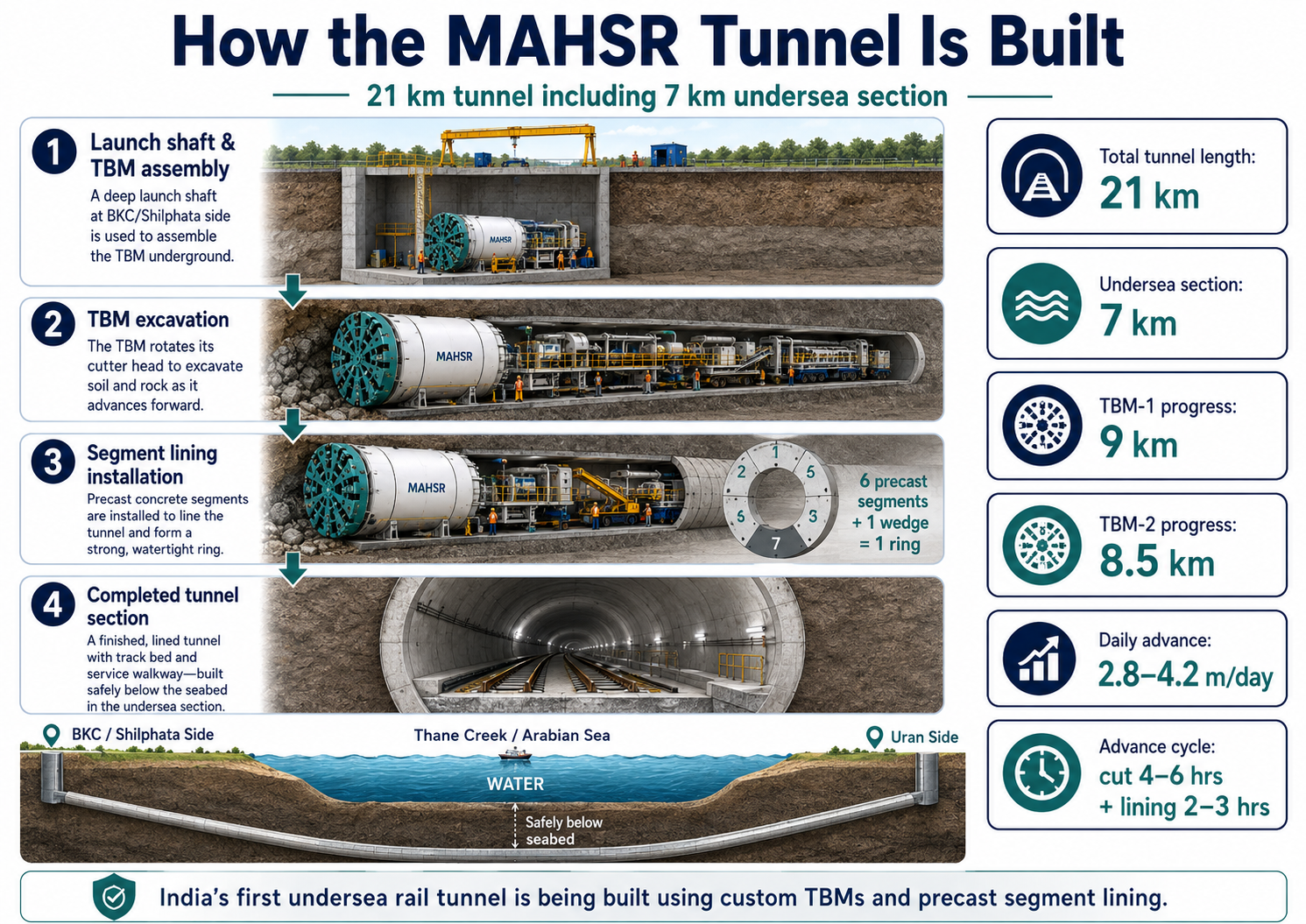
The 21 km tunnel includes 7 km under the sea through Thane Creek — India's first undersea rail tunnel. TBM advance cycle per 1.4 metres: cutting head rotates at 2–3 turns per minute for 4–6 hours → machine stops, 6 precast segments + 1 wedge installed (2–3 hours) → hydraulic cylinders pull back (30 minutes). Daily progress: 2.8–4.2 metres.
CONSTRUCTION PROGRESS — MAY 2026
| What | Status — May 2026 |
|---|---|
| Viaduct | ~345 of 465 km done (~74%) |
| BKC Station (C1) | 60–65% complete — excavation and piling finished, station structure under construction |
| Bored Tunnel (C2) | 45–50% complete — TBM-1 crossed 9 km, TBM-2 crossed 8.5 km; main undersea breakthrough targeted late 2026 |
| Track Slabs Made | 1,75,000+ of 2,11,000 needed |
| Track Laid | ~160 km mainline rails — primarily in Surat–Bilimora–Vapi section |
| C3 Package | ~40% complete — pier work active in Palghar; Vaitarna bridge work in progress |
| C4 Package | ~85% complete — major viaducts finished; Vapi and Surat stations structurally complete |
| C6 Package | ~80% complete — Anand/Nadiad station structure ready; track laying active |
| Land Acquisition | 100% complete across all states ✓ |
3.4 Workforce and Vendor Management
A 40 km viaduct package needed 200 people during setup, growing to 1,200 at peak. L&T kept 300 more workers than industry average — backed by performance bonuses for hitting targets without safety incidents. Every single worker completes an 8-hour training programme before entering site, covering PPE (Personal Protective Equipment — helmet, gloves, safety shoes), hazard identification, emergency steps, rules of conduct, and worker rights. Written test — must score 70% to pass.
Material for a 40 km viaduct: 300,000 cubic metres concrete, 120,000 tonnes cement, 450,000 tonnes stone, 36,000 tonnes steel bars, 2,500 tonnes prestressing strand (high-strength steel wire used to strengthen concrete). Strategy: long-term supply contracts with 2–3 cement suppliers, 3 stone quarries within 30 km, 3-month steel buffer stock. L&T's C3 package: 18 million working hours, zero deaths. Lost Time Injury rate (number of serious injuries per million working hours) 1.8 vs. industry average of 5.
3.5 Advanced Systems and Technology
TRACK: J-SLAB BALLASTLESS TRACK
Normal railway track uses crushed stone (ballast). This works up to 250 km/h — but above that, the stones get thrown by air pressure, geometry shifts quickly, and maintenance costs explode. MAHSR uses the Japanese J-Slab system. Each slab: 2,400 × 2,000 × 200 mm, 2,450 kg, M60 concrete, with 16 steel tendons (high-tension wires inside the slab). Geometry tolerance: gauge 1,435 mm ±1 mm; left-right ±2 mm; up-down ±1 mm. Total: 2,11,000 slabs across the corridor.
POWER SUPPLY: 2×25 KV AUTOTRANSFORMER SYSTEM
Power is sent at 50 kV (kilovolt — a unit of electrical power) between the feeder wire and the rail; small transformers every 10 km step it down to 25 kV for the train. This cuts power losses by 75% and allows substations to be spaced 50–60 km apart. 14 substations power the full corridor. If one substation fails, nearby ones take over in under 0.5 seconds. Regenerative braking (when trains slow down, they generate electricity back into the system) saves about 150 million kWh and ₹1,050 crore in energy costs every year.
SIGNALING: ETCS LEVEL 2
There are NO signal posts along the track. 1,420 Eurobalises (small electronic devices fixed between the rails) — one every 500m — tell each passing train exactly where it is. The Radio Block Centre (central computer that controls all train movements) at Sabarmati calculates how far each train can safely go and sends this via mobile network every 2–5 seconds. If the driver exceeds the permitted speed, the system brakes the train automatically within 50 milliseconds. Five systems were compared — ETCS Level 2 (₹4,100 crore) was chosen over Japan's DS-ATC which would have cost ₹8,500 crore (107% more).
GSM-R MOBILE NETWORK AND OPERATIONS CONTROL CENTRE
420 dedicated railway mobile base stations at 1.2 km average spacing. Coverage: 99.8% of the corridor. Main control room at Sabarmati — 4-storey, 8,000 sq m building, 12 operator desks, video wall of 32 × 55-inch screens showing the full corridor in real time. Backup control room at BKC takes over automatically within 30 seconds if main fails.
ROLLING STOCK — THE UNRESOLVED PROBLEM
Rolling stock procurement remains a critical dependency for the project. As of 2025, only 2 gifted test trains from Japan have been received. India has requested the newer E10 Shinkansen model instead of the originally planned E5, which has led to extended negotiations. The Make in India requirement for 75% local content has added further complexity as Indian manufacturing capacity is still being developed. Official NHSRCL sources have not yet confirmed final details on model selection, delivery schedule, and contract value. Without sufficient train sets, passenger service cannot begin even if all infrastructure is ready.
3.6 Quality Control and Monitoring
NHSRCL's quality system follows ISO 9001 (international quality management standard). Inspection and Test Plans (ITPs) define Hold Points — work cannot go ahead without NHSRCL signing off — and Witness Points. For pile construction alone, six hold points exist. NHSRCL tests 100% of all piles. Industry typically tests only 10%. Finding a problem at pile stage costs ₹5 lakh to fix. Finding the same problem after the structure is built costs ₹50 lakh.
Defect Reports: Critical (safety risk — must be torn down and rebuilt), Major (affects how long it will last — must be repaired), Minor (cosmetic). On L&T's C3 package over 48 months: 800 defect reports total — 12 Critical (1.5%), 240 Major (30%), 548 Minor (68.5%). Defect rate was 0.8% — half the industry average of 1.5–2%. Saved ₹35–55 crore in cost of fixing mistakes on just one package.
BIM (Building Information Modelling — a 3D computer model of the entire structure) was required for all packages above ₹2,000 crore. 3D models reduced rework by 40% on L&T's C3 package. The BKC station had 120 sensors built into the structure measuring ground movement, water levels, and structural stress in real time.
| KEY TAKEAWAYS FROM THIS SECTION |
|---|
| 1.Quality +cost based selection gives better results than always picking the cheapest.L&T's C3 package was not the cheapest bid but had the best technical plan. It delivered 3 months early, had zero fatalities in 18 million hours, and saved ₹35–55 crore in cost of fixing mistakes. Always picking the cheapest bidder on a bullet train level quality project would have been a costly mistake. |
| 2. TBMs and rolling stock must be ordered years in advance. TBMs take 18–24 months to manufacture. Trains take 5–7 years. These cannot be bought like regular materials — they must be ordered during the detailed planning stage, not after construction contracts are signed. This is MAHSR's biggest ordering lesson. |
| 3. 100% pile testing costs less than 10% testing + rework. The industry does 10% pile testing. NHSRCL did 100%. Finding a problem at the pile stage costs ₹5 lakh. Finding the same problem after the structure is built costs ₹50 lakh. Early quality investment always pays back 5–10x. |
Build this level of execution control with Aether
Aether helps EPC and infrastructure teams with live fleet tracking, fuel monitoring, and site-level operations visibility to reduce delays, leakages, and rework.
4. Case Study: Three Specific Lessons
4.1 Land Buying — Gujarat’s Success vs. Maharashtra’s Struggle
Gujarat took 36 months to buy 684 hectares. Maharashtra took 69 months to buy 700 hectares — almost double the time, for almost the same amount of land. The gap is almost entirely explained by how the two governments approached the people whose land was needed.
| What Was Measured | Gujarat | Maharashtra |
|---|---|---|
| Total months taken | 36 months | 69 months |
| Average time per plot | 14 months | 39 months |
| Court case rate | 2.3% | 11.8% |
| Cases settled without going to court | 89% | 68% |
| Cost per hectare | ₹2.8 crore | ₹4.7 crore |
| Village meetings before notice | 340 | 180 |
| Extra state payment | +20% over central rate | Nothing until 2023 |
Gujarat’s five winning steps: (1) CM reviewed progress every month; (2) 340 village meetings 6 months before any official government notice; (3) state paid 20% extra + 30% payment within 15 days; (4) mobile app for landowners; (5) monthly dispute resolution meetings resolved 89% of disputes without courts.
Maharashtra’s five problems: (1) MVA government — a coalition government formed by multiple parties together (Nov 2019) — put process on hold — 24–36 months lost; (2) 12% court case rate; (3) complicated land ownership in Mumbai and Thane with high property prices; (4) tribal areas of Palghar needed approvals under the Forest Rights Act (a law protecting tribal land rights); (5) A major court case (Godrej & Boyce) involving land in Mumbai took 4 years, ending with 54% higher payment.
4.2 Construction Speed — L&T’s C3 Viaduct Package
The Shilphata-Zaroli 135.45 km viaduct (Contract C3, ₹15,697 crore, L&T) is the project's best example of what good execution looks like.
| Metric | Target | Achieved |
|---|---|---|
| Average monthly progress | 833 m/month | 889 m/month |
| Peak monthly production | 1.2 km | 2.1 km (+75%) |
| Project completion | On time | 3 months early |
| Safety | Less than 5 Lost Time Injuries per million working hours | 1.8 Lost Time Injuries per million working hours — Zero deaths |
| Defect rate | Less than 1.5% industry average | 0.8% |
| Cost of fixing mistakes | ₹80–100 crore | ₹45 crore (₹35–55 crore saved) |
| Project Comparison | Progress (metres/month) | |
| MAHSR C3 — L&T | 889 m/month | |
| MAHSR overall average | 650 m/month | |
| Delhi Metro Phase 3 (viaduct) | 550 m/month | |
| Beijing-Shanghai HSR (China) | 920 m/month | |
| California HSR (USA) | 450 m/month |
4.3 Train Procurement — What Went Wrong and Why
| Parameter | Original Plan (2017) | Actual (2025) |
|---|---|---|
| Train model | E5 Shinkansen | E10 Shinkansen (under negotiation) |
| Number of train sets | 24 | 2 (gifted test trains only) |
| Cost per train set | ₹458 crore | ₹625 crore (+36%) |
| Total procurement cost | ₹11,000 crore | ₹15,000 crore (+₹4,000 crore) |
| First delivery planned | 2022 | 2027–2028 (estimated) |
Three causes of delay: India asked for E10 (newer model) instead of E5, starting 3 more years of negotiations; Make in India rule required 75% of the train to be built inside India but no Indian factory can build these trains yet; cost increase from ₹458 crore to ₹625 crore per train set. Note: These figures are based on publicly reported information and should not be read as final official NHSRCL procurement data.
| KEY TAKEAWAYS FROM THIS SECTION |
|---|
| 1. Political risk is a real project risk — plan for it. Maharashtra's 2.5-year land freeze was caused by a change of ruling party. This is not unusual in Indian infrastructure. Future projects must build political risk into the project schedule and maintain cross-party relationships with all parties involved from day one. |
| 2. Parallel execution saves years but creates interface risk. 10+ viaduct packages running at the same time saved 3–5 years of schedule. But the train's power collector briefly lost contact with the overhead wire during trial runs — caused by small errors from two different teams that added up. Always create formal Interface Control Documents (formal agreements between teams about how their work connects) with clear ownership and testing protocols at every package handover point. |
| 3. Long-lead procurement must start at Detailed Project Report (DPR) stage — the detailed planning stage before construction begins, not after construction begins. MAHSR ordered TBMs in time — they arrived when needed. It did not order trains in time — the tracks will be ready before the trains are. For any project involving TBMs, tunnel boring equipment, specialized systems, or rolling stock: identify and order these items during the detailed planning stage. No exceptions. |
5. Conclusion — What We Learned
Where the Project Stands — May 2026
| Workstream | Progress |
|---|---|
| Total Viaduct | ~74% (~345 of 465 km) |
| BKC Underground Station (C1) | 60–65% complete — excavation and piling finished, station structure under construction |
| Bored Tunnel (C2) | 45–50% complete — TBM-1 crossed 9 km, TBM-2 crossed 8.5 km; main undersea breakthrough targeted late 2026 |
| C3 Package (Shilphata–Zaroli) | ~40% complete — pier work active in Palghar; Vaitarna bridge work in progress |
| C4 Package (Zaroli–Vadodara) | ~85% complete — major viaducts finished; Vapi and Surat stations structurally complete |
| C6 Package (Vadodara–Ahmedabad) | ~80% complete — Anand/Nadiad station structure ready; track laying active |
| Track Slabs Made | 1,75,000+ of 2,11,000 needed |
| Track Laid | ~160 km mainline rails — primarily in Surat–Bilimora–Vapi section |
| Land Acquisition | 100% complete across all states ✓ |
| Milestone | Original Target | Revised Estimate |
|---|---|---|
| Trial runs, Surat–Bilimora | August 2023 | 15 August 2027 |
| Passenger service, Surat–Bilimora | 2023 | 2027 |
| Full Gujarat section open | 2023 | 2027–2028 |
| Full corridor open | August 2023 | 2028–2029 |
| Operating costs covered by ticket revenue | 2028 | 2031–2033 |
Financial Snapshot
| Amount | Status | |
|---|---|---|
| Budget when approved (2017) | ₹1,08,000 crore | ✅ Official — Cabinet sanction |
| Revised official estimate (2024) | ₹1,25,000 crore | ✅ Railway Minister statement |
| Reported possible final cost (2026) | ~₹1,98,000 crore | ⚠️ Media reports citing officials — pending cabinet approval |
| Total increase from original approval | ~83% above original sanction | Based on latest 2026 estimate |
| WHERE THE EXTRA MONEY WENT |
|---|
| Maharashtra land acquisition was delayed by over 2 years — contributed significantly to cost overrun (no official figure published) |
| COVID-19 shutdown (4 months, 2020) — caused significant remobilization costs (no official figure published) |
| Train sets — cost jumped from ₹11,000 crore to ₹15,000 crore (+₹4,000 crore) ✅ |
| LOAN & ECONOMIC VALUE |
|---|
| Until 2033 (grace period): ~₹100 crore per year (interest only) ✅ JICA official |
| After 2033: ~₹2,100 crore per year (principal + interest) ✅ JICA official |
| When ticket revenue covers operating costs: 2031–2033 — based on JICA feasibility study and 40,000+ passengers per day |
| Annual economic value once running: ₹18,000+ crore per year — from time savings, fuel reduction, fewer road accidents (JICA feasibility study) |
7 Lessons for Future Infrastructure Projects
-
PLANNING · 01 Spend properly on feasibility studies
They save much more later. MAHSR's 22-month feasibility study (850+ boreholes, 5 route options, 3-scenario demand models) stopped expensive surprises. Projects that cut corners on feasibility always end up spending more on design changes, rework, and legal problems than the study would have cost.
-
STAKEHOLDER MANAGEMENT · 02 Talk to people before giving official notices
Not after they resist. Gujarat held 340 village meetings 6 months before any notice — getting 89% cases settled without courts and 14-month average per plot. Maharashtra's approach of engaging only after resistance appeared led to 68% settlement rate and 39 months per plot.
-
PROCUREMENT · 03 Pick by quality + price, not only the cheapest bid
L&T's C3 package was not the cheapest bid. It delivered 3 months early, had zero deaths in 18 million working hours, and saved ₹35–55 crore in cost of fixing mistakes. Always picking the cheapest bidder on a bullet train level quality project would have been a costly mistake.
-
PROCUREMENT · 04 Order long-lead items years before you need them
Trains take 5–7 years to order, design, build, test, and deliver. TBMs take 18–24 months. Both must be ordered during the detailed planning stage before construction begins. MAHSR ordered TBMs in time. It did not order trains in time — the tracks will be ready before the trains are.
-
GOVERNANCE · 05 Protect large projects from government changes
Maharashtra's 2.5-year land buying freeze — caused by a change of ruling party — cost the project significantly in time and money. Future projects must have legal frameworks that allow governments to oversee the project but not stop it completely when the political situation changes.
-
QUALITY · 06 Catch problems early
It is much cheaper than fixing them late. L&T's policy of testing 100% of piles (industry does 10%) found problems at ₹5 lakh per fix versus ₹50 lakh after the structure is built. Their 0.8% defect rate vs. 1.5–2% industry saved ₹35–55 crore on one package. Money spent on early testing always comes back 5–10x.
-
EXECUTION · 07 Run in parallel with clear handover rules
Running 10+ viaduct contracts at the same time saves 3–5 years. But this creates 500+ handover points. MAHSR used Interface Control Documents (formal agreements between teams about how their work connects) to define ownership and testing protocols at every point. The pantograph issue during trial runs came from a handover that was not tight enough — earlier interface testing would have caught it.
Turn MAHSR-style lessons into measurable field outcomes
From asset and vehicle telemetry to fuel-loss control and command-center dashboards, Aether delivers the hardware, software, and rollout support needed for large-scale execution.
More Fuel Accountability Stories