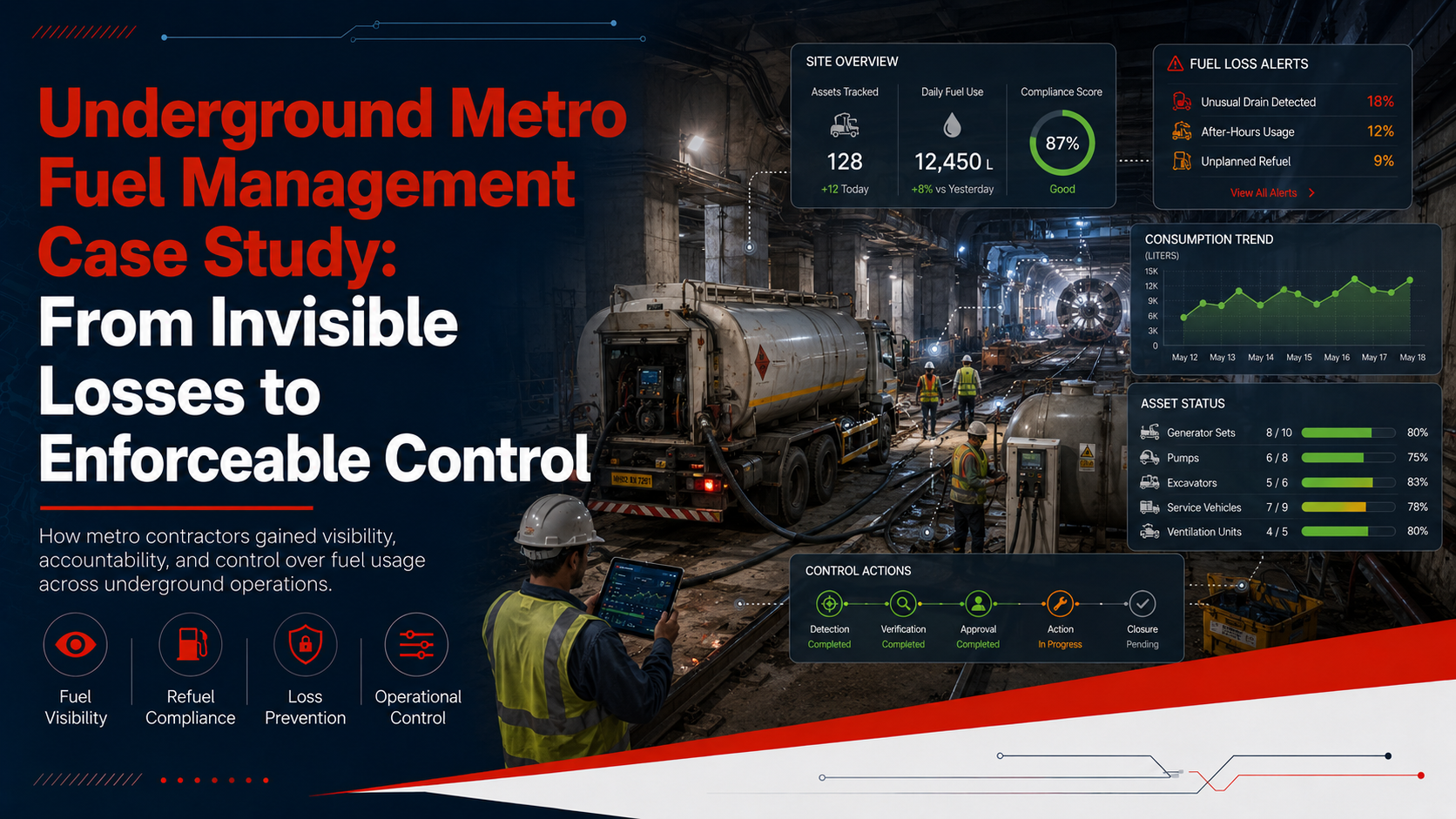
How Aether Delivered Fleet & Fuel Management for India’s High-Speed Rail Construction Project
A deployment-focused case study on how Aether helped MAHSR site teams verify fuel loss, correct running-hour records, and turn disputed fuel data into action-ready evidence.
Reviewed by: Aether IoT Operations & Fuel Analytics Team | Last updated: May 22, 2026
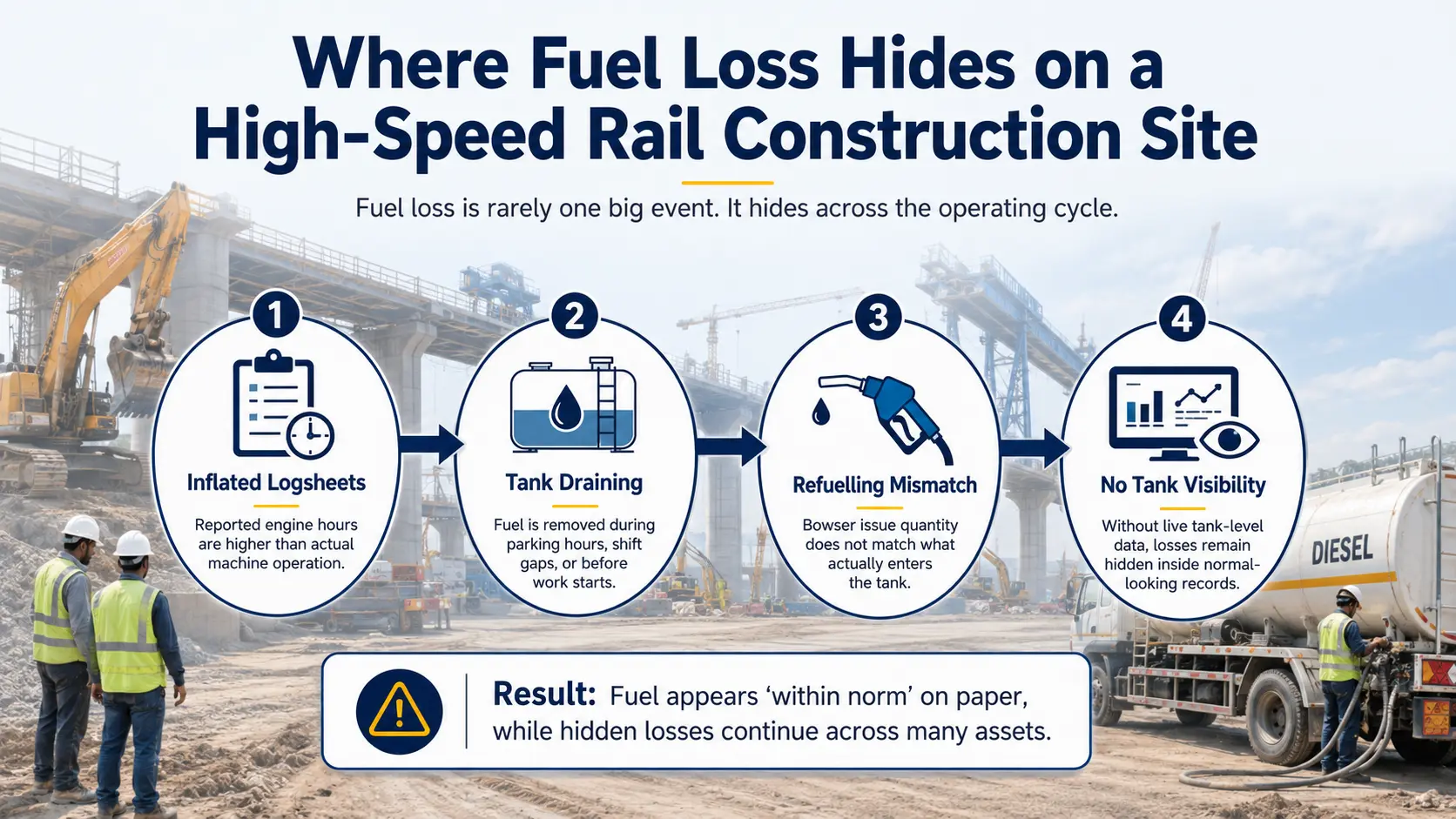
On a high-speed rail construction site, fuel is not lost in one big incident. It is lost inside manipulated logsheets, refuelling gaps, disputed running hours, and tank-level theft that looks like normal consumption until the data is verified.
The teams operating across India's first high-speed rail construction project (MAHSR) knew fuel was leaking out of their records. Fuel was being issued regularly, manual logsheets showed consumption as per site entries, and the numbers balanced on paper. The unanswered question was whether the fuel was actually being consumed by work.
Business Challenge
Every part of the fuel cycle had a record. Operators submitted daily logsheets with engine hours and fuel consumed. The store team maintained refuelling registers. P&M reviewed reports every cycle. On paper, everything added up.
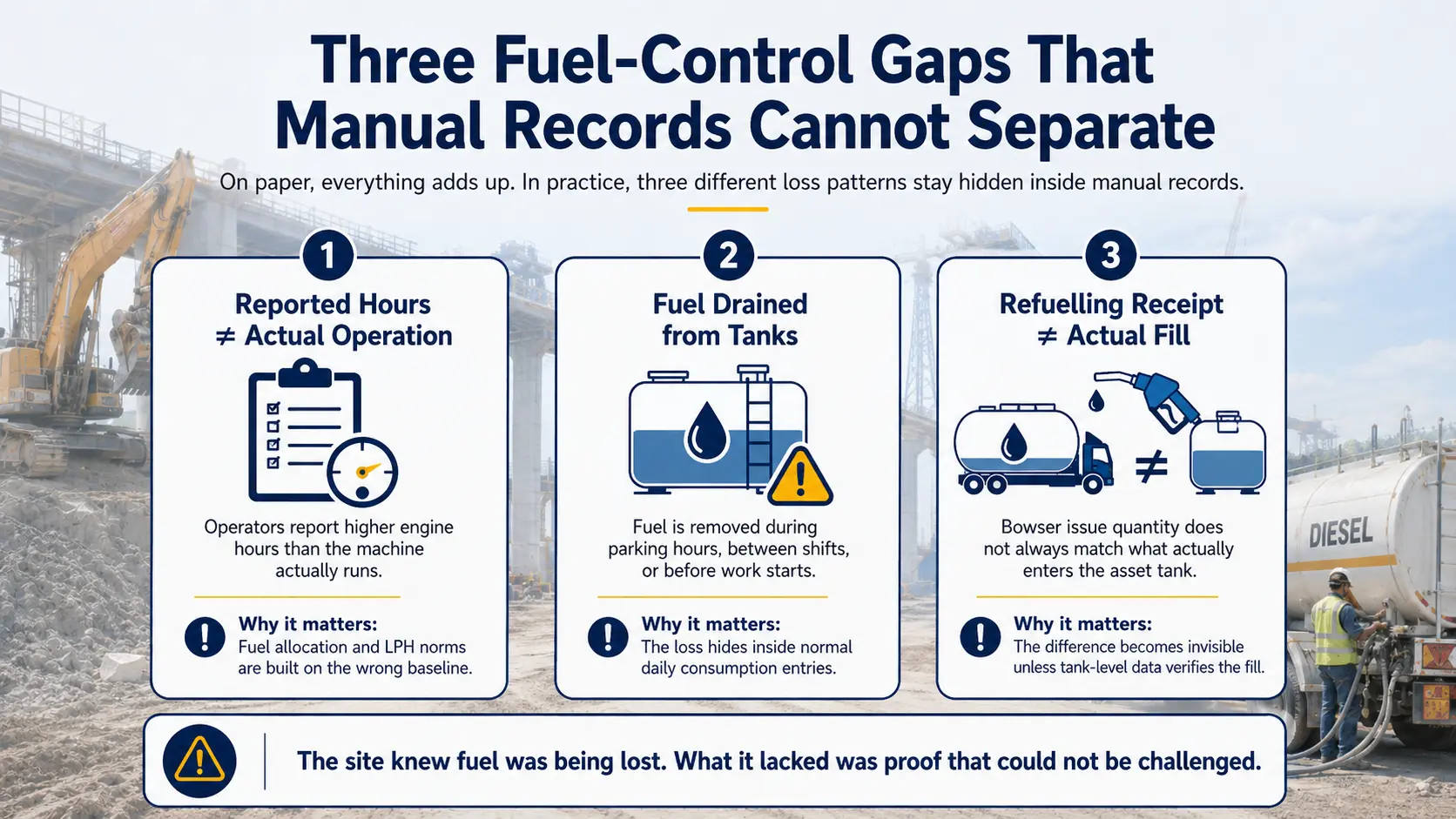
In practice, three fuel-loss problems were running in parallel inside the records: reported hours did not match actual operation, fuel was drained from equipment tanks, and refuelling receipts did not always match the actual fill in the tank.
Reported Hours vs Actual Engine Operation
Operating hours on the logsheet were the basis for fuel allocation, productivity tracking, and LPH norms. On heavy equipment across the site, reported hours were consistently higher than what the machine had actually run.
That single gap affected everything that followed. Higher reported hours meant more fuel was issued. When LPH was calculated against inflated hours, consumption appeared within norm even when fuel was being lost or consumed above the true operating baseline.
Once engine hours came from the IoT device installed on the asset, the site had a parallel record from the machine itself. Manual HMR, KMR, and fuel entries could finally be reconciled against actual operation.
Fuel Draining and Refuelling Mismatch
Fuel was being drained from equipment tanks during parking hours, between shifts, or before the shift started. On a logsheet, this kind of loss hides inside consumption because the operator's daily entry covers the gap.
Refuelling mismatch created another invisible loss. The bowser or store record could show a higher quantity than what actually entered the tank. Without tank-level data, the receipt is signed, the register reconciles, and the diverted fuel appears later as extra consumption.
| Fuel-loss method | What made it visible |
|---|---|
| Inflated running hours | Engine hours captured directly from the IoT gateway. |
| Tank draining | Fuel graph drops verified against ignition and location context. |
| Refuelling mismatch | Actual tank increase compared with quantity issued or recorded. |
| Device-off loss | Offline windows checked against last fuel level, ERP fuel records, and expected consumption. |
| Abnormal consumption | LPH analysis against corrected operating norms. |
Aether Fleet & Fuel Management Solution
Aether's Fleet & Fuel Management System was deployed across the project as an evidence layer for a fuel cycle that had been running on paperwork. The deployment covered major on-site equipment categories, including cranes, transit mixers, earthmoving machines, DG sets, and supporting vehicle fleets.
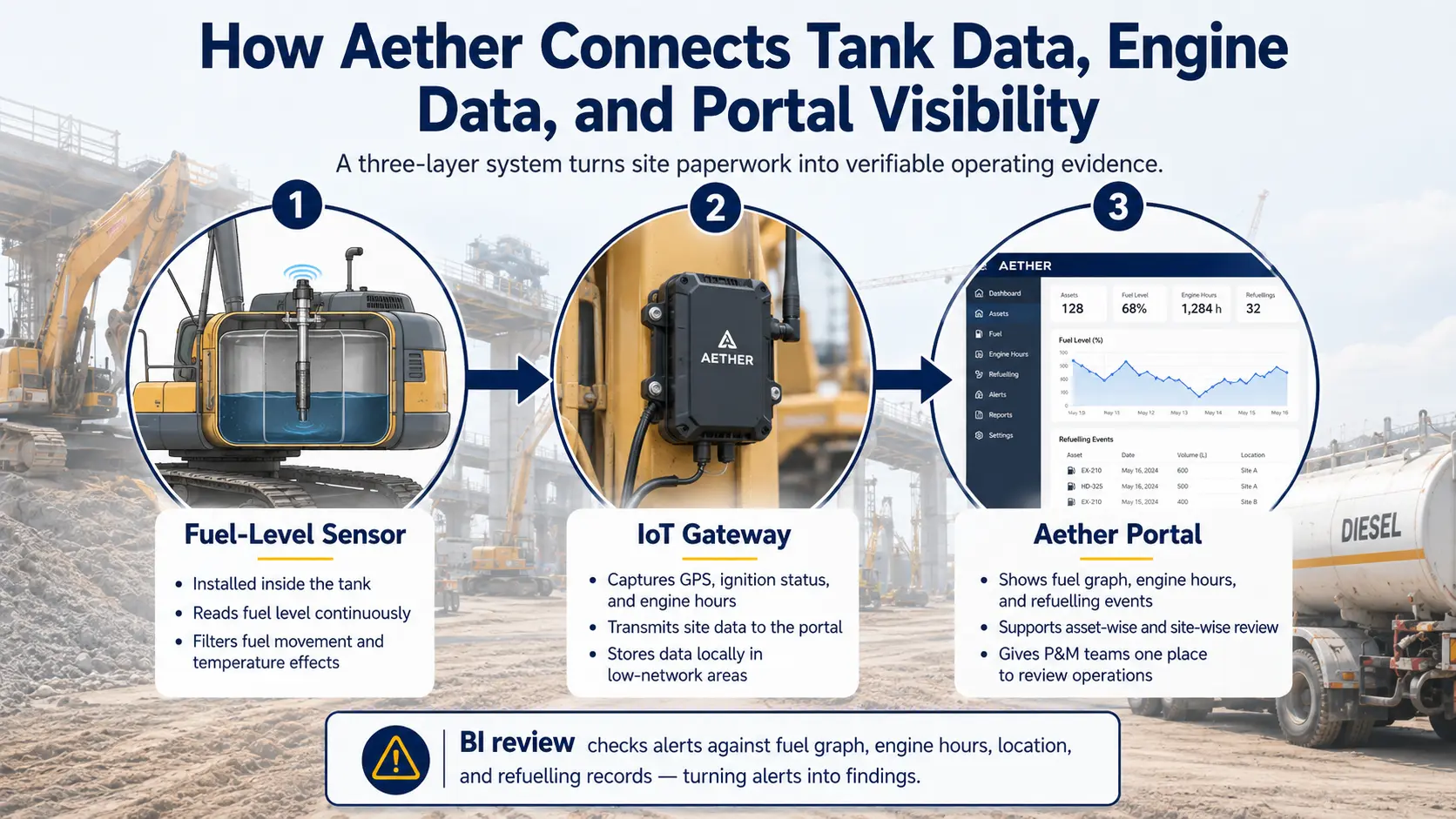
Fuel-level sensor
Omnicomm LLS 4 capacitive fuel sensors installed inside each tank and calibrated against measured fuel quantities.
IoT gateway
Teltonika FMB125 or FMC125 devices captured location, ignition status, actual engine hours, and buffered data during weak network coverage.
Aether portal
Asset-wise and site-wise views showed fuel graphs, engine hours, refuelling events, consumption patterns, and P&M-ready reports.
See What Your Fuel Records Are Hiding
Aether can compare your logsheets, refuelling entries, running hours, and tank-level data to identify where losses are entering the fuel cycle.
Why Most Fleet Systems Stop Working
Hardware alone does not stop fuel loss. Many fleet owners are already on their second or third vendor. Dashboards are running, alerts are being raised, and fuel still disappears because an unverified alert rarely survives a dispute.
Aether's BI team reviews every alert before it goes out as a finding. The team checks the fuel graph against engine hours, location, refuelling records, sensor behavior, planned maintenance, calibration context, and device-off periods. Only after that review does an event become evidence the P&M team can act on.
Implementation Objectives
Objective 1: Stop Fuel Pilferage
Once the system was active, the BI team identified draining events that did not match any operational activity. Each event was traced to the asset, time window, and tank-level signature, then verified against engine hours and ignition data before being shared with the site team.
As direct draining and device tampering were blocked, manipulation shifted toward refuelling records and offline windows. The same system caught those patterns too because fuel sensor data, ERP fuel records, portal hours, and refuelling reconciliation could not all be bypassed at the same time.
Objective 2: Eliminate Logsheet Misrepresentation
The larger issue was not only theft of fuel, but theft of truth from the records. Engine hours were inflated, refuelling entries drifted from actual fill, and HMR/KMR records did not always match machine operation. Once the portal became the reference record, every manual entry had to reconcile against the asset's actual data.
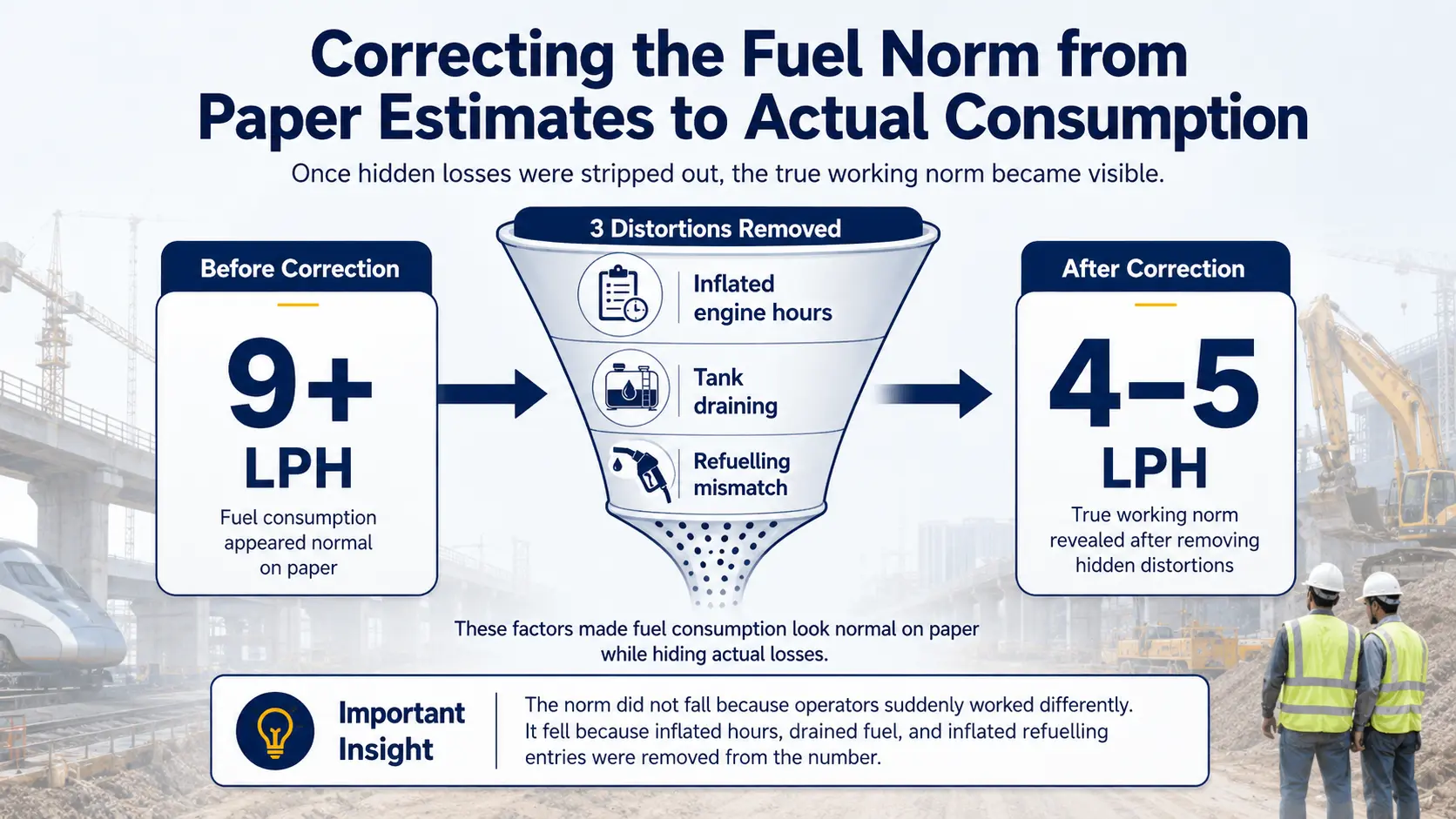
Objective 3: Rebuild Fuel Norms on Accurate Data
With clean engine-hour data flowing in and theft suppressed, the consumption norm could be calculated against real operation rather than inflated paperwork. The corrected norm reflected actual consumption instead of draining, inflated hours, and refuelling manipulation hidden inside the earlier number.
Business Impact
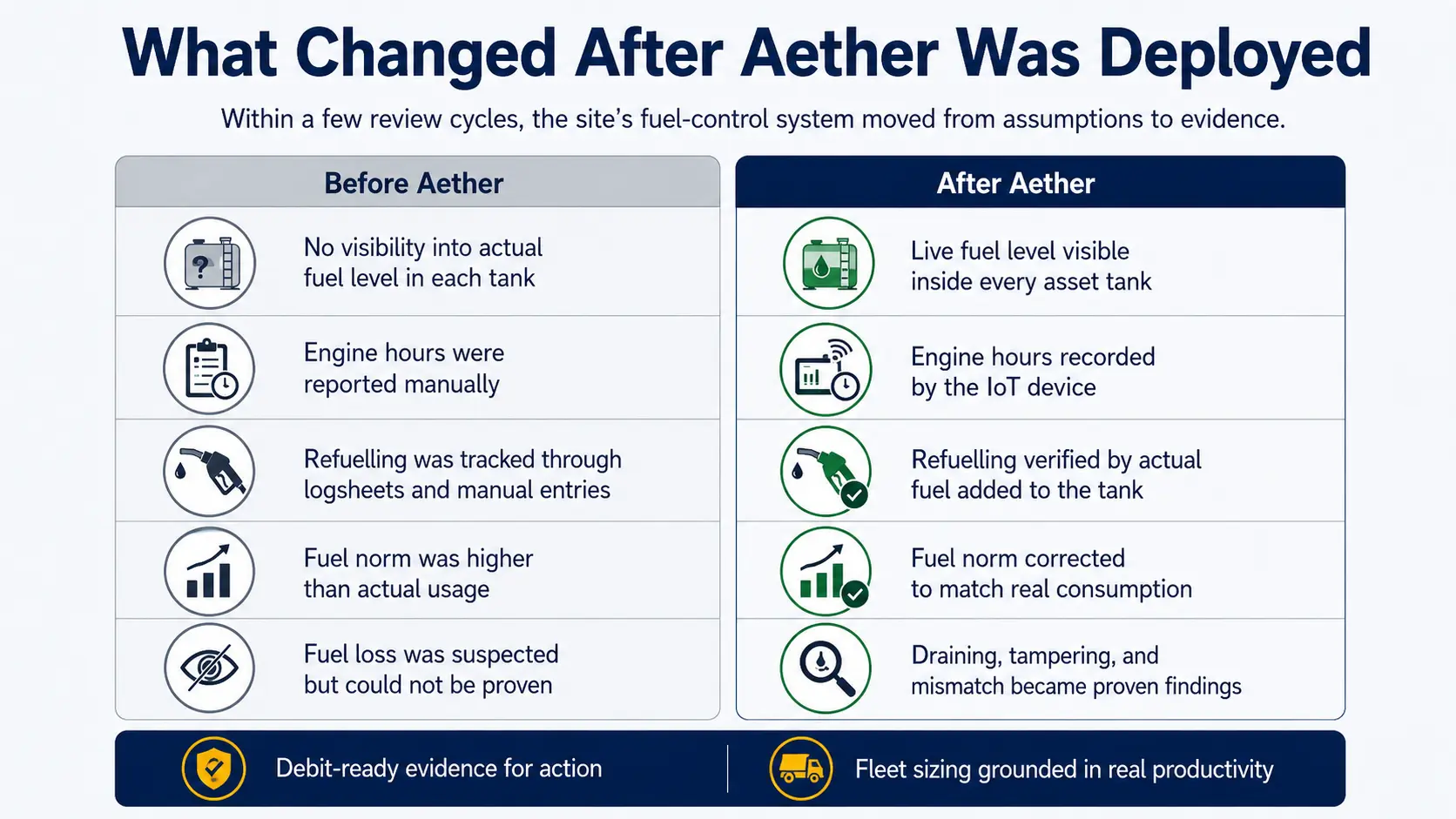
With pilferage reduced, logsheet manipulation exposed, and fuel norms rebuilt on accurate data, the site's fuel cycle no longer ran on assumptions.
| Before Aether | After Aether |
|---|---|
| No visibility into actual fuel level in each tank. | Live fuel level visible for every monitored asset. |
| Engine hours were reported manually. | Engine hours recorded by the IoT device installed on the asset. |
| Refuelling was tracked through logsheets and manual entries. | Refuelling verified by actual tank-level increase. |
| Fuel norms absorbed hidden losses. | Fuel norms corrected against real operation and verified consumption. |
| Fuel loss was suspected but difficult to prove. | Draining, tampering, mismatch, and offline losses became evidence-backed findings. |
Two changes mattered on the ground: debit-ready evidence for action and fleet sizing grounded in real productivity. P&M reviews moved from arguing about what happened to deciding what to do next.
Key Success Factors
The system worked because it did not depend on a single data point. A fuel drop alone can be disputed. GPS location alone cannot prove fuel theft. A logsheet alone can be manipulated. A refuelling entry alone cannot confirm that fuel reached the tank.
- Fuel sensor data tracked every real tank-level change.
- Engine data showed actual running hours independent of the logsheet.
- GPS and ignition context showed where the asset was and whether it was operating.
- Refuelling reconciliation matched issued quantity against actual tank increase.
- BI review converted raw data into clear findings the site team could act on.
If someone inflated working hours, engine data exposed it. If fuel was drained during shutdown, the fuel graph showed it. If consumption ran higher than expected during operation, LPH analysis caught it. If refuelling quantity did not match what reached the tank, reconciliation exposed it.
Conclusion
The shift across MAHSR was not about more dashboards or louder alerts. It was about turning fuel sensor data, engine hours, refuelling records, and BI verification into evidence that operators, vendors, and auditors could not dispute.
Once those records were connected, the site moved from asking where the fuel went to knowing which asset, record, or event needed action. On a project where fuel cost is a major variable and accountability matters across packages, that changes the conversation.
Get Started With Aether
If your site still depends on manual logsheets, refuelling registers, and monthly fuel summaries, Aether can help you run a fuel visibility review across high-consumption assets.
- Identify assets consuming above verified norms.
- Find refuelling entries that do not match actual tank fill.
- Compare running-hour records against machine data.
- Trace draining, tampering, and loss during device-off periods.
Frequently Asked Questions
What problem did Aether solve on the MAHSR construction project?
Aether helped site teams separate actual fuel consumption from inflated running hours, tank draining, refuelling mismatch, and manual logsheet manipulation.
Why were manual logsheets not enough for fleet and fuel control?
Manual logsheets could record fuel and engine hours, but they could not prove actual tank level, actual machine runtime, or whether the recorded fuel quantity entered the asset.
Which hardware was used for fleet and fuel visibility?
The deployment used calibrated Omnicomm LLS 4 capacitive fuel sensors and Teltonika FMB125 or FMC125 IoT gateways connected to the Aether portal.
How does Aether verify fuel theft or abnormal loss?
Aether's BI team reviews fuel graphs against engine hours, location, refuelling records, device-off windows, and expected consumption before sending evidence-backed findings.
What changed after the deployment?
The site gained live tank-level visibility, verified engine hours, refuelling reconciliation, debit-ready evidence, and fuel norms based on actual consumption instead of inflated records.
More Fuel Accountability Stories