Fuel Theft Prevention System for Construction Sites
A practical guide for EPC and P&M teams to detect draining, verify refuelling mismatch, and act on fuel loss with evidence-backed reporting.
Fuel theft on construction sites does not always look like one obvious incident.
Sometimes someone drains fuel while the machine sits parked between shifts. Sometimes someone removes it slowly in small quantities that never trigger an alert. Sometimes the refuelling record shows a certain amount filled, but the tank sensor shows less and the difference needs an explanation. Sometimes the asset goes offline, and by the time it reconnects, the fuel level is lower than it should be.
This is why construction and EPC companies need more than basic GPS tracking or simple fuel alerts. They need a fuel theft prevention system that shows what happened with fuel and gives P&M teams verified evidence they can act on.
On sites where many assets are not reporting, confirmed draining losses reach lakhs of rupees each month. On sites with full visibility, the true scale of loss becomes visible and far more preventable.
Why Fuel Theft Is a Serious Problem on Construction Sites
Fuel is the single largest variable cost on most EPC and infrastructure project sites. On a site running 30 to 50 machines, monthly fuel spend can easily cross several lakhs of rupees. Even a small loss across the fleet, if it goes unnoticed month after month, represents a direct hit to the project margin.
Consider a simple example. If one machine loses just 10 litres a day through slow draining, refuelling errors, or quiet fuel diversion, that is about 300 litres in a month. If the same problem is happening across 30 or 40 machines on a site, the monthly loss becomes enormous very quickly.
The bigger challenge is proof. Fuel theft on construction sites rarely looks like theft. It looks like consumption. Logsheets show normal numbers. Bowser records appear clean. Refuelling entries are filed on time. The loss hides inside the gap between what the records say and what actually happened inside the tank.
Common Fuel Theft Methods in Construction Fleets
Fuel theft on construction sites does not happen in only one way. A machine can lose fuel while parked, while the engine runs, during refuelling, during device-off periods, or through manual logbook manipulation.
In construction fleets, common fuel theft and fuel loss methods include direct tank draining, small repeated draining, return pipe draining, refuelling mismatch, false refuelling, device tampering, fuel loss during offline periods, and logbook manipulation.
Direct Tank Draining
Fuel is taken out of the tank using a pipe or container, usually when the asset is parked and no one is watching. This can happen at any time during a break, between shifts, or when the site is less active. On the fuel graph, it appears as a sudden drop when the engine is off.
Small Repeated Draining Below the Alert Threshold
This is one of the most difficult methods to catch on construction sites. Anyone who knows how the system works drains small quantities, each below the level that triggers an alert. No single event looks suspicious. The only way to catch this pattern is by reviewing the fuel graph carefully over time.
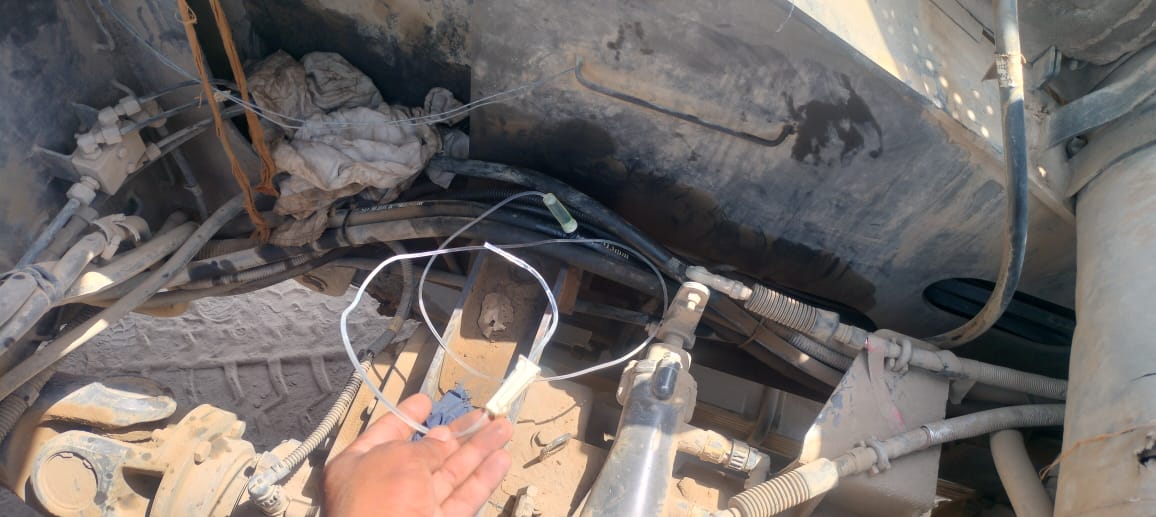
Return Pipe Draining During Operation
Every machine has a return pipe, and fuel that the engine does not burn goes back to the tank through this pipe. When the machine runs, an operator can quietly connect a thin pipe to the return pipe and route the other end into a jerry can kept out of sight. The engine keeps running normally. The machine keeps working. But instead of unused fuel returning to the tank, it slowly collects in the container.
There is no sudden drop on the fuel graph. No alert fires. The only sign is that the machine's fuel consumption is higher than it should be for the work it is doing. Without comparing actual consumption against the expected norm for that machine, this method can remain hidden.
Refuelling Mismatch
Refuelling involves several steps. The bowser goes to the machine. The operator records the amount. Fuel enters the tank. At each step there is a chance for a gap. The store record may show a certain quantity issued, but the fuel sensor shows the tank rose by less.
Fuel may have been partly diverted before it reached the tank. It may have been logged against the wrong machine. The bowser may also have issued less fuel than the register shows. Not every mismatch is intentional, but repeated mismatches on the same machine, bowser, or operator are a clear sign that something needs attention.
This is called refuelling mismatch. Without sensor data, it is almost invisible because it happens during normal documented activity.
Sensor and IoT Gateway Tampering to Create a Blind Window
The fuel sensor or IoT gateway can be disconnected on purpose. During this period the monitoring system cannot see what is happening inside the tank, creating a blind window. When the device reconnects, the tank level may be lower than expected. The exact method of removal is unknown because no data was recorded during that time.
This method is difficult to challenge because the operator can claim the device stopped working on its own. The only way to investigate is to check logsheet data and engine hours from that period, then compare them with tank level when the device comes back online.
False Refuelling
False refuelling happens when the record shows fuel was issued, but the tank does not show the expected rise. This can happen when someone enters fuel in the register but the fuel does not reach the machine tank. It can also happen when someone issues fuel to one asset but records it against another.
Without sensor data, this type of loss is invisible. The refuelling slip looks complete and the register appears correct. Tank-level data is the only way to check whether fuel actually reached the asset.
Logbook Manipulation
Fuel loss does not always come from the tank. It can also come from records. Operators or site staff may add engine hours, alter HMR or KMR entries, report higher fuel use, or enter wrong refuelling quantities.
When the logsheet shows higher consumption than what sensor data shows inside the tank, the gap needs investigation. This loss hides inside what appears to be normal documented activity.
Suspect Fuel Loss on Your Project Site?
Book a free fuel loss review with Aether IoT and get a verification-led action path.
Refuelling Mismatch: The Fuel Loss That Hides in Plain Sight
Refuelling mismatch is a type of fuel loss that many P&M teams still do not review consistently, even on sites where fuel monitoring is active.
It works like this: the bowser or store record shows a certain quantity issued to a machine, but the fuel sensor shows the tank level increased by less than that amount. The gap needs investigation before the entry is approved.
Not every mismatch means theft. Timing differences between entry and sensor timestamp, split fills logged as one entry, or small top-range measurement gaps can all create non-fraud differences. These should be checked and ruled out first.
When the same pattern repeats on the same machine, with the same operator, or at the same refuelling point, it indicates probable diversion at issue stage. This requires a verification step inside the fuel approval process, not just alerts.
Why Manual Logbooks Cannot Prevent Fuel Theft
Fuel issue registers, bowser records, HMR and KMR entries, and refuelling slips capture what someone wrote down. They do not capture what actually happened inside the tank.
The person writing the logsheet cannot directly verify whether the tank rose by the issued quantity, whether slow draining happened between shifts, or whether higher consumption is genuine or manipulated.
A proper fuel theft prevention system cross-checks sensor data against P&M logsheets. Engine hours from the device are matched against logsheet entries. Refuelling quantities are compared against observed tank rise. Any mismatch in consumption or refill behavior is flagged for review before action.
Why GPS or IoT Gateway Alone Cannot Stop Fuel Theft
GPS tracking and an IoT gateway can show where a machine is, when the engine ran, and how far it travelled. That helps with fleet control, but it does not measure what is happening inside the fuel tank.
It cannot show:
- How much fuel is actually inside the tank
- Whether unauthorized draining has taken place
- Whether refuelling actually reached the tank
- Whether recorded refuelling quantity matches actual tank increase
- Whether consumption is normal or higher than expected
- Whether return pipe draining is happening
- Whether fuel is being wasted during idle running
A machine can be parked with engine off and gateway active, and fuel can still be removed without an alert. GPS and IoT provide context. The fuel sensor provides measurement. P&M teams need both together.
Related reads: Fleet Management System, Fuel Monitoring System Guide, and Construction Fleet Tracking.
How Aether Identifies and Verifies Fuel Loss Events
Aether does not directly mark every fuel drop as theft.
On construction sites, fuel movement can happen for many reasons. It can be actual draining, refuelling mismatch, return pipe draining, planned maintenance, sensor issue, device-off period, idle running, or genuine machine consumption.
That is why Aether verifies fuel events before sending them to the P&M team.
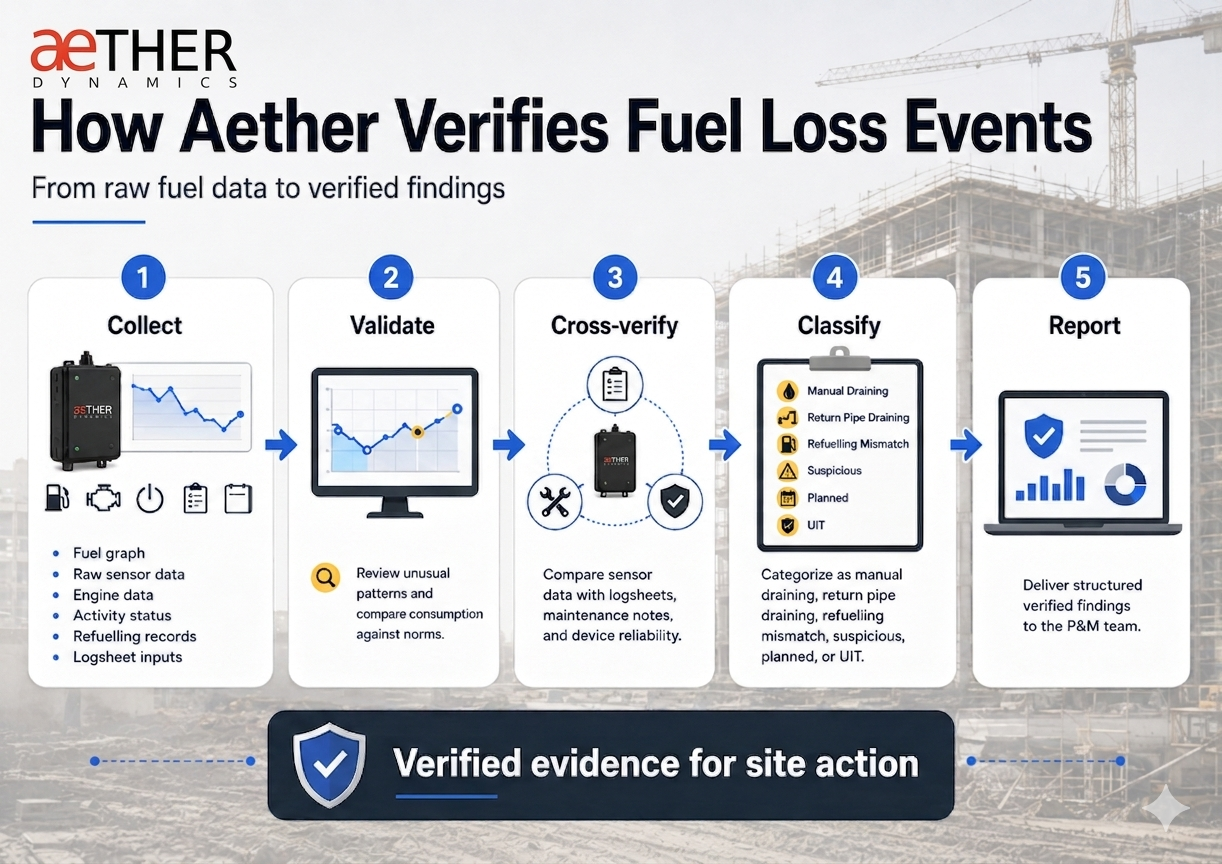
A fuel theft prevention system follows a five-step process to turn raw fuel data into verified findings.
| Step | What happens at each step |
|---|---|
| 1. Collect | Fuel level graph, raw sensor data, engine operation data, fuel graph data, and activity status are collected from the monitoring portal. Refuelling records and P&M team logsheet inputs are collected at the same time. |
| 2. Validate | The BI team (Business Intelligence) zooms into the fuel graph to identify unusual patterns. Operating conditions (idle, running, stop) are cross-checked against the fuel drop. Consumption is compared against established LPH or KMPL norms for that asset. |
| 3. Cross-verify | Sensor data is checked against logsheet entries, maintenance notes, and P&M team confirmed planned draining. Device reliability is reviewed, including sensor failures, device-off periods, and ignition connection issues that could explain an unusual pattern on the graph. |
| 4. Classify | Events are classified by type: system-detected draining, manual draining found through graph analysis, return pipe draining identified through elevated consumption, suspicious draining that is unusual but unconfirmed, planned draining authorized by P&M team, or draining during a device offline period. Volume is calculated for each event. |
| 5. Report | The BI team reviews the volume calculation and event classification before the report is sent. A structured report, including a list of all draining events, individual event pages with screenshots, and summary insights, is delivered to the P&M team in PDF or Excel format. Planned draining events are excluded from debit note recommendations. |
How Fuel Graphs Help Detect Fuel Theft
| Fuel Graph Pattern | Classification | Interpretation |
|---|---|---|
| Sharp drop while engine is OFF | Manual Draining | Direct siphoning from parked machinery. |
| Consumption higher than normal during operation | Return Pipe Draining | Possible diversion during run-state, reflected through elevated LPH. |
| Refuel recorded but lower-than-expected tank rise | Refuelling Mismatch | Volume mismatch between register entry and physical tank increase. |
| Small losses repeating over time | Sub-threshold Micro Draining | Stealth theft pattern designed to bypass alert thresholds. |
| Device offline, then lower fuel on reconnect | UIT Draining | Loss across communication gap requiring reconstructed verification. |
What Reports P&M Teams Need to Prevent Fuel Theft
- Asset-wise fuel consumption report: Daily usage compared with historical machine baselines.
- Verified draining report: Classified events by type, volume, timestamp, and engine state.
- Refuelling mismatch report: Registered issue vs sensor-observed tank increase.
- Idle fuel waste report: Fuel spent in non-productive stationary runtime.
- Offline device report: Sensor and gateway non-reporting windows with risk exposure.
- Site-wise summary: Project-level fuel trend visibility for leadership and finance.
- Unusual fuel movement report: Repeated minor losses and atypical tank movement signatures.
You can also benchmark impact using the Fuel Loss Calculator and live Case Studies.
Fuel Theft Prevention Checklist for Weekly P&M Review
- Match every refuelling record against actual tank increase before approval.
- Review each machine fuel graph for parked-window drops and repeated micro-losses.
- Compare actual consumption against standard LPH norms and escalate outliers.
- Track repetitive patterns by asset, operator, and shift window.
- Audit offline devices weekly and reconcile every blind period with logs.
- Cross-check system-derived engine hours against operator logsheet entries.
- Track and reduce excessive idle running to cut avoidable fuel burn.
- Pre-communicate planned draining, calibration, and maintenance activities.
- Define debit-note SOPs before verified theft findings are issued.
Download the Fuel Theft Prevention Checklist for Construction Sites
Request the checklist from our team and deploy it across all active project packages.
Hardware and Calibration Architecture
Fuel sensor layer
Aether uses Omnicomm LLS 4 capacitive fuel sensors with no moving parts. These sensors continuously capture refuelling, consumption, sudden drops, and abnormal tank profiles in harsh construction conditions.
Gateway layer
Teltonika FMB125 and FMC125 gateways transmit fuel metrics, GPS location, and engine activity to the Aether portal, with onboard memory buffering during poor cellular coverage.
Calibration discipline
Tank-specific calibration is done using measured physical volume mapping. This is critical for reducing disputes and avoiding false mismatch interpretation.
BI Validation for Edge Cases
| Edge Case | How It Is Handled |
|---|---|
| Sensor blind area near top/bottom tank limits | Physical tank geometry and mapping range are reviewed before marking mismatch anomalies. |
| Device-off reporting gaps | Fuel before disconnect, logged fills, expected usage, and reconnect level are reconstructed to classify UIT. |
| GPS signal interruption | Fuel curve and engine behavior are prioritized when positional signal is weak or blocked. |
| Engine telemetry gaps | Location trail, graph geometry, and manual logs are combined to infer actual machine state. |
| Planned maintenance draining | Verified maintenance activity is excluded from theft/debit recommendation. |
| Legitimate high-consumption workloads | Terrain and load context are checked before classifying high LPH as theft. |
| Refuelling timing differences | Clock offsets and split entries are matched with volume spikes to prevent false flags. |
What Makes Aether Different
Basic monitoring tells you that something happened. Aether verification tells you what happened, how it was verified, the exact volumetric impact, and the next operational action.
Frequently Asked Questions
What is a fuel theft prevention system?
A fuel theft prevention system combines in-tank fuel sensing, IoT gateway telemetry, dashboard visibility, and a verification workflow so raw fuel signals become evidence-backed findings.
How can fuel theft be detected on construction sites?
Fuel theft is detected through fuel-graph analysis for sharp drops, repeated micro-losses, refuelling mismatch checks, consumption-vs-norm comparison, and offline-gap reconstruction for UIT scenarios.
Can GPS tracking prevent fuel theft?
No. GPS provides location and movement context but does not measure fuel volume changes inside the tank. Fuel theft prevention requires tank-level sensing plus cross-verification with operations and logs.
How does fuel monitoring help prevent fuel theft?
Fuel monitoring creates a timestamped history of each asset's tank behavior. When this data is reviewed against refuelling records, engine hours, and site logs, teams can separate suspicion from verified loss.
What is refuelling mismatch?
Refuelling mismatch is when recorded issue quantity does not match actual sensor-observed tank rise. One-off gaps can be operational, but repeated gaps by machine, operator, or refuelling point indicate likely diversion.
What is the difference between an alert and a verified report?
An alert is an automated trigger. A verified report is a human-reviewed finding that filters edge cases, classifies event type, and provides evidence suitable for operational and financial action.
What reports should P&M teams check regularly?
Asset-wise consumption, verified draining, refuelling mismatch, offline-device exposure, idle fuel waste, and site-level summary reports should be reviewed on a fixed weekly cycle.
How long does it take to see outcomes?
Initial anomalies usually appear within 1 to 2 weeks. Pattern-level visibility builds in about a month, and process-level correction generally stabilizes within 2 to 3 months.
What is UIT draining?
UIT (Unidentified Type Draining) is fuel loss detected across a communication or device blackout window where exact removal method is not directly visible and must be reconstructed from surrounding evidence.
Why are manual logbooks not enough?
Manual logs record entries, not continuous tank behavior. Without sensor-based validation, slow draining, mismatch, and stealth diversion patterns can remain hidden.
Explore more: Fleet Management Challenges, Fuel Tank Calibration Guide, Fuel Monitoring System Guide, and Underground Metro Fuel Management Case Study.
Need Site-Level Fuel Control?
If your team is dealing with draining incidents, refuelling mismatch, or weak reconciliation confidence, we can help you design a verification-first setup for your projects.
Related Reading