Chapter 4: Six Stages of Operator Resistance That Reduce Fleet Monitoring ROI
A construction site installs fuel sensors and IoT gateways across its machines to control fuel theft. Reports start showing fuel drops, engine-hour gaps, and asset movement patterns. But the P&M team still does not see fuel discipline improve on site. Operators challenge the report, tamper with devices, or change draining methods, so monitoring data does not turn into action. This is where operator resistance reduces fleet monitoring ROI on most project sites. Unaddressed operator resistance is the most common reason fleet monitoring fails to deliver return on investment (ROI).
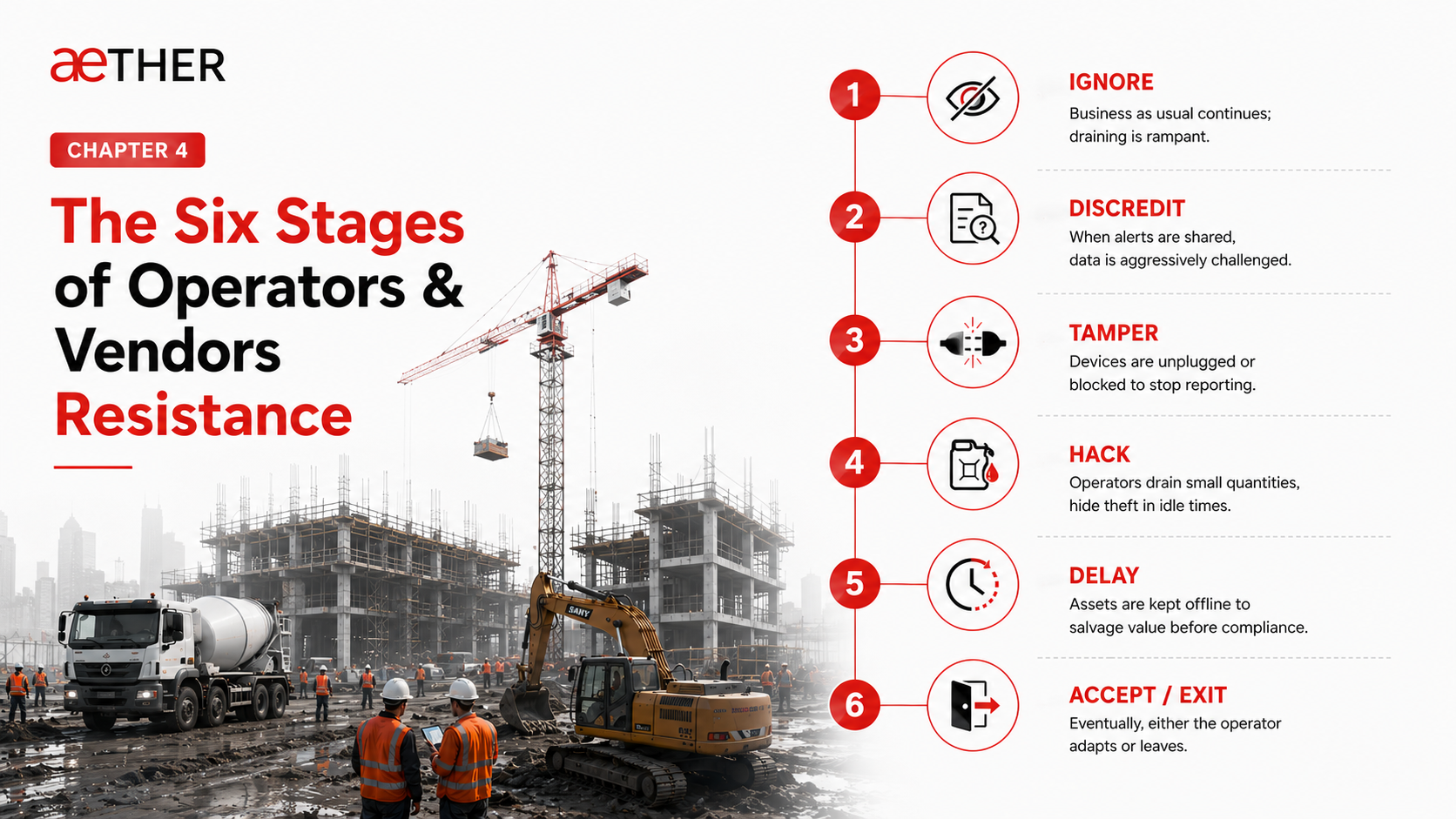
TL;DR: Operator resistance moves through six stages: ignoring the system, discrediting the data, tampering with hardware, switching to small hidden draining, stalling compliance, and accepting control or exiting. Each stage widens the gap between what the system records and what the plant and machinery (P&M) team can act on. Closing that gap takes verified data plus enforced standard operating procedures (SOPs), not more hardware.
Fleet monitoring is not only a technical implementation. It is a behavioral shift on site. Once monitoring starts, operators do not always stop draining immediately. Many first ignore the system, then challenge the data, then tamper with devices, and finally change the draining method itself.
Each stage leaves a different data pattern behind. Large refueling-linked drops, small manual draining, return pipe draining, suspicious consumption, and planned draining are not just report labels. They show where the operator is in the resistance journey.
Why Operator Resistance Reduces ROI
Fleet monitoring gives ROI only when the site team can act on the data. The system shows fuel drops, engine hours, movement, and refueling patterns. But when an operator challenges the data or tampers with the device, the P&M team is left with information it cannot use for action.
Operator resistance turns useful data into disputed data. The site can act only when the report is clear, the event is verified, and the reason for fuel loss is explained. Weak or incomplete data stays on the dashboard instead of becoming a deduction or penalty.
Operator misrepresentation makes fuel loss difficult to prove on site. Operators manipulate manual hours or mileage in logsheets to make fuel use look justified. The logsheet or manual record may look normal, but system data shows whether the asset actually moved, ran, or used fuel in line with the work done. Inflated hours, unmatched fuel entries, and engine hours without movement are claims the site must verify and close. Every litre that slips through becomes project cost that produced no work.
For more on the detection layer, see our Fuel Monitoring System Guide.
The 6 Stages at a Glance
| Stage | What it looks like on site | Direct ROI impact |
|---|---|---|
| Ignore the system | Business as usual continues; large fuel drops continue after refueling | Theft continues as if no system exists |
| Discredit the data | Operators say the fuel sensor is showing wrong data when confronted | Confirmed events stall; no deduction or penalty follows |
| Tamper with hardware | Operators unplug or block devices so assets stop reporting | The site pays for monitoring but gets incomplete or no usable data from those assets |
| Hack: switch to small, hidden draining | Operators drain smaller quantities during operation or through return pipe patterns | Small losses repeat and escape automated alerts |
| Delay compliance | Operators keep devices offline after debit or penalty starts from the draining report | Offline assets create blind windows where fuel loss can continue |
| Accept or exit | One operator accepts the process or exits; a new operator may restart resistance | Savings can drop when handover is not controlled |
How Draining Types Map to Resistance Stages
| Resistance stage | What the operator does | Draining pattern usually seen |
|---|---|---|
| Stage 1: Ignore | Continues business as usual | R&D Draining |
| Stage 2: Discredit | Challenges the alert or sensor data | Verified report required |
| Stage 3: Tamper | Unplugs, blocks, or disables reporting | Offline / tamper signal |
| Stage 4: Hack | Changes method to avoid obvious alerts | Manual Draining / Return Pipe Draining |
| Stage 5: Delay | Keeps asset offline to stall action | Blind-window fuel loss |
| Stage 6: Accept / Exit | Adapts or leaves the site | Reduced draining or repeat-risk with new operator |
Stage 1: Operators Ignore the System
Large fuel drops can continue after installation when operators see no quick action from the site. The system reports fuel movement, but the operator keeps draining fuel in the same way. The report is visible, but action does not happen fast enough for the operator to face a consequence.
Aether categorises these large refueling-linked drops as Refueling & Draining (R&D) Draining. This pattern reduces ROI quickly because the volume can be high and the pattern often repeats after refueling. The site is already paying for monitoring, but fuel theft continues until the P&M team reviews the first event and takes action.
The P&M team should use the first report for a same-day confrontation backed by the refueling timeline. When the operator sees the drop mapped against the exact fill time, the operator has less room to deny it. A documented first action in the Ignore stage shows other operators that reports will lead to action. Our Fuel Theft Prevention System covers the refueling-event evidence to capture first.
Stage 2: Operators Discredit the Data
Operators discredit the data when the P&M team raises a fuel loss event. The operator may say the fuel sensor is not giving correct data, the machine was on a slope, the tank reading is wrong, or the alert is unreliable. The discussion then moves away from fuel theft and becomes about whether the system itself can be trusted.
This stage reduces ROI because discredited data cannot support deduction or penalty. Even if the report shows fuel loss, the P&M team cannot take action when the operator creates doubt around the event. Over time, the P&M team may hesitate to act on future reports.
The P&M team should not depend on one alert alone. Aether’s verified report should show the full pattern: event history, refueling logs, fuel graph, and the normal consumption of that asset. This gives the P&M team a clear case and leaves the operator with less room to dispute the finding.
Stage 3: Operators Tamper with Hardware
Operators tamper with hardware after the P&M team identifies fuel loss in the draining report. Once the operator understands that the system is recording fuel drops, the operator may try to stop future fuel draining from being recorded. The operator may unplug the IoT gateway, loosen the fuel sensor connector, cut a wire, or block the device from reporting.
This stage reduces ROI because a tampered asset gives the site incomplete or no monitoring data. Fuel loss can continue during this blind window, but the P&M team cannot clearly see the fuel graph, engine hours, or asset movement. Frequent tampering makes monitoring data unreliable and makes fuel loss difficult to prove.
Aether tracks reporting status against asset activity. If an asset is working on site but not reporting, the mismatch is flagged as a possible tamper signal.
Stage 4: Hack — Operators Switch to Small, Hidden Draining
Operators switch to small, hidden draining when large fuel drops start getting noticed. At this stage, the operator is no longer ignoring the system. He is studying it. The draining method changes to avoid obvious alerts, stay below detection thresholds, or make fuel loss look like normal consumption.
Instead of one clear drop after refueling, the operator may drain small quantities while the engine is running. In Return Pipe Draining, unused fuel that should return to the tank is diverted during operation, so the fuel graph looks like normal high consumption instead of a sudden draining event. Aether categorises these patterns as Manual Draining and Return Pipe Draining.
This stage reduces ROI because small draining events are easy to miss when each event looks minor. The loss from one event may look low, but repeated small drainings can create a large monthly fuel loss. Return Pipe Draining is difficult to detect because the asset keeps running normally, the logsheet can still look correct, and the fuel level drops slowly instead of showing one clear fuel drop.
Automated alerts alone are not enough at this stage. Small draining may stay below alert thresholds, and Return Pipe Draining may not create a clear draining event on the portal. Aether’s BI team verifies the fuel graph, engine hours, GPS status, and consumption pattern, then reports how the draining happened. The P&M team can use this verified draining report for operator action. Our Return Pipe Fuel Theft explains what to check.
Not every abnormal pattern can be confirmed immediately as draining. When fuel consumption does not match engine hours, GPS movement, workload, or normal asset behavior, Aether flags it as Suspicious Draining. These cases are not treated as confirmed theft by themselves, but they show that the asset needs deeper human verification.
Not all draining is malicious. Planned Draining is treated separately. When the client’s P&M team removes fuel for testing, calibration, or maintenance and communicates it in advance, it is excluded from pilferage analysis and penalty. This distinction prevents genuine maintenance activity from being treated as theft.
Seeing similar patterns on your site?
Stage 5: Delay — Operators Keep Assets Offline to Stall Compliance
Operators delay compliance when debit or penalty starts based on the draining report. The operator may keep the device offline and delay making the asset available for checking or restoration. As a result, the asset stays outside active reporting.
This stage reduces ROI because fuel theft can increase when an asset stays offline. Without reporting, the P&M team cannot see the complete fuel graph, engine hours, or asset movement. This blind window allows fuel loss to continue and makes action on that asset difficult.
Aether regularly monitors asset health at this stage. When an asset goes offline or stops reporting, Aether reports it to the site P&M team and deploys a service engineer when required. This brings the asset back under monitoring and closes the operator’s delay tactic.
Stage 6: Accept/Exit — Resistance Does Not End on Its Own
At this stage, the operator has two choices. The operator either accepts the monitoring process and fuel draining reduces, or the operator leaves the asset/site and a new operator takes over.
This stage reduces ROI because the new operator may handle the asset without knowing its past draining history. The new operator may not know that fuel loss was reported earlier, debit or penalty was applied, or monitoring rules are already active on that asset. Because of this, the same resistance can start again on the same asset.
Aether maintains asset-level history so monitoring does not reset when the operator changes. The asset’s draining history, fuel-use pattern, and past issues remain available in verified reports. When a new operator takes over, the site can use this history to continue the same control.
What Makes the Difference
Fuel data becomes useful only when the site can act on it. Some fuel loss stays invisible when the system does not detect it. Some fuel loss becomes disputed when the system shows it, but the operator challenges the data. Fuel loss becomes enforceable only when Aether verifies the event, checks the evidence, and reports it clearly.
The difference is not better hardware or more alerts alone. It is verified data plus a clear action process. If a draining event is confirmed, the site should already know what action will follow, such as deducting the confirmed fuel loss cost from the vendor invoice, applying a penalty for repeated draining, or taking action for repeated hardware tampering.
Without a clear SOP, even good data may not change behaviour. The operator understands that there is no real cost after being caught. A successful fleet monitoring programme needs verified reports, management support, and a standard response that is followed every time.
Frequently Asked Questions About Operator Resistance in Fleet Monitoring
Why do operators resist fleet monitoring?
Operators resist fleet monitoring because the system makes fuel loss, inflated logsheets, and unusual asset use visible. Before monitoring, many of these issues may not be questioned on site. Once the P&M team starts using reports for action, the operator may try to challenge the data, tamper with hardware, or change the draining method.
How does operator resistance affect fuel monitoring ROI?
Operator resistance reduces ROI because it stops data from becoming action. If fuel loss is disputed, hidden, or blocked, the P&M team cannot use it for deduction or penalty. ROI improves only when confirmed events lead to clear action.
How long does it take to reduce operator resistance?
There is no fixed timeline. It depends on how quickly the site starts acting on verified reports. Sites that use clear SOPs, management support, and defined penalties reduce resistance faster. Sites that only share reports without action may stay stuck for a long time.
What is the most common form of operator resistance on construction sites?
The most common early form is data discrediting. The operator may say the fuel sensor is giving wrong data or the system reading is not correct. This delays action unless the report shows a clear pattern.
What is Suspicious Draining and how is it different from confirmed draining?
Suspicious Draining is an unusual fuel-use pattern that needs human verification. It is not treated as confirmed fuel theft by itself. It is flagged because the consumption does not match normal operation, but more checking is needed before action is taken.
Does fleet monitoring penalise fuel removed for maintenance or testing?
No. Fuel removed by the P&M team for testing or maintenance is treated as Planned Draining when it is communicated in advance. Planned Draining is excluded from pilferage analysis and penalty, so routine maintenance work is not treated as fuel theft.
Get the Playbook
Download the 6 Stages of Operator Resistance Playbook — the field guide to spotting each stage and the enforcement response that moves operators to acceptance.
Related Reading