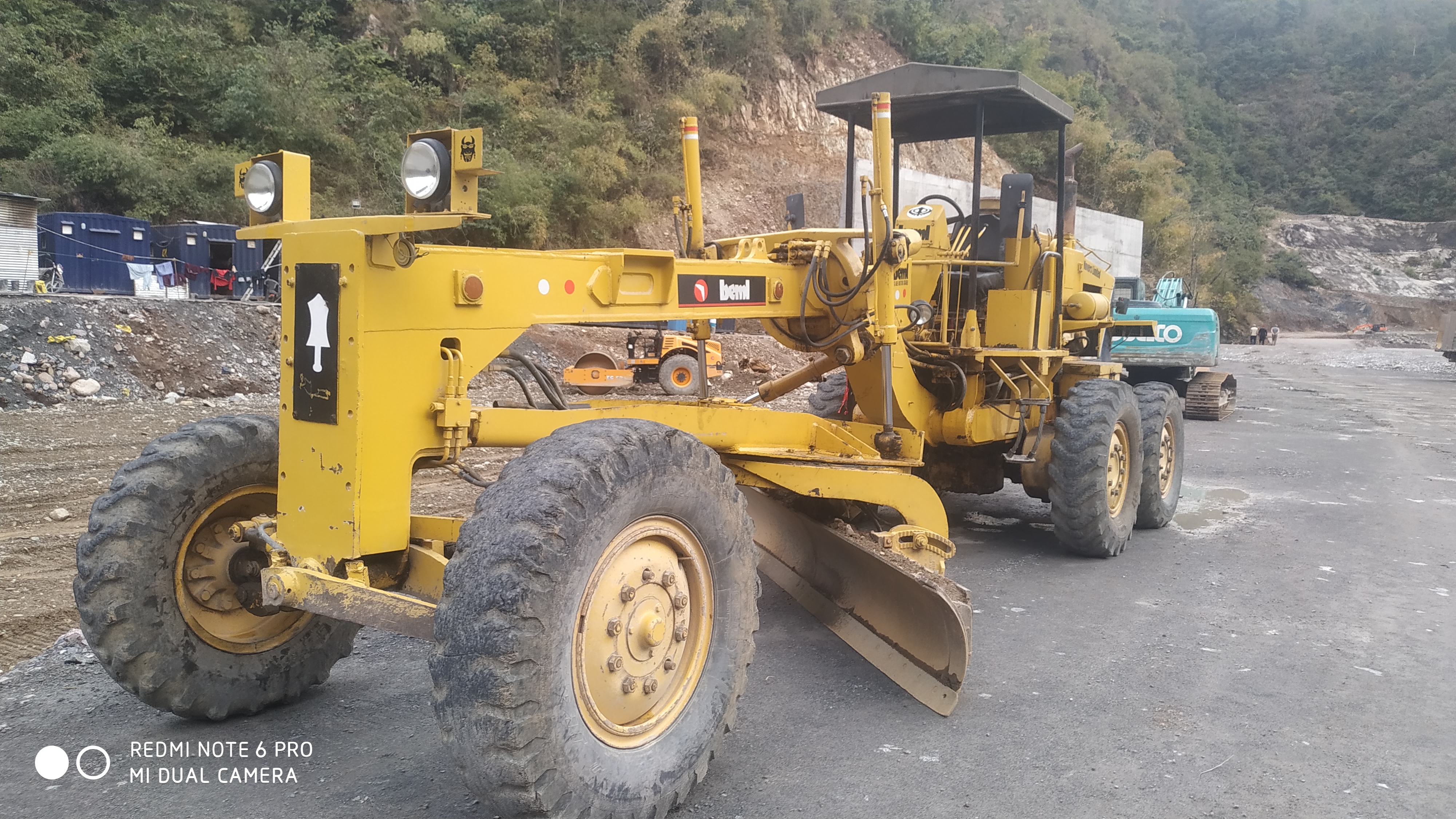
The BEML BG605I motor grader is powered by the BSAA6D125 turbocharged direct-injection diesel engine meeting Bharat Stage III CEV norms. It is built for heavy-duty road construction and haul-road maintenance, pairing a 3,710 mm box-section mouldboard on a 360° hydraulically rotated circle with finger-tip hydroshift gear selection, full hydraulic Orbitrol steering and a 14,700 kg operating weight.
Gross Power112 kW
Operating Weight14,700 kg
Blade Length3,710 mm
Ground Clearance330 mm
Travel Speed0-43.6 km/h
Fuel Tank260 L
Key Highlights
Engine Model
BEML BSAA6D125
Gross Power
112 kW @ 1800 rpm
Net Flywheel Power
108 kW @ 1800 rpm
Maximum Torque
721 Nm @ 1200 rpm
Operating Weight
14,700 kg
With Ripper
16,880 kg
Blade Length
3,710 mm
Blade Load
6,450 kg
Max Travel Speed
43.6 km/h
Transmission
Hydroshift 6F / 5R
Hydraulic Pumps
2x39 / 50 / 78 lpm
Turning Radius
11 m
Fuel Tank
260 L
Tyres
14.00 x 24 - 16PR
Ground Clearance
330 mm
Specifications BEML BG605I Motor Grader
Detailed technical specifications for BEML BG605I Motor Grader
Hydraulic CylindersDouble acting piston type, each connected to a pilot check valve
Cylinder CountBlade lifting 2; blade side shifting 1; drawbar side shifting 1; front wheel leaning 1; front wheel steering 2
Control Valves4-way spool type and 3-way spool type with built-in relief valve
Relief Valve - Work Equipment175 kg/cm²
Relief Valve - Steering140 kg/cm²
DIMENSIONS
Overall Length9,230 mm
Machine Length9,000 mm
Blade Base2,640 mm
Wheelbase / Longitudinal Dimension6,345 mm
Tandem Spacing1,516 mm
Cab / Overall Height3,495 mm
Front Track1,970 mm
Rear Track2,000 mm
Overall Width2,375 mm
Blade Width3,710 mm
Ground Clearance330 mm
MASS & REFILL CAPACITIES
Operating Weight with ROPS Cabin14,700 kg
Operating Weight with Ripper16,880 kg
Mass on Front Wheels3,680 kg
Mass on Rear Wheels11,020 kg
Ground Clearance330 mm
FrameBox-section front frame and two box-section rear frames of steel-plate welded construction; one-piece front frame with hydraulic piping installed internally
LightingHeadlights, panel lamps, work lamp, stop and tail lamp, turn signal lights, back-up light, high beam indicator lamp, battery charging lamp
Safety & ConvenienceROPS canopy, back-up alarm, electric horn, rear view mirrors, cold start system, front pull hook, tool kit with tool box
BEML BG605I Maintenance & Inspection Checklist
Daily pre-start checks · hour-based service schedule · warning actions · fluids and lubricants.
Daily Pre-Start Inspection
Complete before starting work on firm, level ground with the blade lowered, parking brake applied and controls in neutral.
Before every shift
1
Engine oil level
Check the dipstick with the machine level and engine stopped; level must be between L and H.
Act if: level is below L, above H, milky, diluted or contains metal particles.
2
Coolant, radiator & air path
Check coolant only when cool; inspect cap, hoses, clamps, radiator fins and guards for blockage or damage.
Act if: coolant is low/leaking, hoses are damaged, or airflow is restricted. Never open a hot radiator.
3
Fuel tank & water separator
Check fuel level, tank cap, filler strainer and water separator float; drain when water reaches the red line.
Act if: fuel is contaminated, cap/strainer is missing, leaks are present or water remains after draining.
4
Leaks, belts & driven units
Walk around filters, hoses, radiator, pump and engine joints; check fan/alternator belt, pump drive and air-compressor area.
Act if: active leaks, wet high-pressure hoses, belt cracks, pulley play or abnormal noise are found.
5
Air cleaner & dust indicator
Check dust indicator and intake hoses; clean only the outer element when the indicator shows restriction.
Act if: indicator is activated or broken, hose/clamp is loose, or filter paper is damaged.
6
Tyres, rims & wheel nuts
Inspect all tyres, rims and wheel nuts. Verify cold tyre pressure at 2.8 kg/cm2, about 40 psi.
Act if: tyre is damaged, underinflated, rim is cracked, or any wheel nut is loose or missing.
7
Brake air, service brake & parking brake
Allow air pressure to build before moving; test service braking at low speed and confirm the parking brake holds.
Act if: pressure does not build, braking is uneven, pedal/lever travel is abnormal or the brake does not hold.
8
Steering & hydraulic cylinders
Check steering response/free play and inspect tie rods, steering cylinders, work-equipment hoses, fittings and rods.
Act if: steering is delayed/jerky, hose is cut or bulged, fitting leaks, rod is damaged or oil spray is suspected.
9
Blade, circle & drawbar
Check cutting edges, guide area, circle teeth, drawbar ball joint, pins, retainers and mounting bolts.
Act if: fastener/retainer is missing, cutting edge is unsafe or excessive looseness is found.
10
Frame, guards & attachments
Walk around frame, steps, handrails, covers, mirrors and optional attachments.
Act if: cracks, loose guards, damaged access steps or insecure attachments are found.
11
Wiring, battery & instruments
Check visible wiring, terminals and battery cap vents; verify oil-pressure, coolant, fuel, air-pressure and charging indications.
Act if: cable is hot/damaged, terminal is loose, electrolyte leaks, or warning indications remain abnormal.
12
Lights, horn & abnormal condition
Test headlights, work lamps, stop/tail lamps, indicators, horn and back-up alarm; listen for noise, vibration, smoke or delayed controls.
Act if: a safety device fails or any new abnormal condition is present. Park safely and investigate.
Service Schedule by Hours
Use the hour-meter schedule below along with daily walk-around checks and job-site condition checks.
Daily items are pre-start and operating-safety checks before the grader is placed into work.
Engine, cooling & fuel
Engine oil level
Check level and top up if necessary.
CHECK
Coolant level and radiator path
Check coolant, cap, hoses, radiator fins and guards.
CHECK
Fuel level and water separator
Check fuel level; inspect/drain water and sediment.
DRAIN
Air cleaner / dust indicator
Check and clean outer element only when indicated.
CHECK
Brakes, steering & tyres
Tyres and wheel hardware
Check rims, nuts and cold pressure at 2.8 kg/cm2.
CHECK
Service and parking brakes
Confirm air pressure, pedal response and parking hold.
TEST
Steering operation
Check steering response, free play and leakage.
CHECK
Hydraulic, blade & structure
Hydraulic cylinders and hoses
Check for leakage, rod damage, bulges and suspected oil spray.
CHECK
Blade, circle and drawbar
Check cutting edges, guide shoes, circle teeth, pins and retainers.
INSPECT
Lights, horn and reverse alarm
Test all required lights, horn and back-up alarm.
TEST
250-hour tasks include initial service actions and repeat checks for wear items, fluid levels and safety systems.
Engine & filters
Engine oil
Change engine oil, 26 L system.
CHANGE
Engine oil filter
Change with engine oil.
REPLACE
Engine breather element
Clean or change as required.
CLEAN
Fuel filter
Change fuel filter; use shorter service in high-altitude service.
REPLACE
Fluids & levels
Transmission case oil
Check/top up; initial oil change at 250 h.
CHANGE
Final drive and tandem cases
Check/top up; initial oil change at 250 h.
CHANGE
Blade-circle gear case
Check/top up; initial gear-case oil change.
CHANGE
Hydraulic oil and filter
Check/top up hydraulic oil and replace filter initially.
REPLACE
Controls & structure
Valve clearance
Initial cold check and adjustment.
INSPECT
Radiator fins
Check and clean for unrestricted airflow.
CLEAN
Brakes, wheel hub nuts and cutting edges
Check/adjust brakes, re-tighten wheel hub nuts and inspect cutting-edge wear.
INSPECT
At 1,000 hours, complete major drivetrain and hydraulic fluid changes with hydraulic filter replacement.
Drivetrain oils
Transmission case oil
Change 36 L transmission case oil.
CHANGE
Final drive case oil
Change 30 L each-side final-drive oil.
CHANGE
Tandem case oil
Change 36 L each-side tandem case oil.
CHANGE
Blade-circle gear-case oil
Change 4 L blade-circle gear-case oil.
CHANGE
Hydraulic system
Hydraulic oil
Change hydraulic oil, 58 L system capacity.
CHANGE
Hydraulic oil filter
Replace hydraulic-oil filter.
REPLACE
Hydraulic cylinders
Inspect blade lift, side-shift, drawbar, wheel-lean and steering cylinders for leakage or damage.
INSPECT
2,000-hour, calendar and condition-based tasks are applied when the hour-meter, time interval or machine condition requires action.
Engine condition
Valve clearance
Check and adjust cold clearance: inlet 0.33 mm, exhaust 0.71 mm.
INSPECT
Turbocharger
Check axial/radial play; avoid abrupt shutdown after high load.
INSPECT
Alternator and starter motor
Check performance of charging and starting systems.
INSPECT
Cooling & air intake
Cooling system and coolant
Clean/replace annually or as required; never mix coolant or antifreeze brands.
SERVICE
Air cleaner element
Replace after six outer cleanings or one year.
REPLACE
Circle guide shoes and rotation
Check internal gear, 6 guide shoes and 360-degree rotation; lubricate as required.
LUBE
Warning Alerts & Immediate Actions
Red means stop and make the machine safe immediately. Amber means correct the condition before heavy work or continued operation.
RED
Engine oil-pressure abnormal
Oil pressure does not register, drops, or oil-pressure warning remains active.
Action: Stop engine safely; check oil level, leakage and filter before restart.
RED
Engine overheating
Coolant temperature rises rapidly, stays in red range, or coolant is expelled.
Action: Remove load; cool and investigate before opening the system.
RED
Brake system ineffective
Service brake or parking brake travel is abnormal, or the machine does not stop/hold correctly.
Action: Lower blade, stop on firm level ground, chock if needed and remove from service.
RED
Brake air / vacuum does not build
Gauge remains low or pressure falls abnormally.
Action: Do not move the grader; inspect compressor, lines, tanks, valves and brakes.
RED
Steering response abnormal
Excessive play, delayed or jerky response, noise or steering-oil leakage is present.
Action: Stop safely, lower blade and inspect steering linkage and hydraulic circuit.
RED
Fuel leak or pressurised oil spray
Fuel wets hot areas or hydraulic oil is spraying or misting.
Action: Stop engine, isolate ignition sources and never use hands to find leaks.
AMBER
Coolant level low / cooling leak
Level is below the filler neck or hoses/cap show leakage.
Action: Let system cool, correct leak and refill with approved coolant/water mix.
AMBER
Dust indicator activated
Air-cleaner restriction has reached service indication.
Action: Clean outer element with 2-5 kg/cm2 air; replace after six cleanings or one year.
AMBER
Charging indication active
Battery is not charging normally after start.
Action: Check belt, alternator, wiring and terminals before extended operation.
AMBER
Water separator at red line
Water has collected in the fuel separator.
Action: Drain water using approved procedure, then check leakage and air entry.
AMBER
Abnormal noise, smoke or control response
A new change is noticed in sound, exhaust colour, vibration or lever response.
Action: Park safely, note the condition and investigate before heavy work.
AMBER
Loose fastener or damaged tyre
Nut/bolt is loose or missing; tyre/rim is damaged or pressure is incorrect.
Action: Stop work, secure machine and repair to current BEML specification.
Fluids, Lubricants & Service Data
Fill to level marks and use BEML-approved oil/coolant grades for the operating climate.
Engine
Engine oil system
26 L; change at 250 h intervals.
26 L
Engine oil filter
Change with engine oil.
FILTER
Valve clearance
Cold: inlet 0.33 mm / exhaust 0.71 mm.
CHECK
Cooling & fuel
Cooling system
55 L; clean/replace annually or as required.
55 L
Fuel tank
Check cap, filler strainer and water/sediment during daily inspection.
260 L
Water separator
Drain whenever water reaches the red line.
DRAIN
Hydraulic
Hydraulic system
58 L capacity; change at 1,000 h.
58 L
Hydraulic oil filter
Initial replacement at 250 h, then 1,000 h.
FILTER
Relief pressures
Work equipment 175 kg/cm2; steering 140 kg/cm2.
PRESSURE
Transmission & final drive
Transmission case
36 L; initial change at 250 h, repeat at 1,000 h.
36 L
Final drive case
30 L each side; initial change at 250 h, repeat at 1,000 h.
30 L
Tandem & blade circle
Tandem case
36 L each side; initial change at 250 h, repeat at 1,000 h.
36 L
Blade-circle gear case
4 L; initial change at 250 h, repeat at 1,000 h.
4 L
Tyres & electrical
Tyre pressure
14.00 x 24 - 16PR tyres; set cold pressure to 2.8 kg/cm2.
2.8
Electrical system
24 V system; 2 x 12 V / 200 Ah battery, optional 2 x 12 V / 160 Ah.
24 V
Frequently Asked Questions
Everything you need to know about the BEML BG605I Motor Grader
The BG605I uses the BEML BSAA6D125 water-cooled, 4-stroke, turbocharged, direct-injection diesel engine meeting Bharat Stage III CEV norms, with a displacement of 11.04 L and 125 x 150 mm bore and stroke.
Gross power is 112 kW at 1,800 rpm and net flywheel power is 108 kW at 1,800 rpm. Maximum torque is 721 Nm at 1,200 rpm.
Operating weight with the ROPS cabin is 14,700 kg, comprising 3,680 kg on the front wheels and 11,020 kg on the rear wheels. With the optional rear ripper and counterweight the machine weighs 16,880 kg.
The mouldboard is a box-section unit measuring 3,710 x 540 x 20 mm with a blade base of 2,640 mm and a blade load of 6,450 kg. It lifts 400 mm above ground, drops 570 mm below, and the circle rotates a full 360° on six guide shoes.
The BEML hydroshift transmission gives six forward and five reverse gears, reaching 43.6 km/h forward and 30.9 km/h in reverse, with a maximum drawbar pull of 7,280 kg. Orbitrol full hydraulic steering allows 40° of lock each way and a minimum turning radius of 11 m.
BEML offers a V-type scarifier (11 teeth, 1,225 mm digging width, 390 mm depth), a front dozer blade (2,500 x 935 mm) and a rear mounted ripper with counterweight (3 shanks, 460 mm depth, 2,195 mm width). A ROPS cab and tyre inflation kit are also offered.