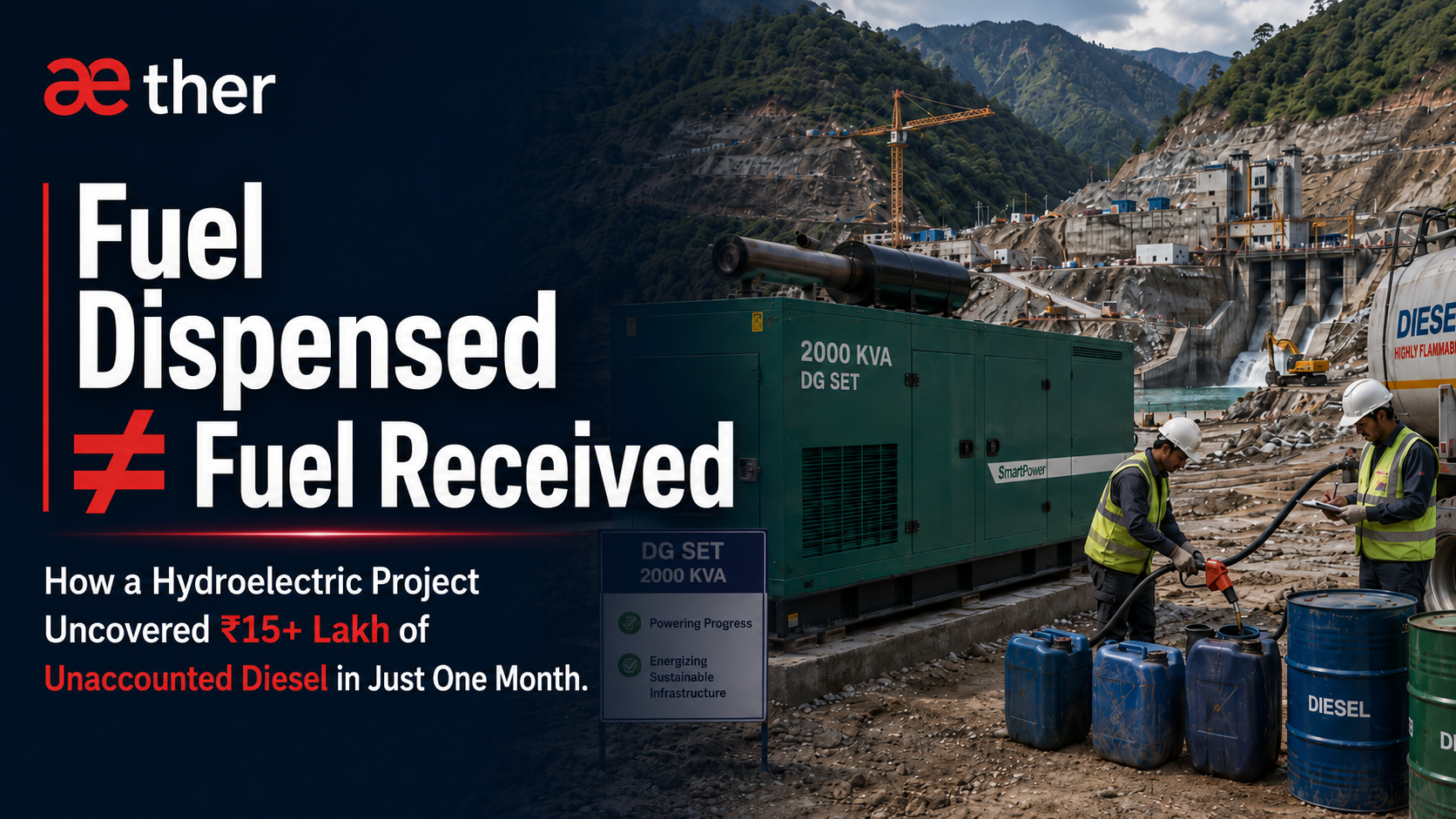
Hydroelectric Project Refueling Fraud Case Study: Closing the Gap Between Dispensed and Received Diesel
The Challenge
At a remote hydroelectric project site, operations relied on a set of approximately 10–15 diesel generators, predominantly 2000 kVA units supplemented by lower-capacity DGs, to support critical equipment, site offices, and project activities.
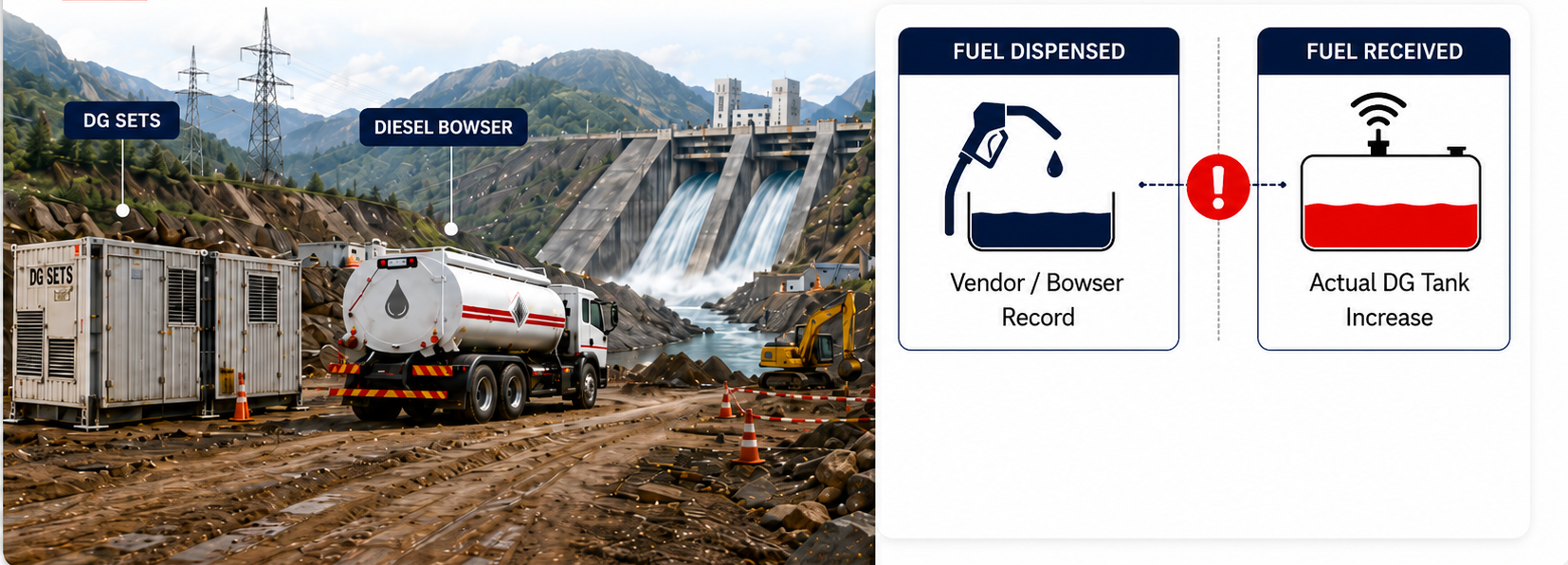
In such environments, diesel becomes one of the largest operating expenses. While refuelling records can confirm how much fuel was dispensed, they cannot verify whether the fuel actually reached the generator tank. Without tank-level monitoring and fuel reconciliation, significant fuel losses can remain undetected.
Monthly Inspection Revealed Project Health Status Issues
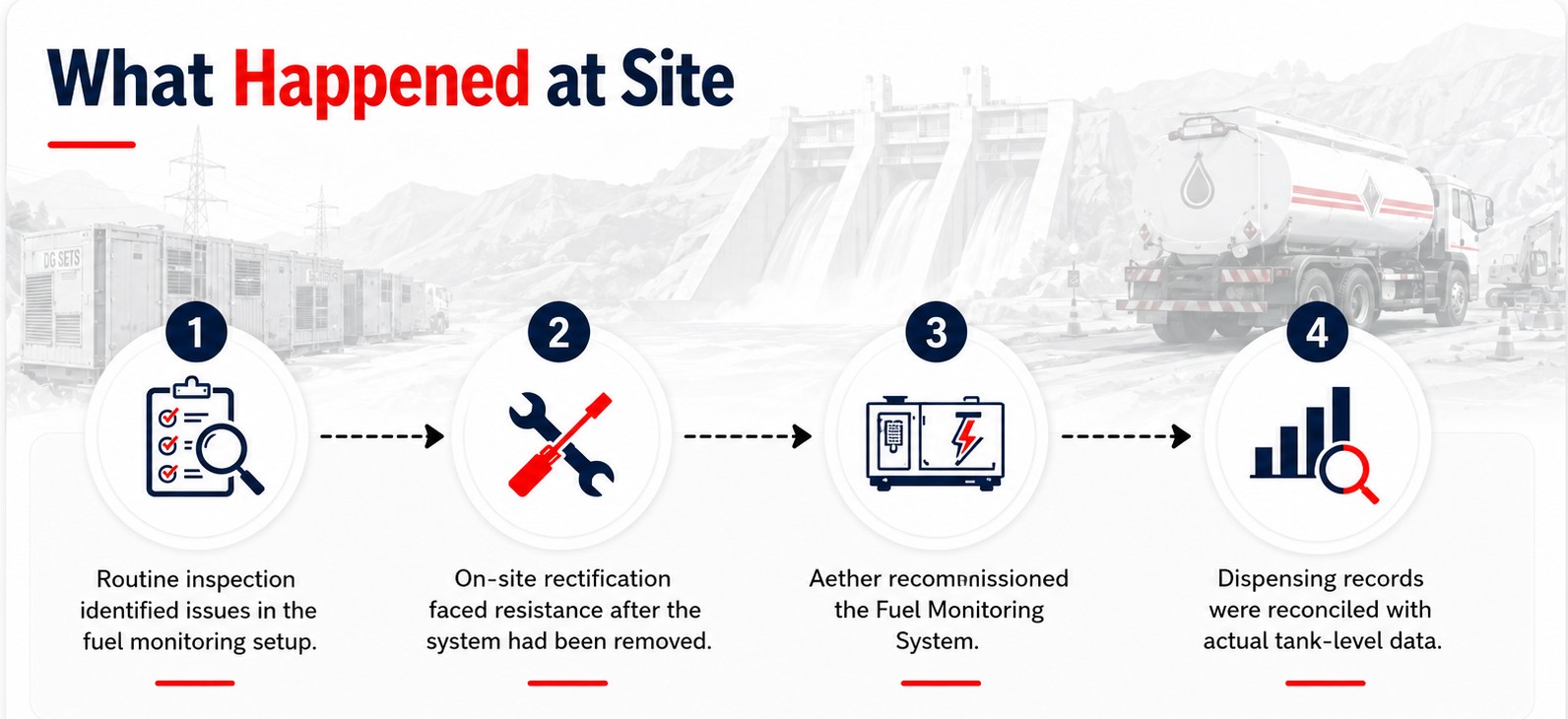
As part of Aether's monthly site health inspection program, our team reviewed the fuel monitoring assets installed across the project.
In this review, “health status” refers to whether the key monitoring components of each asset are working as expected. This includes GPS connectivity, engine data, and fuel-level monitoring. If any one of these three parameters — GPS, engine, or fuel — is not functioning properly, the issue is captured in the health status report.
The monthly health review indicated that the overall health status of the project's fuel monitoring system was below the recommended level. A detailed health report was shared with the customer, highlighting the identified issues and recommending corrective actions to improve health status.
Based on the findings, Aether recommended deploying a service engineer to carry out the required service activities. The customer accepted the recommendation and requested on-site support to address the identified issues.
Accordingly, a service engineer was deployed to the site to attend the service request & maintenance activities.
Unusual Resistance During Rectification
Upon arrival, the site team informed our engineer that the Fuel Monitoring System (FMS) had been removed following a major incident.
To understand the issue, Aether requested supporting documentation, such as an incident report or technical findings linking the problem to the fuel monitoring system. However, no such documentation was available.
Despite this, the P&M assistant team continued to resist rectification.
We do not avoid difficult site situations or allow unsupported objections to derail resolution. Our team handled the conflict calmly and evidence-first — separating perception from proof and ensuring the customer’s operational objective remained the priority.
The matter was escalated to the Plant & Machinery (P&M) Head. Aether communicated that if there was a genuine product-related issue, we would investigate and take responsibility. As no supporting evidence could be provided, the P&M team authorized Aether to proceed with the rectification and recommissioning of the fuel monitoring system.
The Resistance That Triggered Further Investigation
Following the recommissioning of the fuel monitoring system, Aether’s Onsite Support and AE-BI teams (Aether’s Business Intelligence team responsible for analysing fuel and equipment data) found the earlier resistance suspicious. A site fighting this hard to keep its own fuel monitoring switched off, with nothing on paper to justify it, isn’t a technical problem — it’s a behavioural one. So we looked closer.
As part of this process, we requested the site’s diesel refuelling records for reconciliation. Before sharing the data, the P&M team conducted their own comparison between the refuelling records and the fuel data available on the Aether platform.
Based on this initial review, they observed discrepancies and raised concerns that the fuel sensors might not be functioning correctly. They approached Aether stating that the refuelling records were not matching the fuel received data shown on the platform.
To investigate the matter further, Aether requested the complete refuelling records from the site. Our objective was to perform a detailed transaction-level reconciliation to determine whether the discrepancies were caused by sensor inaccuracies or by differences between fuel dispensed and fuel actually received by the generators.
This request marked the beginning of a comprehensive fuel reconciliation exercise.
What the Data Revealed
A complete reconciliation was performed between fuel dispensing records and actual fuel received by the monitored DG sets for the one-month period before the fuel monitoring system was disconnected. This ensured that the analysis was based only on the period where sensor data was available and could be reliably compared with refuelling records.
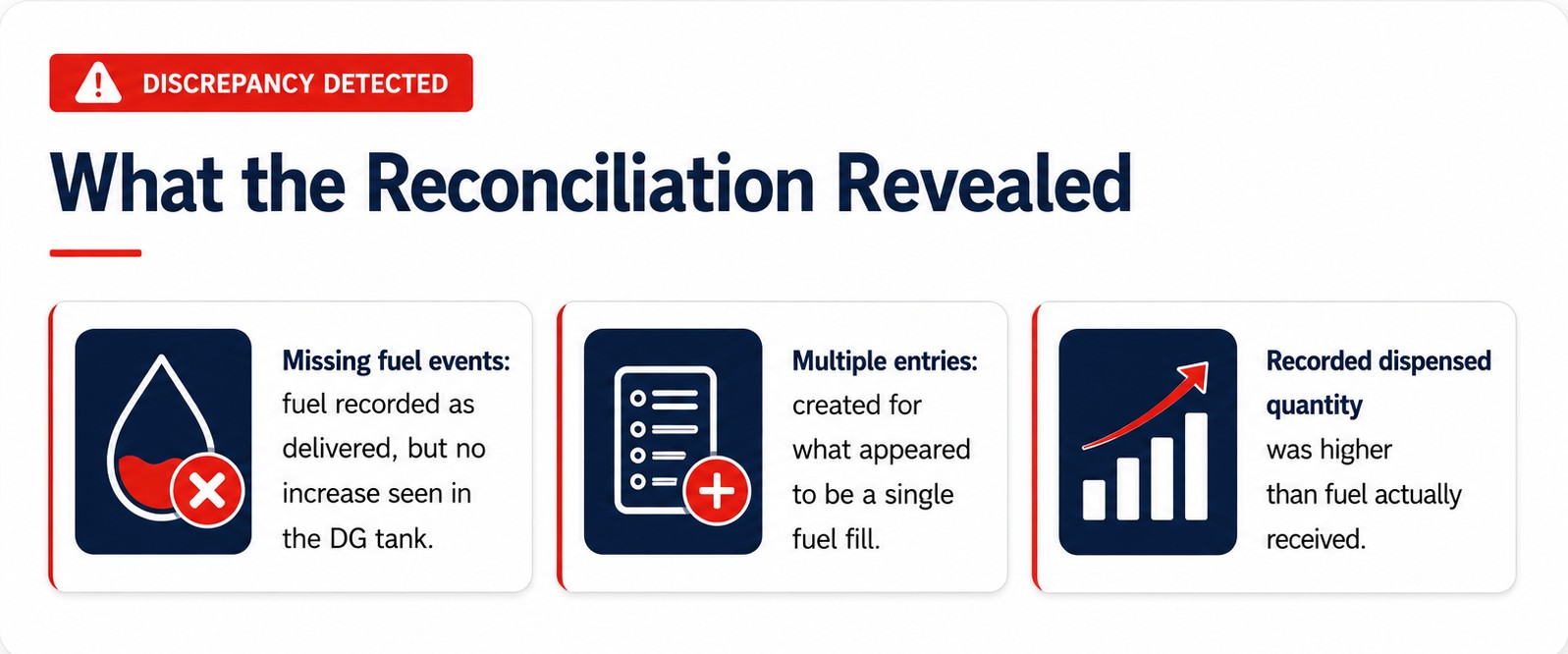
The analysis revealed significant differences:
- Completely Missing Fuel Events: Fuel was recorded as delivered, but the generator tank showed no increase in fuel level.
- Multiple Entries for a Single Fuel Fill: Several refuelling records were created for what appeared to be a single fuel filling event, resulting in higher recorded fuel quantities than actually received.
- Fuel Delivered vs Fuel Received Mismatch: The fuel quantity recorded by the vendor was higher than the fuel actually received in the generator tank.
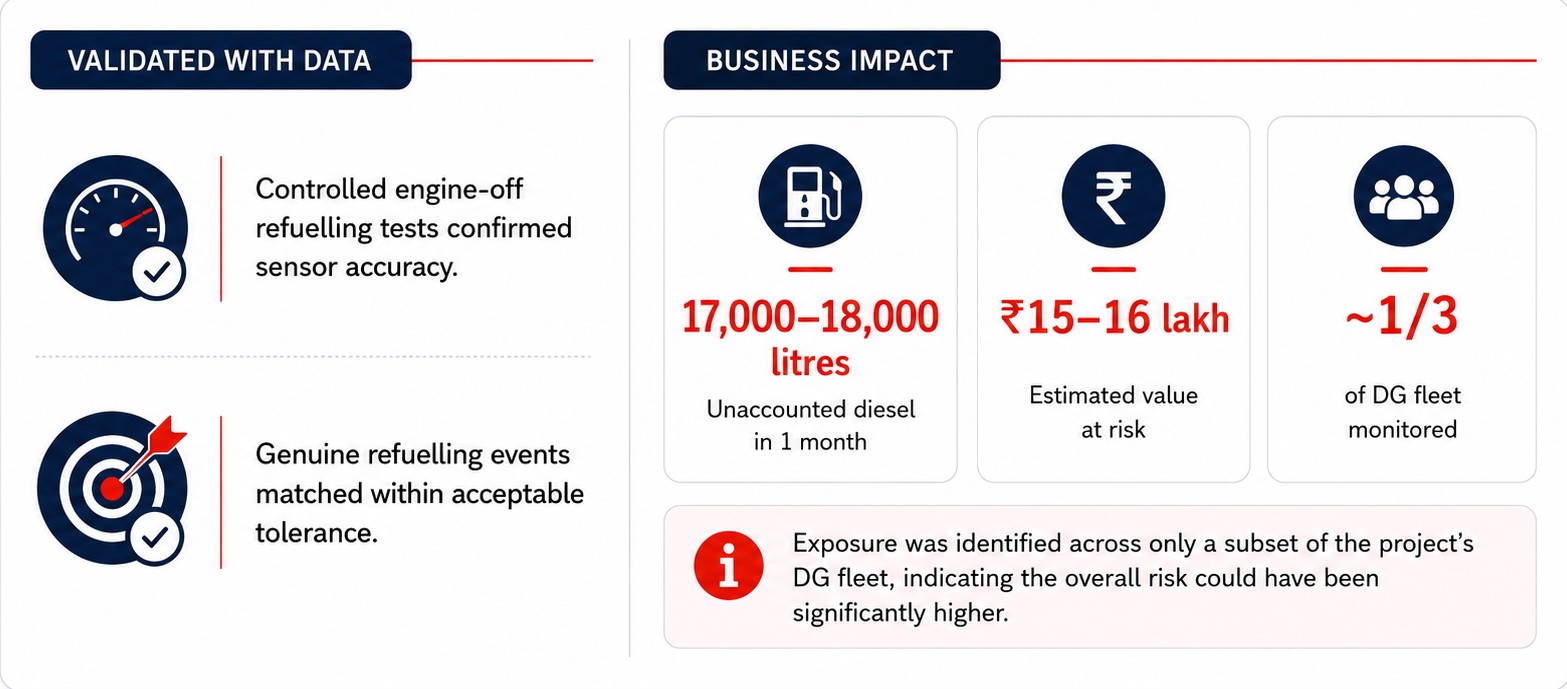
- Approximately: 17,000–18,000 litres of diesel could not be accounted for within a single month.
This analysis was performed on only a subset of the project's DG fleet, representing roughly one-third of the total generators operating at the site, indicating that the overall exposure could have been significantly higher.
Since the generators were owned by the project, every litre of unaccounted diesel directly impacted the project’s operating budget.
Need Site-Level Fuel Accountability?
If your team is seeing dispensing gaps, refuel variance, or fuel costs that don’t square with output, Aether can help map the right fuel monitoring setup for your sites.
Validating the Findings
Since the discrepancies identified during the reconciliation exercise were significant, the customer wanted to ensure that the fuel monitoring system was functioning correctly before drawing any conclusions.
To verify the accuracy of the system, Aether conducted validation tests in the presence of site personnel.
Witnessed Refuelling Test
A controlled refuelling activity was carried out with the generator switched off and site personnel present. The quantity recorded by the fuel monitoring system closely matched the actual volume dispensed, achieving an accuracy of 99%.
Cross-Verification of Refuelling Events
The Aether team also reviewed multiple genuine refuelling transactions and compared the dispensed quantity with the fuel received in the tank. In these cases, the fuel-level data consistently aligned with the actual refuelling records within an acceptable tolerance range.
Note: Fuel-level accuracy depends on site conditions. When the tank is stationary and placed on a flat surface, the system can typically achieve more than 98% accuracy. In regular operating conditions, where the equipment may be running, moving, vibrating, or positioned on uneven ground, accuracy is generally 95% or higher.
Validation Outcome
The validation exercise confirmed that the fuel monitoring system was operating correctly and accurately measuring fuel received by the generators. The witnessed refuelling test, which demonstrated measurement accuracy, provided confidence that the discrepancies identified during the reconciliation process were genuine and not the result of sensor inaccuracies.
Results and Business Impact
The project moved from suspicion to verified evidence.
By reconciling dispensing records with actual tank-level data, the customer was able to identify approximately ₹15–16 lakh worth of unaccounted diesel within a single month.
The findings provided the project team with a defensible, data-backed basis for further investigation and corrective action.
₹15–16 lakh
Unaccounted diesel identified in a single month
Following the study:
- Fuel discrepancies were quantified and verified.
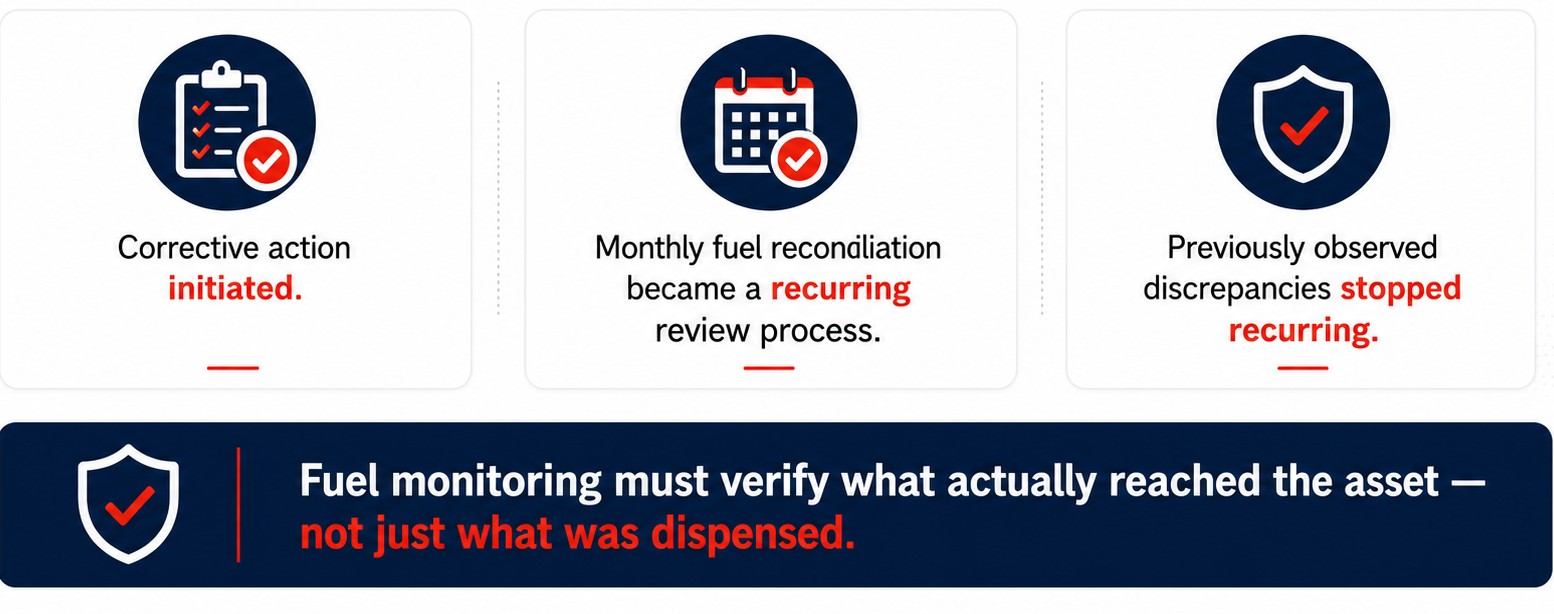
- The customer initiated corrective actions.
- Fuel reconciliation became a recurring monthly review process rather than a one-time audit.
- The project gained greater visibility and accountability over diesel consumption across its DG fleet.
Following the corrective actions, the site reported that the previously observed refuelling discrepancies were no longer occurring, indicating that the source of the losses had been effectively addressed.
The case demonstrated how combining fuel-level monitoring with systematic refuelling reconciliation can transform fuel management from a record-keeping exercise into a measurable operational control process.
Want to implement similar controls across your sites?
See how Aether’s refuelling reconciliation turns dispensing records into verified fuel accountability across your fleet.
More Fuel Accountability Stories