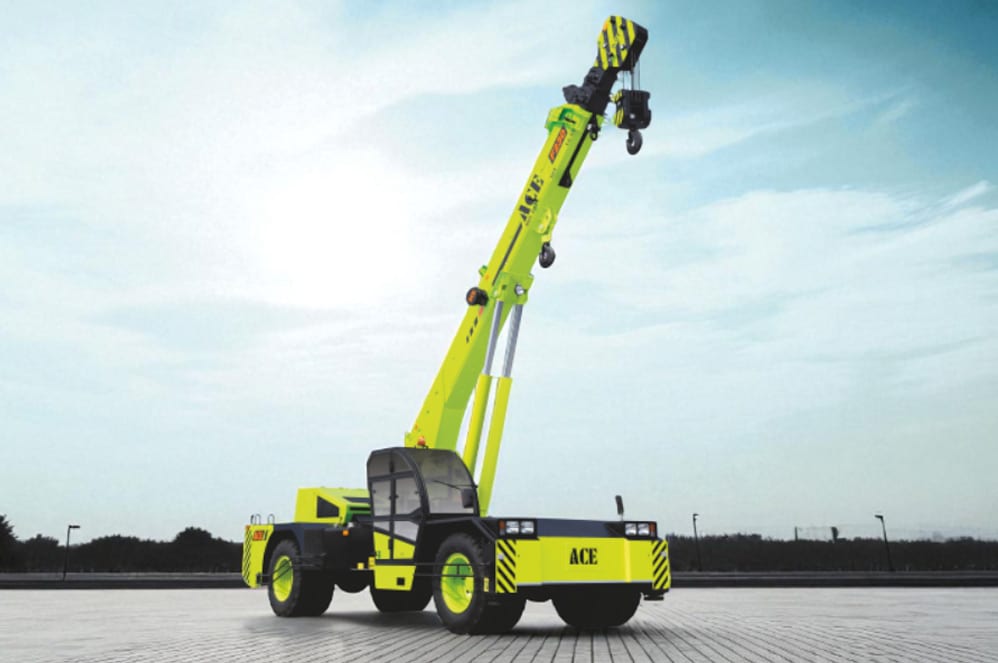
A 23-tonne Nextgen Hydraulic Crane with rough terrain 4x4 capability. Powered by Tata CEV Stage V turbo-charged diesel engine with ECU, IoT telematics (ALSS, SCOS, RAS), and best-in-class stability in articulated/steered condition.
EngineTata 101 HP
Capacity23 Tonnes
Lift Height20.2 m
Max Speed37 km/h
Fuel Tank240 L
Weight20,340 kg
Key Highlights
Lifting Capacity
23 Tonnes
Engine
Tata 497 CEV V
Rated Power
101 HP (74 kW) @ 2200 RPM
Max Height
20.2 m
Top Speed
37 km/h
Gradeability
40% unladen
Operating Weight
20,340 kg
Wheel Base
4900 mm
Drive
4 Wheel Drive (4×4)
Creep Speed
1.3 km/h
Hoist Speed
35 m/min
Hoist Rope
6 falls / 13 mm
Turning Radius
8.15 m
Fuel Tank
240 L
Safety Tech
ALSS / SCOS / RAS
Specifications
Detailed technical specifications for ACE F 230 Nextgen Hydraulic Pick & Carry Crane
Hook / GuardsSelf-adjusting hook block, front and rear wheel guards
ALSSAdvanced Load Sensing System enables low-speed 4WD mode during movement with loads above 1000 kg
SCOSSafe Crane Operation System prevents overload and permits safe functions only
RASRemote Articulation Stability for safe operation during articulation and movement with loads
ACE Live TelematicsIoT device for monitoring, diagnosis and remote troubleshooting
IoT Controlled FeaturesIoT controlled SLI and IoT controlled AC
STANDARD & OPTIONAL EQUIPMENT
Standard EquipmentFront work lights, reflectors, rear-view mirror, tool kit, cabin fan, wiper motor, rear-view camera, front outriggers, beacon rotating light, regeneration switch
Digital ClusterFuel level, low fuel, engine oil pressure, air pressure, parking brake, coolant temperature, RPM, hour meter, speedometer, odometer, urea level, water in fuel, battery charging, neutral safe start, 2WD/4WD, regeneration and fault codes
Optional EquipmentAC cabin, SLI, fly jib, over-hoist hydraulic cutoff, fire extinguisher, cabin front glass protector, helper/slinger seat, drag winch, proximity sensors, man basket
ACE F230 Maintenance Checklist
Daily pre-start checks · Service schedule by operating hours · Warning alert actions — ACE F230 23-tonne pick & carry crane, Tata 497 CEV V diesel with SCR/regeneration, 4×4 drive and air-pressure brakes.
Daily Pre-Start Checklist
Complete every check before engine start and before any lift — approximately 15 minutes. One missed check on a 23-tonne crane can cause catastrophic loss; no shortcuts on safety.
Every Shift
1
Engine Oil
Dipstick check with the engine cold — level between MIN and MAX. Low-ash grade oil required for CEV V compliance.
Act if: milky or metallic oil is found — stop and report immediately.
2
Engine Coolant
Check the overflow reservoir (MIN–MAX); never open the radiator cap when hot. Use pre-mixed approved coolant only.
Act if: below MIN or contaminated — cool down and correct before running.
3
Urea Level (SCR)
Check the urea level indicator on the digital cluster.
Act if: low — fill with urea grade per ACE authorised service centre recommendation before torque derate or shutdown.
4
Regeneration Status
Check the regeneration lamp on the digital cluster.
Act if: warning active — park in a safe open area and run the engine at ≥1,200 RPM for 20–30 minutes per ACE procedure.
5
Fuel Level
Check the fuel gauge — minimum ¼ tank before the shift; drain the pre-filter water separator if fitted.
Act if: below ¼ tank — refuel before the shift.
6
Hydraulic Oil
Check the tank sight glass — level between the MIN and MAX marks.
Act if: foam or discolouration appears — stop and report contamination before any lift.
7
Air Pressure (Brakes)
Check the dashboard air-pressure gauge — minimum 6 bar before releasing the parking brake.
Act if: pressure is low — build pressure with the engine idling before moving.
8
Wire Rope
Inspect all 6 falls of hoist rope for kinks, bird-caging, broken wires, flat spots or crushed sections.
Act if: any damage is found — do not lift with a damaged rope.
9
Hook Block
Confirm the safety latch closes fully and positively, the hook swivel rotates freely and sheaves spin without binding.
Act if: the latch is faulty or the swivel binds — do not lift.
10
Boom Pins
Check every boom-section pin retaining clip is secure — no pin partially withdrawn.
Act if: any clip is missing or a pin is withdrawn — do not lift.
11
Front Outriggers
Confirm pins are secure and pads are set on firm, level ground.
Act if: outriggers are not correctly deployed — do not perform any lift.
12
Tyre Condition
Walk-round all 8 tyres (12.00x24-18PR) for cuts, bulges or pressure loss.
Act if: any defect is found — do not travel or lift.
13
Leak Walk-Round
Check under the chassis for engine oil, fuel, coolant, urea, hydraulic fluid or air-line leaks.
Act if: an active leak is found — tag out; do not operate.
14
Lights & Controls
Test the horn, reverse alarm, rear-view camera and beacon light; confirm cab levers return to neutral correctly.
Act if: any control or alarm fails — fix before the shift.
Note: complete every check before engine start and before any lift. One missed check on a 23-tonne crane can cause catastrophic loss — any active defect means the crane must be tagged out and reported before use.
Service Schedule by Operating Hours
Use the hourmeter; each higher interval also includes all lower-interval tasks. Engine oil change: every 250 h (ACE pick & carry crane standard for the Tata BS-V engine). Hydraulic oil change: 2,000 h. CHANGE / REPLACE / INSPECT / GREASE / CHECK / CERTIFY.
50 h mandatory break-in & 250 h periodic service thereafter (plus all daily tasks).
Engine
Engine oil — 50h break-in / 250h
Low-ash SAE 15W-40 (CEV V compliant); confirm sump volume with ACE service centre
CHANGE
Oil filter
Replace at 50h break-in and at every subsequent oil change
REPLACE
Air filter & belts
Clean primary element if restriction warning active; check fan/alternator belt tension
INSPECT
Fuel & Emissions
Fuel system
Drain water separator bowl; inspect/clean pre-filter gauze; check primary filter
CLEAN
SCR / urea lines
Inspect supply lines, dosing unit connectors and tank vent for crystallisation, kinks or leaks
INSPECT
Hydraulics & Wire Rope
Hydraulic hoses
Inspect boom and hoist circuit hoses for chafing, cracking or weepage
INSPECT
Wire rope dressing
Apply rope dressing/lubricant to all 6 falls of hoist rope; inspect tensioner
GREASE
Greasing & Chassis
Boom pins, pivots & outriggers
EP2 lithium complex grease on boom/hoist drum pivots and outrigger pins
GREASE
Steering joint & wheel nuts
Grease articulated steering joint and cylinder pins; check/torque wheel nuts on all 8 wheels
CHECK
500 h service (plus 250 h + daily tasks). ACE authorised service centre recommended.
Engine & Fuel
Engine oil + filter
Change oil (low-ash SAE 15W-40 or per Tata 497 CEV V spec); replace filter at every change
CHANGE
Air & fuel filters
Replace primary air element (or after 2 cleanings); replace main fuel filter; inspect injectors
Recalibrate and verify all parameters, IoT alert thresholds, geofence boundaries & load logging
CHECK
2,000 h major service (plus 1,000 h + lower intervals) — major hydraulic & structural milestone. Hydraulic oil change confirmed at the 2,000h interval per the ACE F230 specification. All work by ACE authorised service centre.
Hydraulics
Hydraulic oil — full change
Full drain, flush & refill at 2,000h; confirm volume with ACE authorised service centre
CHANGE
Filters, hoses & cylinders
Replace hydraulic return filter; inspect 100 mesh suction strainer and replace if blocked; replace
cracked/weeping hoses; inspect cylinder rods/seals
Full telematics recertification; verify ALSS load cell against certified test weights
CERTIFY
Calendar-based statutory inspection — required every 12 months, irrespective of operating hours.
Statutory Inspection & Load Test
Third-party inspection — annual
Competent Person under Factories Act 1948 (Sec 28–31) / BOCW Act 1996; report to DGFASLI / State Factory Inspector
CERTIFY
SWL proof load test
125% SWL (23T × 1.25 = 28.75T) witnessed by Competent Person; dynamic test at 100% SWL, full boom extension
CERTIFY
Structure & Safety Devices
Crane structure exam
Visual/dimensional exam of frame, boom, articulation joint, outriggers & welds by Competent Person
INSPECT
Safety devices — statutory test
ALSS, SCOS, RAS, over-hoist indicator, anti-two-block, outrigger interlocks; results recorded
CERTIFY
Brakes & Rope
Brakes — statutory test
Service, parking & emergency brake performance recorded in the inspection register
CHECK
Wire rope — statutory exam
Thorough exam of rope, drum, sheaves & anchoring under Factories Act provisions; retirement recorded
CERTIFY
Hook, Electrical & Certification
Hook, hydraulics & telematics
Hook exam & swivel test; hydraulic pressure test at relief valve setting; ALSS/beacon/alarm circuit inspection
CHECK
Certificate of Fitness
Obtain & file Form 8 / applicable statutory certificate; maintain in the asset maintenance register
CERTIFY
1 Confirm engine, hydraulic, transmission and auxiliary-gearbox oil grades and fill volumes with an ACE-authorised service centre before any fluid change. 2 Confirm overhaul, rope-retirement and structural/NDT intervals beyond 1,000 h with an ACE-authorised service centre. 3 Statutory intervals are indicative—confirm applicable requirements with the relevant authority (DGFASLI / State Factory Inspector).
Warning Alerts & Immediate Actions
Monitor the digital cluster for alerts. RED = stop crane or engine operations immediately; AMBER = take corrective action before continuing any lift. Log every alert in the asset maintenance register and report to the fleet manager.
Red — Stop immediatelyAmber — Act before continuing
RED
Engine Low Oil Pressure
Engine oil critically low or oil-pump failure.
Immediate action: STOP the engine immediately. Do not restart. Check oil level, condition and lines.
Risk if ignored: seized engine — complete write-off.
RED
Engine Overtemperature
Coolant critically low or cooling-system failure.
Immediate action: STOP the engine. Let it cool naturally; do not open the radiator cap. Check coolant level and radiator.
Risk if ignored: blown head gasket or cracked block — major engine repair.
RED
Low Air Pressure (<6 bar)
Air-compressor failure or a major pneumatic circuit leak.
Immediate action: park immediately on level ground. Apply the parking brake. Do not move. Investigate the compressor.
Risk if ignored: total brake failure — uncontrolled movement of a 23-tonne crane.
RED
Over-Hoisting Alarm (Audio)
Hook block at the upper limit — rope about to overwind on the drum.
Immediate action: STOP hoist-up immediately. Lower the hook block. Inspect the anti-two-block device function.
Risk if ignored: rope overwind — sudden load drop — risk to life.
RED
Urea Level Critical
Urea (SCR system) near empty — ECU torque derate active.
Immediate action: refill urea immediately, per ACE authorised service centre recommendation. Do not substitute.
Risk if ignored: progressive power derate — engine shutdown on site.
AMBER
Regeneration Required
Soot loading high — passive regeneration insufficient during normal operation.
Immediate action: move the crane to a safe open area. Run the engine at ≥1,200 RPM for 20–30 minutes per ACE authorised service procedure.
Risk if ignored: regeneration system blockage — engine power loss.
Immediate action: refill urea. If the fault persists after refilling, it is a dosing-unit fault — stop at an ACE authorised service centre.
Risk if ignored: SCR failure, emissions exceedance, ECU-triggered power derate.
AMBER
Hydraulic Oil High Temperature
Hydraulic oil overheating — excessive load or a blocked cooler.
Immediate action: reduce the lift load. Idle the engine for 10 minutes. Check hydraulic oil level and cooler fins.
Risk if ignored: seal damage, pump failure, hydraulic hose blowout under pressure.
AMBER
Wire Rope Damage Detected
Kinks, bird-caging, broken wires or flat spots found during inspection.
Immediate action: STOP all lifting operations. Quarantine the crane. Arrange rope inspection and replacement before any lift.
Risk if ignored: rope failure under load — risk to life.
AMBER
High Engine Temperature
Coolant marginal or partial radiator blockage.
Immediate action: reduce the load. Idle the engine. Check coolant level and radiator fins for blockage.
Risk if ignored: escalates to RED overtemperature — engine damage.
Critical: if any RED alert activates — low oil pressure, overtemperature, low air pressure, over-hoisting, or urea critical — stop the relevant motion or the engine immediately. Do not reset and continue. Any crane with a red event must be inspected by an ACE-authorised technician before returning to lifting duty.
Frequently Asked Questions
Everything you need to know about the ACE F 230 Next Gen Crane
The ACE F 230 has a maximum lifting capacity of 23 Tonnes, optimized for heavy-duty pick
and carry operations.
It is powered by a Tata (CEV Stage V) 4-cylinder water-cooled turbo-charged diesel engine, Model 497, with Electronic Control Unit (ECU), delivering 101 HP (74 kW) @ 2200 RPM.
The ACE F 230 features a 4-part slotted boom (2 parts hydraulically operated & synchronized, 4th part power extended). Maximum height is 20.2 m with 3-part + 1 Manual configuration. Optional Fly jib capacity: 1.25 Tonnes, manual extension capacity: 2.0 Tonnes.
The ACE F 230 comes with advanced ULTRA features: ACE Live Telematics (IoT device for live monitoring, diagnosis and remote trouble shooting), IoT Controlled SLI, ALSS (Advanced Load Sensing System — ensures low speed 4WD mode during movement with loads of 1000 kgs+), SCOS (Safe Crane Operation System), and RAS (Remote Articulation Stability) for safe crane operations.
Optional equipment includes: Air Conditioned (AC) cabin, SLI - Safe Load Indicator, Fly jib (1.25 T max capacity), Over Hoist hydraulic cutoff, Fire extinguisher, Cabin Front Glass Protector, Helper/Slinger Seat, Drag Winch, Front & Side Proximity Sensors, and Man Basket Attachment.
Yes, the ACE F 230 comes with a standard 1-year warranty or as specified by the manufacturer at the time of purchase.