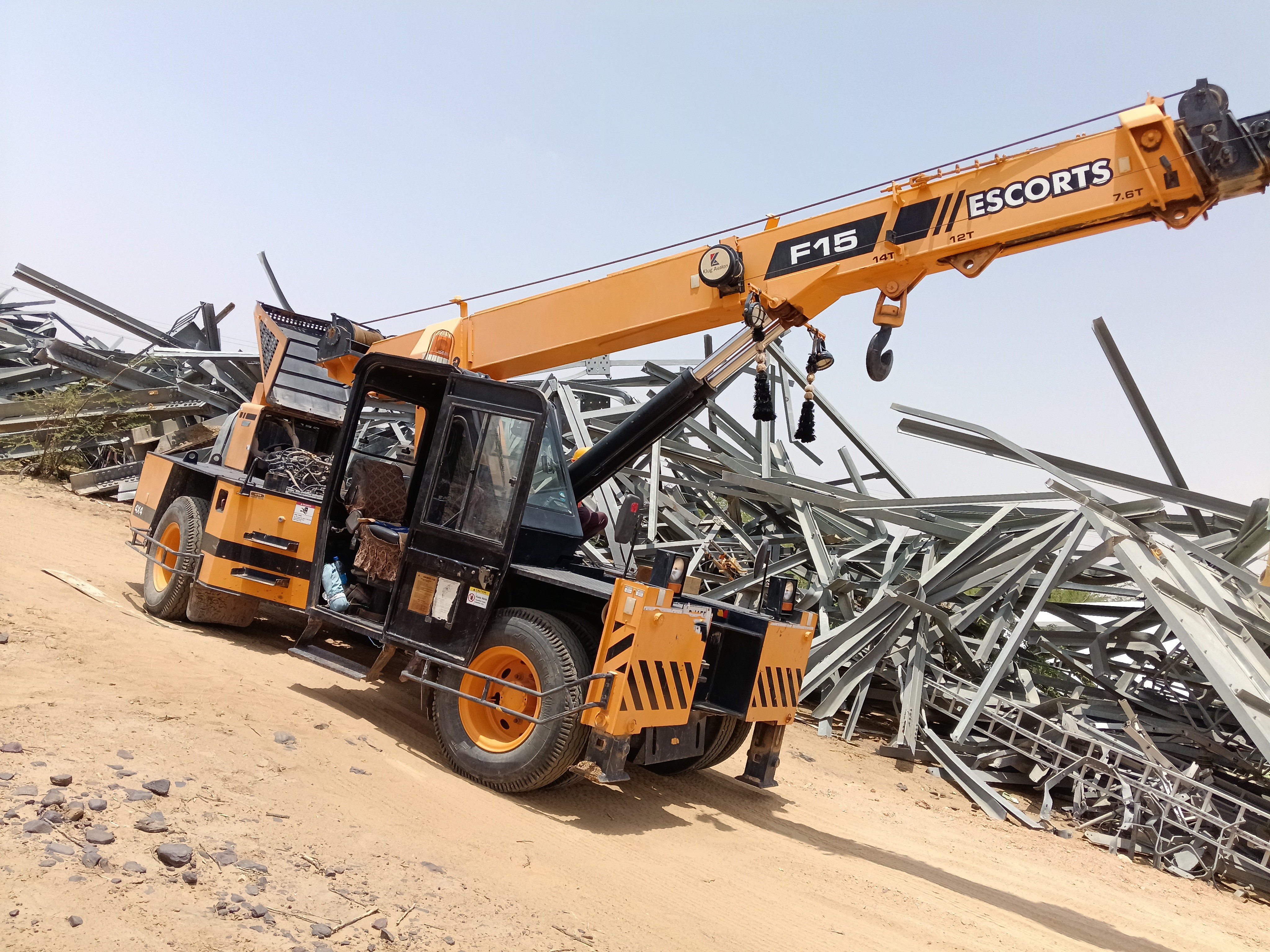
A 14 t high-end pick and carry crane with a four-section boom, 21 m maximum height with fly jib, VECV E494 CEV Stage V engine, 4-wheel drive and a visibility-focused operator cabin.
Engine101 HP
Rated Capacity14 t @ 1.5 m
Max Height21 m with Fly Jib
Max Speed49 km/h
Fuel Tank235 L
Operating Weight16,020 kg
Key Highlights
Engine
VECV E494 CEV Stage V
Engine Power
74 kW / 101 HP @ 2,200 rpm
Rated Capacity
14 t at 1.5 m radius
Max Height
21 m with fly jib
Max Speed
49 km/h
Creep Speed
1.3 km/h
Gradeability
38% unladen
Turning Radius
7.2 m
Operating Weight
16,020 kg
Fuel Tank
235 L
Hydraulic Tank
228 L
Drive
4 Wheel Drive
Wheelbase
3.95 m
Tyres
8 nos. — 11 × 20 - 16 PR
Engine Service Interval
500 hours
Specifications
Detailed technical specifications for the Escorts Kubota F15 Pick & Carry Crane
Standard AccessoriesAll-weather cabin, rear-view camera with LCD, front outriggers, wheel guards, mobile charging socket, battery cut-off, auto-leveling hook block, projector headlamp, LED work/cabin lamps and fly jib
Optional AccessoriesSafe load indicator with hydraulic cut-off, man-carrying basket, fire extinguisher, helper-seat platform, drag winch, rhino hook, stereo and equipment monitoring system
DIMENSIONS
Operating Weight16,020 kg total (6,820 kg front / 9,200 kg rear)
Wheelbase3.95 m
Overall Width2.45 m
Overall Length9.73 m
Overall Height3.21 m
Wheel Track1.83 m front / 1.83 m rear
Escorts Kubota F15 Maintenance Checklist
Daily pre-start checks · Service schedule by operating hours · Warning alerts and immediate actions
Daily Pre-Start Checklist
Complete every check before each shift or every 10 operating hours. Do not operate when a safety-critical defect is found.
Every Shift / 10 h
1
Radiator Coolant
Check only with the engine cold. Inspect the radiator, cap and hoses.
Act if: level is low or leakage/damage is visible. Never open a hot radiator or add cold water to a hot engine.
2
Engine Oil Level
Park level, stop the engine, allow oil to settle and check the dipstick.
Act if: below the safe mark, contaminated or leaking. Correct before starting.
3
Hydraulic Oil Level
Lower and retract the boom, then check the tank indicator and inspect for leakage.
Act if: below the safe mark or leaking. Do not operate the boom, steering or winch until corrected.
4
Fuel Level
Check the gauge and confirm enough clean diesel is available for the shift.
Act if: fuel is insufficient, contaminated or leaking. Refill safely and never mix kerosene with diesel.
5
Air-Cleaner Restriction
Check the air-cleaner restriction indicator before starting.
Act if: restriction is indicated, the intake is blocked or the housing is damaged.
6
Pre-Air Cleaner
Remove accumulated dust and debris, then refit securely.
Act if: blocked, cracked, missing or unable to be secured correctly.
7
Brake-Pedal Clearance
Confirm normal pedal clearance, free movement and return.
Act if: clearance is abnormal or the pedal binds or fails to return. Do not move the crane.
8
Parking Brake
Apply on firm level ground, confirm it holds, then release and verify normal release.
Act if: it does not hold or release fully, or the crane creeps while applied.
9
Air Leakage
Pressurise the system; listen for hissing and inspect lines, joints, reservoirs and brake chambers.
Act if: leakage is heard, pressure falls abnormally or any component is damaged.
10
Service Brakes
Test at very low speed in a clear area before entering the work zone or road.
Act if: braking is weak, delayed, uneven or noisy, or the crane pulls to one side.
11
Air-Pressure Build-Up
Start the engine and confirm pressure builds steadily to the operating range.
Act if: build-up is slow, the operating range is not reached or pressure falls afterward.
12
Air-Pressure Setting
Confirm the gauge reaches approximately 8.25 kg/cm² and remains stable.
Act if: pressure is low, high or unstable. Do not alter the unloader setting.
13
Air-Reservoir Condensate
Open the drain valves and discharge accumulated water or oily sediment.
Act if: contamination is excessive or a drain valve is blocked or will not close.
14
Wheel-Nut Tightness
Inspect every wheel for loose, damaged or missing nuts and rim cracking.
Act if: any nut is loose/missing or wheel movement or cracking is visible. Do not travel.
15
Tyres & Pressure
Inspect all tyres for cuts, bulges, exposed cord and uneven wear; check specified pressure.
Act if: damaged, excessively worn, underinflated or overinflated. Correct before travel or lifting.
16
Lights, Horn & Gauges
Test bulbs, horn, wiper and switches; confirm gauges and warning indications respond normally.
Act if: any safety-related control, gauge, warning, light, horn or wiper is inoperative.
Service Schedule by Operating Hours
Select the interval to view the work due. Record every completed task, fluid change and defect in the maintenance log.
Daily or every 10 hours — complete before operating.
Engine & Intake
Coolant and engine oil levels
Check cold coolant level, dipstick and leakage
CHECK
Air-cleaner indicator and pre-cleaner
Check restriction; remove dust and debris
CLEAN
Hydraulic & Leakage
Hydraulic oil level
Check with boom safely lowered and retracted
CHECK
Fuel and fluid leaks
Inspect fuel, engine-oil, hydraulic and coolant systems
INSPECT
Brakes & Air System
Pedal, parking and service brakes
Check clearance, holding, release and low-speed braking
CHECK
Air leakage, build-up and setting
Check pressure behaviour and drain reservoir condensate
CHECK
Wheels & Electrical
Wheel nuts and tyre condition
Check tightness, damage, wear and pressure
INSPECT
Connections, lights, horn, wiper and gauges
Check all electrical and warning functions
CHECK
Weekly / 50-hour service; includes initial oil and filter changes on a new machine.
Engine & Hydraulics
Initial engine oil and filter
Change at the first 50-hour service
CHANGE
Air-filter element
Clean and inspect condition
CLEAN
Initial hydraulic return filter
Change on a new machine; check all leakage
CHANGE
Winches & Drivetrain
Lifting and dragging winch oil levels
Check and top up by level indication
CHECK
Front and rear axle oil levels
Check both axles for level and leakage
CHECK
Propeller shafts
Lubricate UJ crosses and splines; check/tighten bolts
LUBRICATE
Brakes & Suspension
Air reservoirs
Drain condensate
DRAIN
Slack adjusters and shackle pins
Lubricate front and rear
LUBRICATE
Brake linings and tyre pressure
Inspect linings and verify tyre pressure
INSPECT
Electrical & General
Battery and alternator
Check electrolyte, connections and charging function
CHECK
All grease points and centre joint
Lubricate every scheduled point and bearing
LUBRICATE
Monthly / 250-hour routine service.
Engine & Air
Engine oil and filter
Routine oil and filter change
CHANGE
Air breathers
Clean all scheduled breathers
CLEAN
Brakes & Wheels
Brake system
Check and adjust brake operation
ADJUST
Wheel-nut tightness
Check all wheels and tighten correctly where required
CHECK
Clutch & Mountings
Clutch-pedal free play
Check and adjust
ADJUST
Axle and engine mounting bolts
Inspect for looseness, damage and movement
INSPECT
Quarterly / 500-hour filter and wheel-bearing service.
Fuel System
Primary fuel filter
Change and inspect for contamination or leakage
CHANGE
Hydraulic System
Hydraulic return filter
Routine filter change; inspect oil condition and leakage
CHANGE
Front Wheels
Front wheel bearings
Check wear, adjustment, noise and lubrication condition
INSPECT
Yearly / 1,000-hour major fluid and filter service.
Fuel & Hydraulic
Secondary fuel filter
Change and inspect the fuel system
CHANGE
Hydraulic oil
Change by correct level indication and inspect for contamination
CHANGE
Winches & Axles
Lifting and dragging winch oils
Change oil in both winch assemblies
CHANGE
Front and rear axle oils
Drain and refill both axles
CHANGE
Transmission
Main and auxiliary gearbox oils
Change both gearbox oil charges
CHANGE
Warning Alerts & Immediate Actions
RED = stop or do not move the crane. AMBER = correct before continued operation or at the next safe opportunity.
Red — StopAmber — Correct
RED
Low Air Pressure / Buzzer Active
Immediate action: do not move. Allow pressure to build; inspect the air system if the buzzer remains active.
Risk if ignored: brake binding, weak braking, collision or loss of control.
RED
Fluid or Air Leakage
Immediate action: stop, isolate the leak and repair before returning to service.
Risk if ignored: fire, brake or hydraulic failure, engine damage or loss of control.
RED
Brake Not Holding
Immediate action: park safely, chock the wheels and remove the crane from service.
Risk if ignored: runaway crane, collision or serious injury.
RED
Air-Pressure Setting Altered
Immediate action: do not adjust without calibrated equipment and an authorised procedure; use a qualified workshop.
Risk if ignored: inefficient braking, tyre wear or air-system damage.
RED
Spring-Brake Actuator Work
Immediate action: do not dismantle without specified tools and trained workshop personnel.
Risk if ignored: sudden release of stored energy and severe injury.
RED
Cold Water Added to Hot Engine
Immediate action: stop and allow the engine to cool naturally before refilling correctly.
Risk if ignored: cracked engine components and major repair.
RED
Coasting with Engine Off
Immediate action: keep the engine running and use the correct gear. Never coast with the engine switched off.
Risk if ignored: gearbox damage and reduced braking or steering control.
RED
Welding with Electrical System Connected
Immediate action: disconnect battery and alternator connections before welding.
Risk if ignored: alternator, wiring or component failure and fire.
RED
Jacking on Soft or Uneven Ground
Immediate action: use hard level ground, apply the parking brake and chock wheels before lifting.
Risk if ignored: crane fall, crushing injury or structural damage.
AMBER
Starter Cranked Too Long
Immediate action: limit each attempt to 15 seconds and wait 30–60 seconds before retrying.
Risk if ignored: starter, cable or battery damage.
AMBER
Fuel Setting or Fuel Quality
Immediate action: use clean diesel only and do not alter fuel-system settings.
Risk if ignored: poor performance, smoke and reduced engine or fuel-system life.
AMBER
Clutch Pedal Being Ridden
Immediate action: keep the foot off the clutch except when shifting or stopping.
Risk if ignored: premature clutch and release-component wear.
AMBER
Suspension Modified
Immediate action: retain the original suspension; do not add leaves or recamber springs.
Risk if ignored: spring failure and unstable handling.
AMBER
Air Tanks Not Drained
Immediate action: drain all reservoirs at least weekly and investigate excessive contamination.
Risk if ignored: corrosion, sticking valves and reduced brake reliability.
AMBER
Tyre Pressure Incorrect
Immediate action: correct pressure and inspect for leakage or damage before operating.
Risk if ignored: tyre failure, poor stability, wear and braking problems.
AMBER
Battery Electrolyte Low
Immediate action: top up only with distilled water and inspect the charging system.
Risk if ignored: battery damage, starting failure and shortened life.
AMBER
Fuel Tank Partly Empty After Work
Immediate action: fill the 235 L tank at shift end where site procedure permits.
Risk if ignored: condensation, corrosion and fuel contamination.
AMBER
Operating Without Battery in Circuit
Immediate action: keep the battery connected during operation and repair circuit faults first.
Risk if ignored: reduced alternator life and electrical-system damage.
Critical stop rule: any brake, steering, air-pressure or major fluid-leak defect requires the crane to be stopped, parked safely and isolated until repaired and tested.
Frequently Asked Questions
Everything you need to know about the Escorts Kubota F15 Pick & Carry Crane
The F15 is rated for 14 t at a 1.5 m radius. Its extended-reach rating is 0.9 t at a 15.80 m radius, with safe working loads based on 75% stability and strength under IS 4573.
It uses a VECV E494 CEV Stage V HPCR diesel engine producing 74 kW (101 HP) at 2,200 rpm.
The F15 has a four-part boom with three hydraulically powered, fully synchronized sections. With the fly jib, its maximum height is 21 m.
The F15 reaches 49 km/h, provides a 1.3 km/h creep speed and has 38% unladen gradeability. Fuel and hydraulic tank capacities are 235 L and 228 L, respectively.