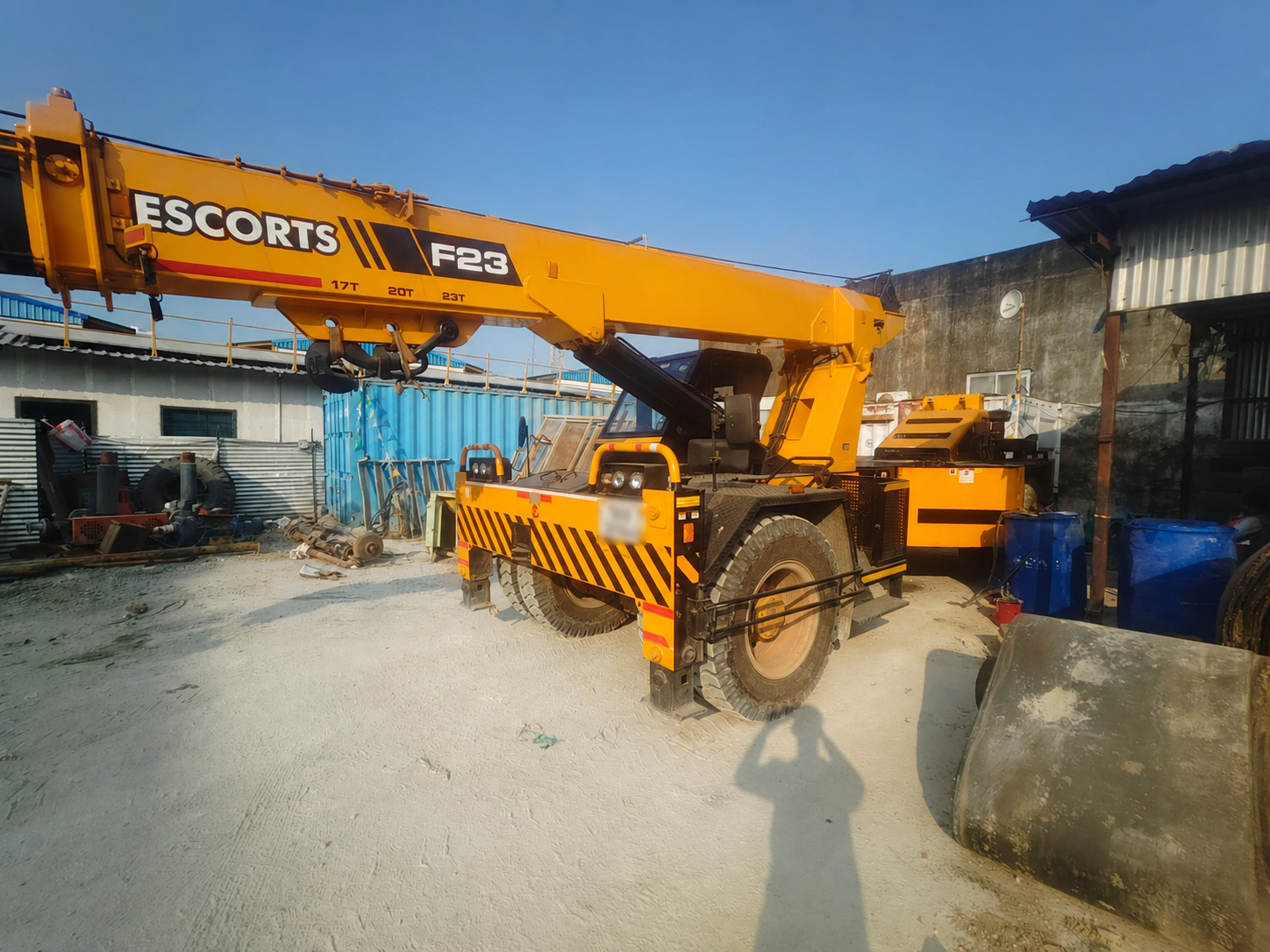
The Escorts F23 is a 23 t pick and carry crane built for high-capacity lifting, steady load handling and site mobility. It combines a VECV E494 CEV Stage V engine, 4-wheel drive, 4-part boom, front outriggers and integrated safety systems for demanding construction and material-handling work.
Engine101 HP
Capacity23 t
Max Height22.3 m
Max Speed40 km/h
Fuel Tank280 L
Work Weight21,950 kg
Key Highlights
Engine
VECV E494 CEV Stage V
Power
74 kW / 101 HP @ 2200 rpm
Rated Capacity
23 t at 1.5 m radius
Max Torque
435 Nm @ 1600 rpm
Max Height
22.3 m with fly jib
Hoist
15 t with 6 falls
Max Speed
40 km/h
Creep Speed
1.3 km/h
Gradeability
36% unladen
Fuel Tank
280 L
Hydraulic Tank
185 L
Tyres
8 nos. 12 × 24 - 20 PR
Drive
4 Wheel Drive
Wheelbase
4.88 m
Axle
TATA heavy duty / 40 t front
Specifications
Detailed technical specifications for Escorts F23 Pick & Carry Crane
Travel WeightFront axle 9,230 kg / Rear axle 10,130 kg / Total 19,360 kg
Work WeightFront axle 8,900 kg / Rear axle 13,050 kg / Total 21,950 kg
SAFETY & ACCESSORIES
Safety SystemsSafety brakes on hoist, counter-balance protection valve, parking-brake visual warning, low-air-pressure buzzer and regeneration pop-up messages
Operator SystemsDigital display, safe load indicator with hydraulic cut-off and rear-view camera with LCD
Standard AccessoriesAll-weather cabin, rear-view camera with LCD, front outriggers, wheel guards, mobile charging socket, battery cut-off switch, auto-leveling hook block, projector head lamp, LED work lamp, LED cabin lamp, fly jib, safe load indicator with hydraulic cut-off, helper seat platform, stereo system and equipment monitoring system
Optional AccessoriesMan carrying basket, fire extinguisher, drag winch and rhino hook
Escorts Kubota F23 Maintenance Checklist
Daily pre-start checks · Service schedule by operating hours · Warning alert actions — F23 23-tonne 4WD pick-and-carry crane with VECV E494 CEV Stage V engine.
Daily Pre-Start Checklist
Complete all checks before every shift. Estimated time: 10–15 minutes.
Every Shift
1
Engine Oil Level
On level ground with engine off, check the E494 dipstick. Oil sump: 14.5 L; use the approved grade.
Act if: below MIN, milky/contaminated, or metal particles are visible.
2
Coolant Level
Inspect the reservoir, radiator and hoses with the engine cool.
Act if: below MIN, discoloured, oily, or leaking.
3
DEF / AdBlue Level
Check the DEF tank used by the SCR aftertreatment system.
Act if: low or warning active — refill; operation without adequate DEF causes derating.
4
Fuel Level & Lines
Check the 280 L tank, lines and Bosch CP 4.1 HPCR rail for leaks or damage.
Act if: fuel is insufficient or any leak is found. Never run the tank dry.
5
Air Filter Indicator
Check the restriction indicator on the turbocharged, intercooled intake.
Act if: RED/restricted — replace the element immediately.
6
ECU / EMS Warnings
Turn ignition ON; check ECU/EMS lights and DPF regeneration messages.
Act if: a light remains on, a regeneration message appears, or check-engine is active.
7
Exhaust & Turbo
Inspect for exhaust leaks; at start-up listen for abnormal turbo whine and observe smoke.
Act if: boom descent is uncontrolled or the lift circuit leaks.
25
Cabin & Safety Equipment
Check doors, glass, seat, controls, wheel guards and fire extinguisher if fitted.
Act if: visibility is obstructed, latch is defective, or extinguisher has expired.
26
SLI (if fitted)
Test the Safe Load Indicator and hydraulic cut-off against the load chart.
Act if: it gives no/incorrect reading or cut-off fails at rated capacity.
Safety note: do not travel or lift with a braking, steering, boom-pin, hoist-brake, wire-rope, outrigger, counter-balance-valve or SLI defect. Isolate the crane and have the fault inspected.
Service Schedule by Hourmeter
Do not delay a due service. Engine oil and filter interval: 500 hours.
Complete before every shift or each 10 operating hours.
Engine & Emissions
Engine oil, coolant, DEF and fuel
Inspect levels and condition; refill DEF as needed; check the 280 L fuel tank and lines
INSPECT
DPF regeneration messages
Monitor the instrument cluster and follow regeneration prompts
MONITOR
Hydraulics & Boom
Hydraulic oil, hoses and cylinders
Check the 185 L tank, hoses, fittings, boom sections and cylinders
INSPECT
Fourth-section manual pin
Confirm fully inserted and locked
CHECK
Hoist & Safety
Wire rope, hoist brake and hook block
Inspect six-fall rope; test 15 t safety brake and auto-leveling hook block
INSPECT
Outriggers, SLI and warnings
Inspect front outriggers; test optional SLI and low-air buzzer
TEST
Travel System
Brakes, tyres and transmission oil
Drain air reservoirs; inspect brakes and eight tyres; check transmission oil level
INSPECT
Electrical and cabin
Inspect battery, lights, camera, cluster, cabin and optional fire extinguisher
INSPECT
Perform at 50 hours in addition to daily checks.
Engine & Hydraulics
Drive belts and tensioners
Inspect condition, alignment and tension
INSPECT
Tandem vane pump and counter-balance valve
Check pressure, noise, temperature and hose-burst protection
INSPECT
Boom & Hoist
Boom, manual pin, rope and hoist brake
Inspect sections/wear pads, manual pin, wire rope and brake
INSPECT
Boom pivot, slide pads and sheaves
Grease with EP2 lithium-complex NLGI #2; inspect rope guide/tensioner
GREASE
Drivetrain & Brakes
Clutch and air brake system
Inspect self-adjusting clutch, service/parking brakes, compressor and dryer
INSPECT
Propeller shafts and U-joints
Lubricate with EP2 lithium-complex grease
GREASE
Chassis & Lubrication
Wheel nuts and front outriggers
Torque-check wheel nuts; inspect outrigger operation and structure
INSPECT
Pivots, king pins, steering and winch bearings
Grease all points with EP2 lithium-complex NLGI #2
GREASE
Perform at 250 hours in addition to daily checks.
Engine & Emissions
Fuel primary filter
Replace with a genuine HPCR-compatible filter
REPLACE
Coolant, belts, ECU and DPF
Inspect coolant, drive belts/tensioners, ECU diagnostics and regeneration system
INSPECT
Hydraulics
Pump and all control valves
Inspect tandem pump, main 3-spool, outrigger 2-spool and drag-winch valves
INSPECT
Counter-balance valve and hoses
Safety inspection of lift protection, hoses and fittings
INSPECT
Boom & Hoist
Boom, cylinders, pin and hook block
Inspect sections, wear pads, cylinders, fourth-section pin and auto-level function
INSPECT
Wire rope, brake, sheaves and fly jib
Inspect rope/brake/guide/tensioner and optional fly jib; grease boom points
INSPECT
Travel, Electrical & Safety
Brakes, steering, tyres and wheel nuts
Adjust brakes; inspect linings, rams, orbitrol, tyres and wheel-nut torque
INSPECT
Battery, camera, cluster, structure and SLI
Inspect/test electrical, chassis, outriggers, cabin and optional safety systems
INSPECT
Scheduled engine service interval: every 500 operating hours.
Engine Service
Engine oil and filter
Change 14.5 L engine oil and filter using the approved grade
Detailed inspection of structure, cylinders, pin, wear pads, rope, brake, sheaves and optional jib
INSPECT
Brakes, steering, electrical and safety systems
Inspect/test complete travel system, warning buzzer, cut-off switch, SLI and EMS/telematics if fitted
INSPECT
Major service at 1,000 hours or annually where specified.
Engine & Cooling
Oil, all filters and coolant
Change engine oil/filter; replace air and fuel filters; flush/change coolant
CHANGE
Belts and valve clearance
Replace drive belts/tensioners and adjust valve clearance as specified for E494
REPLACE
HPCR, turbo, ECU, DPF, DOC and SCR
Complete diagnostic and aftertreatment inspection
INSPECT
Hydraulic System
Hydraulic oil and return filter
Change full 185 L oil charge and return-line filter; flush if contaminated
CHANGE
Suction strainer
Clean at 500 h; replace at 1,000 h
REPLACE
Pump, valves, protection and hoses
Inspect all components and replace worn hoses/fittings
INSPECT
Drivetrain & Brakes
Transmission, AGB, axles and hub oils
Change all specified drivetrain oils
CHANGE
Clutch, brakes and steering
Inspect clutch, air system, steering rams/orbitrol; replace worn brake linings
INSPECT
Boom, Structure & Safety
Boom wear pads, rope and sheaves
Replace wear pads/rope/sheaves only when discard or wear criteria are met; inspect all lifting systems
INSPECT
Structure, outriggers and optional systems
Inspect chassis, cabin, wheel guards, SLI, fire extinguisher and EMS/telematics
INSPECT
All lubrication points
Grease boom, propeller shafts, steering, pivots, king pins and winch bearings with EP2 NLGI #2
GREASE
Warning Alerts & Immediate Actions
RED = stop the engine or crane operation immediately. AMBER = take action before continuing work.
Red — Stop immediatelyAmber — Act before continuing
RED
Low Air Pressure Warning
Brake-system pressure is below the safe level.
Immediate action: stop the engine. Do not move or lift. Engage the parking brake, inspect for leaks and call maintenance.
Risk if ignored: complete brake failure, uncontrolled movement, dropped load and fatal accident.
RED
Hoist Safety Brake Failure
The 15 t hoist brake is not holding and the load slips.
Immediate action: stop operations, clear below the load, use the emergency lowering procedure and shut down.
Risk if ignored: uncontrolled load drop, fatal crush risk and catastrophic damage.
RED
Counter-Balance Valve Failure / Hose Burst
Lift-circuit protection has failed or the boom is descending uncontrolled.
Immediate action: stop the engine, evacuate below/near the boom and call maintenance.
Risk if ignored: uncontrolled boom collapse, fatal crush injury and total loss of load.
RED
SLI Hydraulic Cut-Off (if fitted)
The load exceeds rated capacity and hydraulic cut-off has engaged.
Immediate action: stop lifting; never override the SLI. Reduce radius or lower the load and verify the load chart.
Risk if ignored: tip-over, boom failure, fatal accident and IS 4573 violation.
RED
Engine Overheat — Coolant Critical
E494 coolant temperature is above the safe limit.
Immediate action: stop the engine, allow it to cool, check level/leaks and never open a hot radiator cap.
Risk if ignored: engine seizure, turbo failure and engine replacement.
RED
Fourth Boom Section Pin Not Secured
The manually pinned fourth section is extended without a fully engaged safety pin.
Immediate action: stop boom motion, retract, insert and fully lock the pin before extending.
Risk if ignored: section collapse, catastrophic boom failure and fatal injury.
AMBER
Parking Brake Warning During Travel
Parking-brake warning remains on while moving.
Immediate action: stop, fully disengage the brake and inspect the spring-actuated mechanism if warning persists.
Risk if ignored: overheating, wear, reduced braking and fire.
AMBER
DPF Regeneration Required
The ECU/EMS displays a regeneration prompt.
Immediate action: park safely and complete the on-screen regeneration procedure.
Risk if ignored: DPF blockage, engine derate, forced shutdown and costly replacement.
AMBER
DEF / AdBlue Low
SCR fluid is low.
Immediate action: stop at the earliest safe point and refill DEF.
Risk if ignored: SCR failure, progressive derate, forced idle and emission non-compliance.
AMBER
Hydraulic Oil Level Low
The 185 L tank is below MIN, possibly due to leakage.
Immediate action: stop, inspect the pump/valves/hoses and top up with the correct oil after fixing leaks.
Risk if ignored: cavitation, loss of boom/hoist/outrigger control and system damage.
AMBER
Steering Abnormal
Orbitrol/twin rams respond abnormally or full articulation is unavailable.
Immediate action: reduce speed, reach a safe area, inspect rams/orbitrol and check hydraulic oil.
Risk if ignored: loss of steering control and collision.
AMBER
Tyre Pressure Abnormal
One or more 12 × 24–20 PR tyres is outside the recommended pressure.
Immediate action: stop travel, adjust all tyres and inspect punctures/valves.
Risk if ignored: blowout, uneven loading and reduced lifting stability.
AMBER
Fuel Level Critical
The 280 L tank is critically low.
Immediate action: stop and refuel; do not run the Bosch CP 4.1 HPCR system dry.
Risk if ignored: air ingress, difficult priming and injector damage.
AMBER
Hoist Wire Rope Damage
Broken strands, kinks, crushing, bird-caging or corrosion are visible.
Immediate action: stop lifting, inspect the full rope and replace if IS/ISO discard criteria are exceeded.
Risk if ignored: rope failure, uncontrolled load drop and fatal injury.
AMBER
Clutch Slipping / Abnormal
The cerametallic self-adjusting clutch does not engage properly.
Immediate action: reduce load, use 1.3 km/h creep speed only, inspect and schedule service.
Risk if ignored: loss of drive during load transport and transmission damage.
AMBER
Engine Oil Pressure Low
E494 oil pressure is below the safe limit.
Immediate action: stop the engine within 30 seconds, check the 14.5 L sump and leaks; do not restart until resolved.
Risk if ignored: bearing failure, turbo seizure and catastrophic engine damage.
Critical: never override a safety cut-off or continue operating after a RED alert. Isolate the crane and return it to service only after the fault has been corrected and the affected safety system tested.
Frequently Asked Questions
Everything you need to know about the Escorts F23 Pick & Carry Crane
The Escorts F23 has a rated capacity of 23 t at 1.5 m radius and 0.9 t at 16.6 m radius.
It uses a VECV E494 CEV Stage V diesel engine with HPCR technology, turbo charging, water cooling and ECU engine management, developing 74 kW / 101 HP @ 2200 rpm.
The maximum height is 22.3 m with fly jib. The boom is a 4-part design with 3 hydraulic synchronized parts and a fourth power-extended, manually pinned section.
The maximum speed is 40 km/h, creep speed is 1.3 km/h and gradeability is 36% unladen.
The fuel tank capacity is 280 L and the hydraulic tank capacity is 185 L.
The travel weight is 19,360 kg and the work weight is 21,950 kg.